If you have recently been diagnosed with snoring or mild to moderate obstructive sleep apnea, you have likely heard about a treatment option called a snore guard appliance. Also known as a mandibular advancement device (MAD) or oral appliance therapy (OAT), this custom-fitted mouthpiece is a popular alternative to Continuous Positive Airway Pressure (CPAP) machines.
However, when you start looking into getting one, you quickly run into a world of insurance forms, medical necessity letters, and—most importantly—specific codes. The term you are likely searching for is the ADA code for snore guard appliance.
In the world of dental and medical billing, codes are the language used to tell insurance companies exactly what service was provided. Using the right code is the difference between a claim that gets paid and one that gets denied.
This guide is your complete roadmap to understanding the specific Current Dental Terminology (CDT) codes used for snore guards, how they interact with medical insurance, what you can expect to pay, and how to navigate the process to get the treatment you need without unnecessary financial stress.
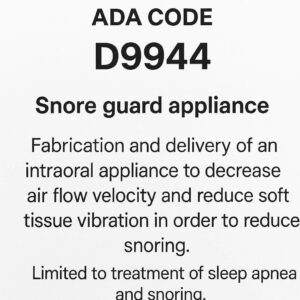
ADA Code for Snore Guard Appliance
Table of Contents
ToggleUnderstanding the Basics: What is a Snore Guard Appliance?
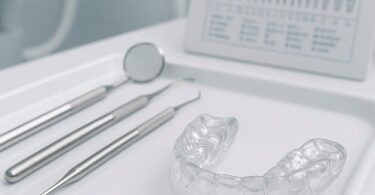
Before we dive into the coding, it is helpful to understand exactly what we are coding for. A snore guard appliance is not a one-size-fits-all mouthpiece you buy at a pharmacy. While those exist, the “appliance” referred to in ADA codes is a professional, custom-fabricated device.
The Medical Purpose
Snore guards work by physically repositioning the lower jaw (mandible) slightly forward. This forward movement tightens the soft tissues at the back of the throat, preventing them from collapsing and vibrating, which causes snoring. For patients with obstructive sleep apnea, this advancement helps keep the airway open during sleep, preventing the dangerous pauses in breathing that define the condition.
Dental vs. Medical Device
This is where the coding gets tricky. The snore guard is fabricated by a dentist. However, it is prescribed to treat a medical condition (sleep apnea). Therefore, while the code for the fabrication falls under the American Dental Association (ADA) coding system, the insurance coverage often comes from your medical insurance plan, not your dental plan.
The Primary ADA Code: D7880
When dentists bill for the fabrication and placement of a snore guard, they rely on a specific set of codes defined in the CDT (Current Dental Terminology) manual, which is published by the American Dental Association.
The most common and primary code you will see on your dental claim form is D7880.
What is D7880?
D7880 is defined as: Occlusal orthotic device adjustment, evaluation, and insertion.
In simpler terms, this code covers the comprehensive process of:
-
Taking impressions of your teeth to create a precise model.
-
Fabricating the custom appliance in a dental laboratory.
-
Inserting the appliance to ensure a perfect fit.
-
Adjusting the appliance to achieve the correct jaw position for optimal airway opening.
-
Providing instructions on how to clean and maintain the device.
It is important to note that D7880 is not just for the plastic itself. It is a service code that bundles the clinical expertise, lab costs, and follow-up adjustments necessary to make the therapy safe and effective.
Is D7880 a Dental or Medical Code?
Technically, it is a dental (ADA) code. However, when it comes to treating snoring and sleep apnea, this code is almost always submitted to medical insurance.
Most standard dental insurance plans classify snore guards under “occlusal orthotics,” which often have low annual maximums or are subject to “missing tooth clauses.” Conversely, medical insurance plans (like Blue Cross, Aetna, Cigna, etc.) have specific policies for durable medical equipment (DME). If your dentist is in-network with medical plans or has a billing specialist, they will use D7880 to bill your medical insurance.
Related ADA Codes for Snore Guard Therapy
While D7880 is the star of the show, it rarely travels alone. Comprehensive care involves several other codes that cover the diagnostic and follow-up phases of treatment. Understanding these can help you avoid surprise bills.
The Diagnostic Codes
Before a dentist can build a snore guard, they need to establish a diagnosis and a treatment plan. These preliminary codes are essential.
| ADA Code | Description | Why It Matters |
|---|---|---|
| D0150 | Comprehensive Oral Evaluation | This is a full exam of the teeth, gums, and oral structures. It ensures that your mouth is healthy enough to support an appliance. |
| D0366 | Cone Beam CT (CBCT) Scan | Not always required, but often used to assess the airway and temporomandibular joints (TMJ) to ensure the appliance is safe for your jaw structure. |
| D7872 | Polysomnography (Sleep Study) Interpretation | If the dentist is coordinating care, this code is used when they review your official sleep study results to confirm the diagnosis of sleep apnea. |
| D7873 | Analysis and Fabrication of Oral Appliance | Sometimes used instead of D7880, depending on the complexity. It specifically refers to the fabrication of a sleep apnea appliance. Note: This code is often bundled with D7880, so you typically won’t see both. |
Follow-Up and Maintenance Codes
A snore guard is not a “set it and forget it” device. Your jaw position may need to be adjusted over time, and the appliance will eventually wear out.
| ADA Code | Description | When It’s Used |
|---|---|---|
| D7881 | Occlusal orthotic device adjustment | This is used for subsequent visits. After the initial insertion (D7880), you will likely return for 2-4 follow-up appointments to fine-tune the advancement. Each of these adjustment visits is billed under D7881. |
| D7899 | Replacement of oral appliance | Snore guards typically last 3-5 years. If yours breaks or wears out, this code is used to bill for the fabrication of a replacement. |
Important Note for Readers: If your dentist uses D7880 for the initial fabrication and then attempts to charge you a separate “office visit” copay for the follow-up adjustments, verify if they are using D7881. Some insurance plans cover adjustments under the original appliance fee; others cover them separately.
The Insurance Landscape: Dental vs. Medical
This is where most patients get lost. Understanding the difference between how dental and medical insurance handle the ADA code for a snore guard appliance is the key to managing your out-of-pocket costs.
Dental Insurance Coverage
If the claim is sent to your dental insurance:
-
Classification: The appliance is usually classified as “major restorative” or “occlusal orthotic.”
-
Frequency Limitations: Most dental plans will only cover one orthotic device every 3 to 5 years.
-
Deductibles and Maximums: Dental plans have an annual maximum (often $1,000–$2,000). If you need a crown or a root canal in the same year, the snore guard may not be covered because the money runs out.
Medical Insurance Coverage
If the claim is sent to your medical insurance (which is preferred for sleep apnea):
-
Medical Necessity: Coverage is almost always contingent on a documented diagnosis of obstructive sleep apnea (OSA) from a sleep study.
-
DME Benefit: Oral appliances fall under the “Durable Medical Equipment” benefit. You will likely pay your DME coinsurance (e.g., 20% of the allowed amount) until you meet your medical deductible.
-
Prior Authorization: This is non-negotiable. Your dentist’s office should submit a “prior authorization” to your medical insurance before fabricating the appliance. This tells you exactly what they will pay.
A Comparative Look
To visualize the difference, here is a comparison table of how a typical $2,000 snore guard might be covered:
| Factor | Dental Insurance Path | Medical Insurance Path |
|---|---|---|
| Required Diagnosis | Snoring or bruxism (teeth grinding) | Obstructive Sleep Apnea (confirmed by sleep study) |
| Typical Coverage | 50% of “usual and customary” fees after deductible | 80% (after deductible) under Durable Medical Equipment |
| Annual Max | Usually $1,000 – $2,000 (shared with other dental work) | No annual max (subject to out-of-pocket max) |
| Out-of-Pocket Cost | Often higher due to low annual max | Often lower, especially if medical deductible is already met |
| Primary Code | D7880 (submitted to dental plan) | D7880 (submitted to medical plan) |
Why Medical Necessity is the Key
You cannot simply walk into a dentist’s office and ask them to bill your medical insurance for a snore guard using the ADA code D7880. If you try to do so without proof, the claim will be denied immediately.
Medical insurance operates on the principle of “medical necessity.” To prove that the appliance is medically necessary, you need three things:
-
A Polysomnogram (Sleep Study): This can be an in-lab study or a home sleep test (HST). The results must show a diagnosis of obstructive sleep apnea (OSA). Some insurers require a specific Apnea-Hypopnea Index (AHI) score, typically between 5 and 30, to qualify for oral appliance therapy.
-
A Prescription: The dentist or sleep physician must write a prescription for a “mandibular advancement device” or “oral appliance for sleep apnea.”
-
A Letter of Medical Necessity (LMN): The dentist will write this letter explaining why you are a candidate for an oral appliance. It often mentions:
-
Intolerance to CPAP (if you tried CPAP and couldn’t tolerate it).
-
Mild to moderate sleep apnea (where oral appliances are considered first-line therapy).
-
Patient preference (in some cases).
-
Without these three pillars, the ADA code D7880, no matter how correctly it is entered, will result in a denial from your medical carrier.
Step-by-Step: How the Billing Process Works
If you are considering a snore guard, knowing the workflow can save you months of headaches. Here is how a professional dental office should handle the ADA code for your snore guard appliance.
Step 1: The Consultation and Diagnosis
Your journey begins with a comprehensive exam. The dentist will evaluate your oral health. If you have untreated gum disease, loose teeth, or severe TMJ issues, you may need to address those first.
Step 2: The Sleep Study
If you haven’t already had a sleep study, your dentist will likely refer you to a sleep specialist or provide a home sleep test. You must have a documented diagnosis of OSA to qualify for medical insurance coverage.
Step 3: Verification of Benefits (VOB)
The dental office’s billing coordinator will call your medical insurance company. They will ask specific questions:
-
Does the patient have DME coverage?
-
Is there a deductible?
-
Is there a co-insurance percentage?
-
Is a prior authorization required for code D7880?
Step 4: Prior Authorization (The Most Critical Step)
The office submits a package to your medical insurance. This package includes:
-
The sleep study results.
-
The Letter of Medical Necessity.
-
The prescription.
-
The treatment plan with ADA codes (D7880, etc.).
They wait for a written approval. Do not let the dentist fabricate the appliance until you have a written prior authorization. A verbal “it looks okay” is not enough.
Step 5: Fabrication and Insertion
Once authorization is received, the dentist takes digital scans or impressions. The appliance is fabricated in a lab. You return for the insertion appointment, where the dentist fits the appliance and sets the initial jaw position. This is billed under D7880.
Step 6: Follow-Up Adjustments
You will return for follow-ups to ensure the appliance is working and not causing jaw pain. These visits are billed under D7881 (adjustment). Some insurers bundle this into the initial D7880 fee; others pay per visit.
Cost Expectations: With and Without Insurance
Let’s talk numbers. The cost of a custom snore guard appliance varies widely based on geographic location, the type of material used, and the dentist’s expertise.
-
Without Insurance (Cash Price): Typically ranges from $1,800 to $3,500. This usually includes the appliance, the initial insertion, and a set number of follow-up adjustments.
-
With Dental Insurance: If your dental plan covers it, you might pay $900 to $1,500 out-of-pocket, depending on your plan’s co-insurance and annual maximum.
-
With Medical Insurance (DME): If you have met your medical deductible, you could pay as little as 10-20% of the negotiated rate. For a $2,000 appliance, that could be $200 to $400. If you have not met your deductible, you may pay the full negotiated rate until the deductible is satisfied.
A Note on “Boil and Bite” Devices
You might see devices online for $50 to $200. These are not the same as the device coded under D7880. Over-the-counter (OTC) devices are not custom-fitted to your teeth and can cause permanent changes to your bite, jaw pain, and tooth movement. The ADA code specifically refers to a professionally fabricated device that is designed to be safe for long-term use.
Common Billing Mistakes and Denials
Even when everything seems right, claims get denied. Here are the most common reasons why an ADA code for a snore guard appliance gets rejected by insurance companies.
1. Missing Medical Diagnosis
The Problem: The claim is submitted with D7880 but without the corresponding ICD-10 (International Classification of Diseases) diagnosis code for sleep apnea.
The Fix: The diagnosis code must be present. The correct code is usually G47.33 (Obstructive Sleep Apnea). If the diagnosis is simply “snoring” (R06.83), medical insurance will almost always deny it, as snoring is not considered a medical condition requiring durable medical equipment.
2. No Prior Authorization
The Problem: The dentist fabricated the appliance, submitted the claim, and the insurance company denied it, stating “no prior authorization obtained.”
The Fix: For DME (D7880), most medical plans require prior authorization. If you get the appliance and then ask for permission, it is often too late. You (the patient) may be responsible for the full cost.
3. Using the Wrong Code for Replacement
The Problem: The patient lost or broke their 2-year-old appliance. The dentist bills D7880 again.
The Fix: Insurance companies have frequency limitations. If they paid for D7880 two years ago, they will deny it if billed again. The correct code is D7899 (Replacement of oral appliance), though some medical plans may have specific guidelines for replacement frequency.
4. Bundling Issues
The Problem: The dentist bills D7880 for the appliance and also bills an “office visit” code (e.g., D0150) on the same day for the insertion.
The Fix: Many insurance plans consider the insertion visit to be inclusive of the D7880 code. They will deny the separate exam code. This is called “bundling.” A good billing coordinator knows to apply the exam fee to the initial consultation visit, not the insertion visit.
Tips for Patients: How to Protect Yourself Financially
Navigating the intersection of dentistry, medicine, and insurance can feel overwhelming. However, by taking a proactive role, you can ensure a smooth process and avoid unexpected bills.
1. Ask the Right Questions Before Starting
When you call a dentist’s office to inquire about snore guards, do not just ask “Do you do them?” Ask:
-
Do you bill medical insurance for sleep apnea appliances?
-
Do you have a dedicated insurance coordinator who handles DME prior authorizations?
-
Can you provide me with a written estimate of my out-of-pocket cost after insurance verification?
If the office says, “We just send the bill to your dental plan,” and you have sleep apnea, you may want to look for a practice that specializes in dental sleep medicine. They are more adept at navigating medical billing.
2. Keep a Paper Trail
Never rely on verbal promises. Ensure you receive:
-
A copy of the prior authorization letter from your insurance company.
-
A treatment plan showing the estimated patient portion.
-
A copy of your sleep study and Letter of Medical Necessity.
3. Understand Your “Durable Medical Equipment” Benefit
Call your medical insurance member services number. Ask them:
-
What is my DME deductible?
-
*What is my DME coinsurance? (e.g., 80/20, 90/10)*
-
Do I have a separate DME maximum? (Some plans have a cap, though it is rare.)
4. Beware of “Discount Plans” Masquerading as Insurance
Some patients purchase discount dental plans. These are not insurance. They will not reimburse for D7880. If you have a discount plan, you will likely be paying the office’s negotiated cash rate.
The Future of Coding and Oral Appliance Therapy
As awareness of sleep apnea grows, coding and coverage are evolving. The ADA updates the CDT codes every year, and insurance companies are refining their policies.
Telehealth and Sleep Testing
Recent years have seen a shift toward home sleep testing and telehealth consultations for sleep apnea. While the code D7880 remains the same, the diagnostic pathway is becoming more efficient. Some insurers now allow a dentist to diagnose and treat mild sleep apnea without a separate sleep physician referral, streamlining the process.
Integration of Digital Dentistry
The use of intraoral scanners (digital impressions) is becoming standard. While this technology improves accuracy and patient comfort, it is generally bundled into the D7880 fee. Insurers rarely pay extra for “digital impressions” over traditional molds.
Medical-Dental Integration
We are seeing a slow but steady trend toward “medical-dental integration.” More dental schools and continuing education courses are teaching dentists how to bill medical insurance correctly. In the coming years, using ADA codes like D7880 for medical reimbursement will become more standardized, reducing the confusion patients currently face.
Frequently Asked Questions (FAQ)
Q1: Can I submit the ADA code D7880 to my insurance myself?
A: Technically, yes, you can submit a claim to your insurance. However, it is highly complex. The claim requires specific modifiers, diagnosis codes, and provider information. Most patients find that allowing the dentist’s billing team to handle it is more successful. If you do it yourself, you risk a denial that can be difficult to reverse.
Q2: My dentist said the D7880 code requires a “sleep study.” Why?
A: For medical insurance to cover the appliance, the diagnosis must be Obstructive Sleep Apnea (OSA). A sleep study (polysomnogram) is the only way to clinically diagnose OSA. Without that diagnosis, the appliance is considered “snoring prevention,” which is rarely a covered medical benefit.
Q3: Will my dental insurance cover the snore guard if my medical denies it?
A: Sometimes. If your medical insurance denies the claim because you do not have a sleep apnea diagnosis, you can ask the dentist to submit the claim to your dental insurance. However, dental plans often have a “missing tooth clause” or exclude orthotic devices. It is best to ask your dentist to check both insurances before starting.
Q4: How often can D7880 be billed?
A: For medical insurance, frequency is typically once every 3 to 5 years. If the appliance breaks or is lost, a replacement code (D7899) is used. If the replacement occurs before the frequency limit, insurance may deny it unless it was due to a medical necessity (like a change in jaw position requiring a new device).
Q5: What if I have Medicare? Does it cover D7880?
A: Yes, Medicare does cover oral appliances for obstructive sleep apnea. However, the requirements are very strict. You must have a diagnosis of OSA, and you must be evaluated by a sleep physician. The dentist must be enrolled in Medicare as a provider. Not all dentists accept Medicare assignment for DME. You must verify that the dentist is a participating provider before proceeding.
Q6: What is the difference between D7880 and D7872?
A: D7872 is often used for the analysis and fabrication of the appliance, while D7880 is for the adjustment, evaluation, and insertion. In practice, many offices use D7880 to encompass the entire process. If you see both codes on a treatment plan, ask why. It may indicate they are trying to unbundle the services to maximize reimbursement, which can sometimes lead to patient balance billing if insurance bundles them.
Additional Resources
Navigating insurance codes can feel like learning a new language. For further reading and support, the American Academy of Dental Sleep Medicine (AADSM) is an excellent resource. They provide patient guides and a “Find a Provider” tool to help you locate dentists who specialize in oral appliance therapy and are experienced in medical billing.
You can visit their patient resource section at: aadsm.org/patients
Conclusion
Understanding the ADA code for snore guard appliance—specifically D7880—is more than just a bureaucratic hurdle; it is the key to unlocking your insurance benefits and accessing effective, comfortable treatment for snoring and sleep apnea. While the process involves a blend of dental expertise and medical necessity, being an informed patient makes all the difference. By securing a proper sleep study, ensuring a prior authorization is in place, and working with a dental team that specializes in medical billing, you can navigate this system successfully and breathe easier at night.
Disclaimer: This article is for informational purposes only and does not constitute medical, dental, or legal advice. Insurance coding and coverage policies vary by provider and location. Always consult with your dental provider and insurance carrier to confirm coverage details.
Disclaimer: This article is for informational purposes only and does not constitute medical, dental, or legal advice. Insurance coding and coverage policies vary by provider and location. Always consult with your dental provider and insurance carrier to confirm coverage details.
Author: Professional Dental Health Writer
Date: March 30, 2026