If you have ever dealt with the frustration of an ingrown toenail—medically known as onychocryptosis—you know it is more than just a minor annoyance. For patients, it can mean pain with every step. For medical professionals, treating it involves precision. When conservative measures fail, the Winograd procedure often becomes the go-to surgical solution.
But for medical billers and coders, the question isn’t just about how the surgery is performed; it is about how to document it correctly. Finding the right cpt code for winograd procedure is essential to ensure accurate reimbursement and avoid compliance issues.
In this guide, we will strip away the confusion. We will walk you through the anatomy of the procedure, the specific codes used, the common pitfalls in billing, and how to distinguish this surgery from other nail treatments. Whether you are a seasoned coder or a clinician looking to understand the paperwork side of things, this article will serve as your reliable reference.
CPT Code for the Winograd Procedure
What Is the Winograd Procedure?
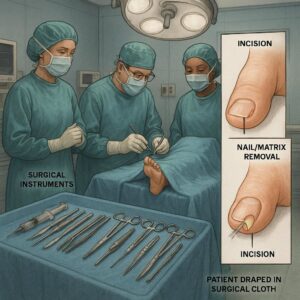
Before we dive into the numbers, it helps to understand what actually happens in the operating room. The Winograd procedure is a surgical technique used to treat ingrown toenails that are recurrent or severe. Unlike a simple nail trimming, this is a permanent solution.
The procedure involves removing a portion of the nail plate, but the key differentiator is the removal of the underlying nail matrix (the tissue that grows the nail). By excising the matrix, the surgeon ensures that the problematic corner of the nail does not grow back.
The Surgical Steps
-
Anesthesia: A digital block is administered to numb the toe.
-
Excision: A wedge of the nail plate (the hard part) is removed vertically.
-
Matrixectomy: The underlying germinal matrix is destroyed or excised, often using chemical cauterization (like phenol) or sharp excision.
-
Closure: The wound is usually left open to heal by secondary intention or closed with a few sutures.
Because this procedure addresses the root cause of the ingrowth permanently, it requires a specific billing approach that distinguishes it from less invasive procedures.
The Primary CPT Code: 11750
When medical professionals ask for the cpt code for winograd procedure, the answer almost always points to CPT 11750.
CPT 11750: Excision of nail and nail matrix, partial or complete (eg, ingrown or deformed nail), for permanent removal.
This is the workhorse code for permanent nail removal. The Winograd procedure falls squarely under this descriptor because it involves the excision of the nail plate plus the destruction or removal of the matrix.
Why 11750 Fits the Winograd Procedure
The Winograd technique is a specific type of permanent partial matrixectomy. CPT 11750 is the umbrella code that covers the permanent removal of a nail, whether it is the entire nail or just a portion. Since the Winograd procedure typically removes a wedge of the nail and destroys the corresponding matrix, 11750 is the most accurate selection.
However, there is a common misconception. Many people confuse 11750 with CPT 11730, which is for an avulsion of a nail plate without permanent removal of the matrix.
11750 vs. 11730: The Difference Is Permanence
The distinction between these two codes is critical. If you bill 11750 when a 11730 was performed, you are overcharging. If you bill 11730 when a matrixectomy was done, you are undercharging and leaving revenue on the table.
| Feature | CPT 11730 (Avulsion) | CPT 11750 (Winograd/Matrixectomy) |
|---|---|---|
| Procedure | Nail plate removal only | Nail plate removal + Matrix destruction |
| Permanence | Temporary; nail grows back | Permanent; nail does not grow back |
| Indication | Acute ingrown, diagnostic sampling | Recurrent ingrown, chronic deformity |
| Re-growth | Yes, the nail typically regenerates | No, the removed portion is gone permanently |
| Work RVU | Lower | Higher |
If the surgeon performs a Winograd procedure, you must use 11750. It reflects the higher skill, time, and permanence involved in the surgery.
When to Use Modifiers with 11750
Knowing the code is only half the battle. In the world of medical billing, modifiers are just as important as the code itself. They tell the payer that something about the procedure was different from the standard description.
Multiple Toes: Modifier 59 or XS
The Winograd procedure is often performed on one toe, but sometimes patients present with ingrown nails on multiple toes (commonly the great toes on both feet). If the surgeon performs the procedure on two separate toes, you cannot simply bill 11750 twice without a modifier.
You will need to append a modifier to the second (and third) procedure to indicate that it was a distinct and separate service.
-
Modifier 59 (Distinct Procedural Service): This is the traditional modifier used to indicate that the procedure was separate.
-
Modifier XS (Separate Structure): This is a more specific modifier introduced by Medicare to describe procedures performed on separate anatomical structures. For toes, XS is often preferred because it clearly shows the service was on a different digit.
Example: If a patient has a Winograd procedure on the left great toe and the right great toe, you would bill:
-
Line 1: 11750 (left great toe)
-
Line 2: 11750-XS (right great toe)
Bilateral Procedures
For podiatry and foot surgery, many payers have specific rules regarding bilateral procedures. If the procedure is performed on both feet during the same session, some commercial payers expect a Modifier 50 (Bilateral Procedure) instead of two separate line items. However, Medicare and many other carriers prefer the 59 or XS modifiers on separate lines. Always check your local MAC (Medicare Administrative Contractor) guidelines.
Common Billing Scenarios and Pitfalls
Even with the correct code and modifiers, claims can get denied. Let’s look at some realistic scenarios that often trip up billing specialists.
Scenario 1: The Chemical Matrixectomy
Sometimes, after removing the nail wedge, the surgeon applies phenol to destroy the matrix chemically. Does that change the code? No. Whether the matrix is destroyed by sharp excision (cutting) or chemical cauterization (phenol), the intent is permanent removal. CPT 11750 still applies. The method of matrix destruction does not change the code selection.
Scenario 2: The “Simple” Ingrown That Became Complex
A patient comes in for a routine ingrown toenail. The physician attempts to trim the nail border (CPT 11719 or 11720). However, due to hypertrophy of the tissue, the physician decides to proceed with a matrixectomy. You cannot bill for the attempted trimming if the definitive procedure (11750) is performed. You should only bill the 11750, as it includes the work of exposing the nail.
Scenario 3: Infection and Separate Incision and Drainage
This is one of the most common pitfalls. If a patient has an ingrown toenail with an associated paronychia (infection), the surgeon may perform an incision and drainage (I&D) of the infection in addition to the Winograd procedure.
-
The Rule: You cannot bill an I&D (CPT 10060 or 10061) separately if the Winograd procedure is performed on the same toe. The surgical approach used to perform the matrixectomy inherently drains the infection. Payers view the I&D as bundled into the primary procedure.
Navigating Payer Policies and LCDs
Local Coverage Determinations (LCDs) are documents published by Medicare that outline what medical necessity looks like for specific procedures. For CPT 11750, these LCDs are strict.
Medical Necessity Requirements
To justify a Winograd procedure (11750), the documentation must prove that conservative treatment failed. This usually requires:
-
Failed conservative management: Documentation showing that the patient tried non-surgical interventions (like proper nail trimming, antibiotic therapy for infection, or use of gutter splints) for a specified period (often 3-6 months).
-
Severe symptoms: Documentation of significant pain, inability to wear shoes, recurrent infection, or the presence of granulation tissue (overgrowth of flesh around the nail).
-
Permanent deformity: Conditions like pincer nails or onychogryphosis (ram’s horn nails) that justify permanent removal.
Important Note: If a patient has a systemic condition like diabetes or peripheral vascular disease, payers may require additional documentation regarding pre-operative evaluation and wound healing risks. The presence of these conditions does not preclude the surgery, but it does require meticulous documentation.
What to Avoid: Billing Myths and Misconceptions
Let’s clear up a few myths that float around in the coding world.
Myth 1: There is a specific “Winograd procedure” code.
There is no standalone CPT code named “Winograd procedure.” The code used is 11750. The name “Winograd” simply describes the technique used to achieve the permanent removal. As a coder, you should look for the operative elements: excision of nail plate plus matrixectomy.
Myth 2: You can bill for the nail removal and the matrixectomy separately.
This is called unbundling and is a serious compliance error. Some coders mistakenly try to bill 11730 (avulsion) and 11750 (matrixectomy) together. This is incorrect. CPT 11750 includes the work of the avulsion. The two codes are mutually exclusive for the same toe.
Myth 3: All matrixectomies are the same.
While 11750 covers the Winograd procedure, there is also CPT 11755 (Biopsy of nail unit) . If the surgeon is removing the nail and matrix specifically to send it to pathology for a suspected tumor (like a melanoma), 11755 might be more appropriate than 11750. However, for standard ingrown nails, 11750 remains the correct choice.
The Importance of Documentation
For a coder, the operative report is the final authority. To confidently assign the cpt code for winograd procedure, the documentation must contain specific keywords.
What the Operative Report Should Include
-
Diagnosis: Clearly state “recurrent ingrown toenail,” “onychocryptosis,” or “chronic paronychia.” Avoid vague terms like “nail pain.”
-
Procedure Detail: Explicitly mention the “Winograd technique” or state that the “nail matrix was excised/destroyed for permanent removal.”
-
Anatomy: Specify the toe (e.g., left hallux, right second digit).
-
Size: While not always required, noting the size of the wedge removed can support the complexity if audited.
-
Method of Matrixectomy: Note whether it was sharp excision or chemical cauterization.
A Quote from the Operative Report
“Following the administration of a digital block, a full-thickness wedge of the nail plate was excised vertically. The underlying germinal matrix was then cauterized using phenol to ensure permanent ablation. The wound was irrigated and dressed.”
When a coder reads this, they immediately recognize the elements of 11750.
Global Period and Post-Operative Care
CPT 11750 has a 10-day global period. This means that the initial surgery fee covers all routine post-operative care for 10 days following the procedure. If the patient returns for a scheduled post-op visit to check the wound, you cannot bill an Evaluation and Management (E/M) code (like 99212) unless the patient has a distinct, separate problem.
When You Can Bill an E/M with 11750
-
If the patient is seen for a separate issue (e.g., a wart on the other foot) during the post-op period.
-
If the patient returns for a complication unrelated to the standard healing process (e.g., a severe post-operative infection requiring a new I&D).
-
If the decision for surgery was made during a previous visit. You can bill the E/M for the initial consultation (with modifier 57 if it was the day before or day of surgery) and the 11750 for the procedure.
A Comparative Overview of Nail Procedure Codes
To give you a better bird’s-eye view, here is a comprehensive table comparing the most common nail procedure codes.
| CPT Code | Description | Indication | Matrix Involvement | Nail Regrowth |
|---|---|---|---|---|
| 11719 | Trimming of non-dystrophic nails | Routine care, hygiene | No | Yes |
| 11720 | Debridement of nail(s) by any method; 1-5 | Mild infection, dystrophy | No | Yes |
| 11721 | Debridement of nail(s) by any method; 6 or more | Multiple affected nails | No | Yes |
| 11730 | Avulsion of nail plate, partial or complete, simple | Acute trauma, simple ingrown | No | Yes (usually) |
| 11750 | Excision of nail and nail matrix, partial or complete | Recurrent ingrown, chronic deformity | Yes | No (permanent) |
| 11755 | Biopsy of nail unit | Suspicious lesion, melanoma | Varies | Varies |
| 11765 | Excision of nail fold (wedge excision) | Hypertrophic nail fold | No | Yes |
Tips for Reducing Denials
Denials for 11750 often stem from a lack of medical necessity or improper modifier usage. Here are a few quick tips to keep your claims clean:
-
Link the Diagnosis Correctly: Ensure the ICD-10 code supports the procedure. For ingrown nails, L60.0 (Ingrowing nail) is standard. For deformed nails, use L60.8 (Other nail disorders) . Avoid linking a systemic code like diabetes (E11.9) as the primary reason for the surgery unless the nail condition is specifically documented as a manifestation.
-
Photographic Documentation: In an era of audits, having a pre-operative photograph in the chart can be invaluable. If an auditor questions the necessity of a matrixectomy, a picture showing granulation tissue or severe curvature provides clear proof.
-
Know Your Payer: Commercial insurance plans often follow Medicare guidelines, but not always. Some plans require prior authorization for 11750, especially if it is performed in an outpatient hospital setting (ASC). Always verify benefits before the procedure.
Conclusion
Navigating the world of podiatry coding requires a sharp eye for detail. While the cpt code for winograd procedure is technically a simple one—11750—the complexity lies in the documentation, the modifiers, and the medical necessity requirements that support it.
By understanding that 11750 represents a permanent solution involving matrix destruction, you can confidently distinguish it from simple avulsions. Remember to use modifiers like XS or 59 for multiple toes, avoid unbundling I&D procedures, and always ensure your operative notes clearly reflect the work performed. A clean claim not only ensures fair reimbursement but also keeps your practice compliant and audit-ready.
Frequently Asked Questions (FAQ)
Q1: Can I use CPT 11750 if the surgeon only uses phenol and does not cut the matrix?
Yes. The code describes the excision of nail and nail matrix, but this includes chemical destruction. Whether the matrix is cut out or chemically ablated, the code remains 11750.
Q2: What is the difference between CPT 11750 and CPT 11765?
CPT 11765 is an “excision of nail fold.” This is a different procedure often called a “wedge resection” where the skin fold (the tissue next to the nail) is removed. It does not involve permanent destruction of the nail matrix. If the surgeon performs both a Winograd and a wedge excision on the same toe, you typically only bill 11750 because it is the more comprehensive procedure.
Q3: How do I bill for a Winograd procedure on a patient under 18 years old?
The coding is the same. However, payers may scrutinize medical necessity more closely in younger patients, as conservative treatment is often preferred. Ensure the documentation clearly states why conservative measures failed or why surgery was the best option.
Q4: My physician performed the Winograd procedure but had to remove the entire nail because the ingrown was so severe. Do I still use 11750?
Yes. CPT 11750 covers both partial and complete excision. If the matrix is destroyed permanently, even if the entire nail plate comes off, 11750 is still the correct code.
Q5: What is the average reimbursement for CPT 11750?
Reimbursement varies widely based on the payer (Medicare, Medicaid, commercial), geographic location, and place of service (office vs. facility). In a physician’s office, the global fee typically ranges from $200 to $400, though this is subject to change and should be verified with your specific payer contract.
Additional Resource
For the most up-to-date information on Local Coverage Determinations (LCDs) for nail procedures, we recommend visiting the Centers for Medicare & Medicaid Services (CMS) Coverage Database. You can search for your state’s MAC (like Noridian, Novitas, etc.) and enter “Nail Procedures” or “CPT 11750” to find specific medical necessity guidelines and documentation requirements applicable to your region.
Summary of Key Takeaways
-
The specific CPT code for the Winograd procedure is 11750, representing permanent nail and matrix removal.
-
Distinguish 11750 from 11730 (avulsion) by the permanence of the matrix destruction.
-
Use modifiers XS or 59 for multiple toes and ensure documentation supports medical necessity to avoid denials.