You look at a patient’s x-ray and see a tiny shadow. It is not deep enough to be a classic cavity. But it is also too large to ignore.
What do you do?
Many dental professionals choose a preventive resin restoration, or PRR. It is a conservative treatment that stops decay before it becomes a big problem. But then comes the tricky part: finding the correct dental code for preventive resin restoration.
This guide gives you a clear answer. We will explore the exact code, how to use it, and why it matters for your patients and your practice.
Let us start with the most important fact.
What Is a Preventive Resin Restoration?
A preventive resin restoration is a hybrid dental treatment. It sits somewhere between a dental sealant and a traditional filling.
Think of it this way. A sealant protects a clean, healthy groove. A filling repairs a hole that already exists. A PRR does both at the same time.
The dentist removes a tiny amount of decayed tissue. Then, they apply a bonding agent and flowable composite resin. Finally, they often cover the remaining grooves with a sealant.
This approach is minimally invasive. You preserve more healthy tooth structure. You also prevent future decay from starting in the same tooth.
When Do You Choose a PRR?
You choose a PRR when the decay is small. Specifically, it works best for:
- Incipient lesions that extend just into dentin
- Pits and fissures with minimal enamel breakdown
- Teeth that are high-risk for decay but have limited damage
- Cases where a full filling would remove too much good tooth
Many dentists describe a PRR as a “preventive filling.” That name is accurate. You treat a small problem today to avoid a large problem tomorrow.
The Exact Dental Code for Preventive Resin Restoration
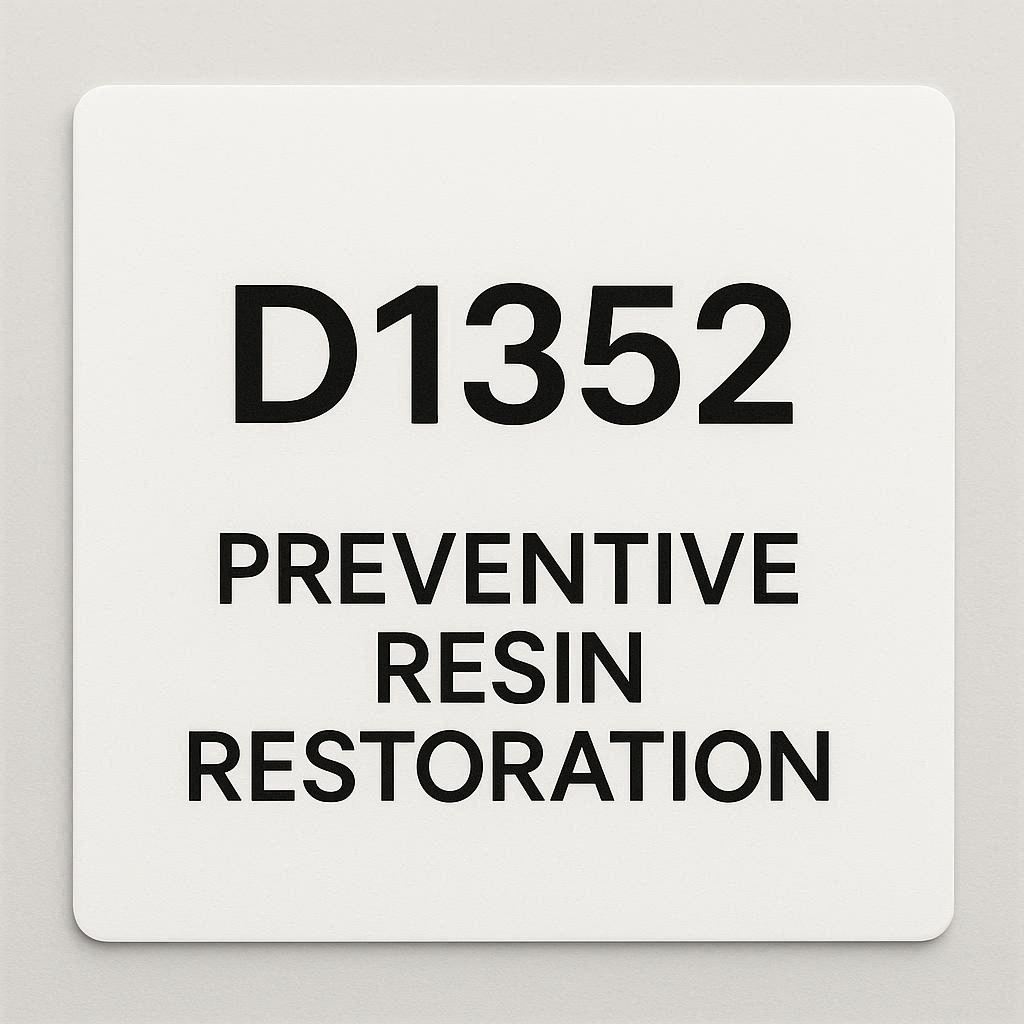
The correct dental code for preventive resin restoration is D1353.
This code belongs to the preventive category in the CDT (Current Dental Terminology) code set. The full descriptor for D1353 is:
“Sealant repair – per tooth – preventive resin restoration”
Some older coding manuals might list it differently. But as of 2026, D1353 is the standard code for a PRR that involves removing minimal decay and sealing the remaining grooves.
A Quick Reference Table for D1353
| Code | Description | Category | Typical Tooth Surface |
|---|---|---|---|
| D1353 | Sealant repair – per tooth – preventive resin restoration | Preventive | Occlusal (pit and fissure) |
| D1351 | Sealant – per tooth – without resin restoration | Preventive | Occlusal only |
| D2391 | Resin-based composite – one surface – posterior | Restorative | Any surface |
This table helps you see the difference. D1351 is purely a sealant. D2391 is a full filling. D1353 is the middle option.
D1353 vs. Other Common Codes
One of the biggest mistakes in dental billing is mixing up D1353 with other codes. Let us clarify the differences.
D1353 vs. D1351 (Sealant)
A sealant (D1351) goes on a clean tooth. There is no decay. There is no removal of tooth structure. You simply etch, bond, and flow material into the grooves.
A PRR (D1353) involves removing a small amount of decay. You use a bur or hand instrument to clean out the lesion. Then you place the resin. After that, you seal the remaining grooves.
Key difference: Decay removal. If you did not remove any decay, it is not a PRR.
D1353 vs. D2391 (One-Surface Filling)
A traditional filling (D2391 for posterior composite) removes all decay and extends into healthy tooth structure for retention. The preparation has defined walls and margins. You often need local anesthesia.
A PRR is more conservative. You only remove the decayed area. You do not create a traditional cavity preparation. You may not even need anesthesia.
Key difference: Preparation size. If you cut a traditional box shape with distinct walls, it is a filling, not a PRR.
When to Avoid D1353
Do not use D1353 in these situations:
- The decay extends into dentin deeper than 0.5 mm
- The lesion involves multiple surfaces (mesial, distal, buccal, or lingual)
- The tooth already has a full coverage restoration
- The patient is under 6 years old with primary molars that are about to exfoliate
In these cases, a traditional filling code like D2391 or D2330 is more appropriate.
How to Document a PRR for Insurance
Insurance companies look closely at D1353. Why? Because it costs less than a filling but more than a sealant. Some payers try to downgrade it to D1351.
You need strong documentation to get paid correctly.
Required Elements in Your Clinical Notes
Your notes should include these five items:
- Pre-operative finding: Describe the lesion. Use terms like “incipient caries,” “enamel breakdown,” or “minimal dentinal involvement.”
- Decay removal method: State whether you used a bur, hand excavator, or laser.
- Bonding and material: List the bonding agent and composite resin brand.
- Sealant application: Note that you sealed the remaining grooves after placing the resin.
- Post-operative radiograph or photo: This is optional but highly recommended. A black and white image proves the lesion existed.
Example Note for D1353
“Patient presents with incipient occlusal caries on tooth #30. Radiograph shows lesion confined to inner enamel with possible minimal dentinal involvement. After consent, I removed the decayed tissue using a small round bur. The preparation remained confined to the pit and fissure. I applied OptiBond FL and placed Filtek Supreme Ultra flowable composite. I then sealed the remaining grooves with Clinpro sealant. Final occlusion checked. Patient tolerated well.”
This note is clear, detailed, and justifies the use of D1353.
Insurance Coverage for Preventive Resin Restoration
Here is the honest reality. Not all insurance plans cover D1353.
Some treat it as a sealant. Others treat it as a filling. A few plans have a specific exclusion for “preventive fillings.”
What to Tell Patients
Always have a conversation before treatment. Say something like this:
“Your tooth has a very small spot of decay. I can fix it with a preventive resin restoration. It is more conservative than a traditional filling. However, your insurance may not cover it fully. They might pay it as a sealant or deny it. If that happens, your out-of-pocket cost would be approximately [dollar amount]. Would you like to proceed?”
This honesty builds trust. It also prevents surprises when the patient receives their Explanation of Benefits.
Tips for Getting Paid
If an insurance company denies D1353, do not give up right away.
- Appeal with your documentation. Send your clinical notes and radiograph.
- Ask for a reconsideration. Explain that the code is appropriate per CDT guidelines.
- Check your contract. Some plans explicitly cover D1353 under “preventive services” at 100%.
Some practices choose to bill D2391 for a PRR if they know the plan denies D1353. Be careful with this approach. It is not technically correct. But in some regions, it is accepted practice. Consult your billing attorney or coding consultant before doing this.
Step-by-Step: Performing a PRR (For Clinical Reference)
Even though this is a coding guide, understanding the procedure helps you code correctly. Here is a quick clinical overview.
Step 1: Assessment
Take a bitewing radiograph. Confirm the lesion is small. No more than one-third through dentin.
Step 2: Isolation
Place rubber dam or cotton roll isolation. Moisture control is critical.
Step 3: Decay Removal
Use a small round bur (e.g., 1/4 or 1/2 round) in a slow-speed handpiece. Remove only the soft, discolored dentin. Do not extend into healthy grooves.
Step 4: Etch and Bond
Apply 37% phosphoric acid for 15 seconds on enamel and 10 seconds on dentin. Rinse. Apply a fifth-generation or universal bonding agent. Light cure.
Step 5: Resin Placement
Place a flowable or low-viscosity composite into the prepared area. Light cure.
Step 6: Sealant Overcoat
Apply a traditional pit and fissure sealant over the entire occlusal surface, including the resin restoration. Light cure.
Step 7: Check and Adjust
Verify occlusion. Polish if needed.
That is the full PRR protocol.
Common Billing Mistakes and How to Avoid Them
Even experienced billers make errors with D1353. Here are the most frequent problems.
Mistake 1: Billing D1353 on the Wrong Surface
D1353 is only for occlusal surfaces. Do not use it for buccal pits, lingual grooves, or interproximal lesions. Those need D2330 (anterior composite) or D2391 (posterior composite).
Mistake 2: Billing D1353 Plus D1351 on the Same Tooth
Some billers try to add D1351 for the sealant part. Do not do this. D1353 already includes the sealant. Billing both is double-dipping and will result in a denial or audit.
Mistake 3: Using D1353 for Deep Caries
If the decay extends into deep dentin or near the pulp, D1353 is fraud. You must bill a restorative code.
Mistake 4: No Radiograph Documentation
If you cannot show a pre-operative lesion, the insurance company will assume you performed a sealant. Always take a bitewing or use a DIAGNOdent reading.
A Comparison Table: PRR vs. Sealant vs. Filling
| Feature | Sealant (D1351) | PRR (D1353) | Filling (D2391) |
|---|---|---|---|
| Decay present | No | Yes (minimal) | Yes (moderate to deep) |
| Tooth structure removed | None | <0.5 mm | 0.5–2.0 mm |
| Anesthesia | Rarely | Sometimes | Usually |
| Average time | 5 minutes | 10–15 minutes | 15–20 minutes |
| Insurance coverage | Often 100% | Varies (50–80%) | 50–80% after deductible |
| Longevity | 3–5 years | 5–7 years | 7–10+ years |
This table helps you explain options to patients visually.
Geographic Variations in Coding
Dental codes are national in the United States. But interpretation varies by region and by insurance company.
Delta Dental
Most Delta Dental plans cover D1353 as a preventive service. But some state-specific Delta plans (e.g., Delta Dental of California) classify it as a basic restorative service.
Cigna and Aetna
These plans often require pre-authorization for D1353 on posterior teeth. Without pre-auth, they may downgrade to D1351.
Medicaid
State Medicaid programs vary widely. Some cover D1353 for children only. Others do not recognize it at all. Always check your state’s fee schedule.
UnitedHealthcare
UHC typically covers D1353 under the same guidelines as sealants for patients under 18. For adults, they often deny it.
Important Note for Readers: Insurance policies change frequently. Always verify coverage with the specific plan before submitting a claim. Do not rely on general guidelines alone.
Frequently Asked Questions (FAQ)
1. Can I use D1353 on a primary tooth?
Yes. D1353 is appropriate for primary molars with small occlusal lesions. However, if the tooth is close to exfoliation (within 6–12 months), a sealant or no treatment may be better.
2. Is D1353 the same as a “flowable composite” code?
No. D1353 is specifically for the combination of minimal decay removal plus sealant overcoat. A flowable composite alone without sealant is a filling (D2391).
3. What if I only remove decay and do not place a sealant?
Then it is not a PRR. It is a traditional filling. Use D2391.
4. Does D1353 require a separate surface code (e.g., MO or DO)?
No. D1353 is a per-tooth code. You do not add surface modifiers. The code itself implies the occlusal surface only.
5. How much can I charge for D1353?
Fees vary by region. In a suburban private practice, the typical fee ranges from $75 to $150. Urban areas may see $100 to $200. Medicaid fees are much lower, often $30 to $50.
6. Can a hygienist place a PRR?
In most U.S. states, no. A PRR involves removing decay, which is a diagnosis and treatment procedure. That requires a dentist’s supervision or direct performance. Some states allow expanded function dental assistants (EFDAs) to place sealants, but decay removal is usually outside their scope.
7. What is the ADA’s official stance on D1353?
The American Dental Association recognizes D1353 as a valid code. Their CDT manual states that D1353 is for “sealant repair” that includes a “preventive resin restoration” after minimal decay removal.
8. My software only shows D1351 and D2391. What do I do?
Update your CDT code set. D1353 has been active since 2015. If your software is older, contact your vendor for an update. In the meantime, use a paper claim or a “code not listed” override.
Practical Tips for Your Dental Practice
Let us move from theory to action. Here are actionable tips you can use tomorrow.
Tip 1: Train Your Front Desk
Your front desk should know the difference between D1351, D1353, and D2391. Create a one-page cheat sheet. Laminate it and keep it at the computer.
Tip 2: Use a PRR Consent Form
Create a short consent form that explains the procedure, the cost, and the insurance risk. Have patients sign it before starting. This protects you if the insurance denies the claim.
Tip 3: Photograph Everything
A smartphone photo of the pre-op tooth and the post-op restoration is powerful evidence. Attach it to the patient’s chart. Some insurance portals allow image uploads.
Tip 4: Know When to Downgrade
If you know a specific plan never pays D1353, you have two choices:
- Bill D1353 and appeal (time-consuming)
- Bill D1351 and accept the lower fee (honest only if no decay)
Never bill D2391 for a PRR just to get higher reimbursement. That is fraud.
Tip 5: Educate Your Patients
Many patients have never heard of a PRR. Explain it as a “super sealant” or “mini filling.” Use analogies. For example: “Think of a pothole in the road. A sealant is like a new coat of paint. A filling is like repaving the whole street. A PRR is like patching just the hole and sealing around it.”
The Future of Preventive Resin Restoration Coding
The CDT code set updates every year. As of 2026, D1353 remains stable. But there is discussion about creating a separate code for “biomimetic minimal intervention restoration.”
What does that mean for you? Stay informed. Subscribe to the ADA’s CDT newsletter. Join a local study club. Coding changes happen slowly, but they do happen.
For now, D1353 is your best tool for preventive resin restorations.
Additional Resources
For more official guidance, visit the American Dental Association’s CDT Code webpage:
🔗 https://www.ada.org/en/publications/cdt
You can also download the full CDT 2026 manual from that link. It includes all descriptors, clinical examples, and official coding scenarios.
Final Thoughts and Honest Advice
Let me give you some direct, honest advice.
The dental code for preventive resin restoration is D1353. That is the correct answer. But knowing the code is only half the battle.
The real challenge is getting paid.
Many dentists love PRRs because they are conservative and patient-friendly. But insurance companies do not always share that love. They see a gray area. Some exploit that gray area to pay less.
My advice? Use D1353 correctly. Document everything. Educate your patients. And if an insurance company consistently denies valid claims, consider dropping that plan or billing the patient directly.
You did the right treatment. You used the right code. Do not let a payer’s refusal to pay make you feel like you did something wrong.
Conclusion
The correct dental code for preventive resin restoration is D1353, used for minimal occlusal decay removal followed by a sealant overcoat. Always document the lesion with radiographs and clinical notes to justify the code. Be honest with patients about potential insurance denials, and appeal when appropriate to receive fair reimbursement.
FAQ (Summary for Quick Reference)
| Question | Short Answer |
|---|---|
| What is the code for PRR? | D1353 |
| Can I use D1353 for deep decay? | No |
| Does insurance always cover D1353? | No, varies by plan |
| Is a PRR the same as a filling? | No, it is more conservative |
| Do I need a radiograph? | Yes, strongly recommended |
| Can I bill sealant plus PRR? | No |
| What if my plan denies D1353? | Appeal or bill patient directly |