If you have ever stared at a patient’s chart reading “bullous skin disease” and felt unsure which ICD 10 code to choose, you are not alone.
Bullous skin diseases sound like one condition, but they are actually a family of disorders. Each has different causes, different treatments, and — most importantly for you — different codes.
The good news? Once you understand the key distinctions, coding becomes straightforward. This guide walks you through everything you need to know, from the most common codes to real-world documentation examples.
What Exactly Is Bullous Skin Disease?
Before we jump into the alphanumeric codes, let us talk about the condition itself.
Bullous skin disease is not a single diagnosis. It is an umbrella term for any skin disorder that causes bullae — large, fluid-filled blisters that measure more than 0.5 centimeters in diameter. Smaller blisters (under 0.5 cm) are called vesicles.
These blisters form when the skin layers separate due to inflammation, autoimmune attacks, or genetic defects. The fluid inside is usually clear, but it can become bloody or pus-filled if infection sets in.
Common Examples of Bullous Skin Diseases
- Pemphigus vulgaris
- Bullous pemphigoid
- Dermatitis herpetiformis
- Epidermolysis bullosa
- Pemphigus foliaceus
Each of these conditions has its own ICD 10 code. You cannot just use one generic code for all bullous diseases.
Important note for coders: If the physician documents “bullous skin disease” without further specification, you may be forced to use an unspecified code. However, always query the provider for more detail whenever possible.
The Main ICD 10 Code for Bullous Skin Disease
Now to the question you came here for.
There is no single ICD 10 code labeled “bullous skin disease.” Instead, the coding system directs you to the specific type of bullous disorder.
However, when the documentation truly does not specify the type, the closest code is:
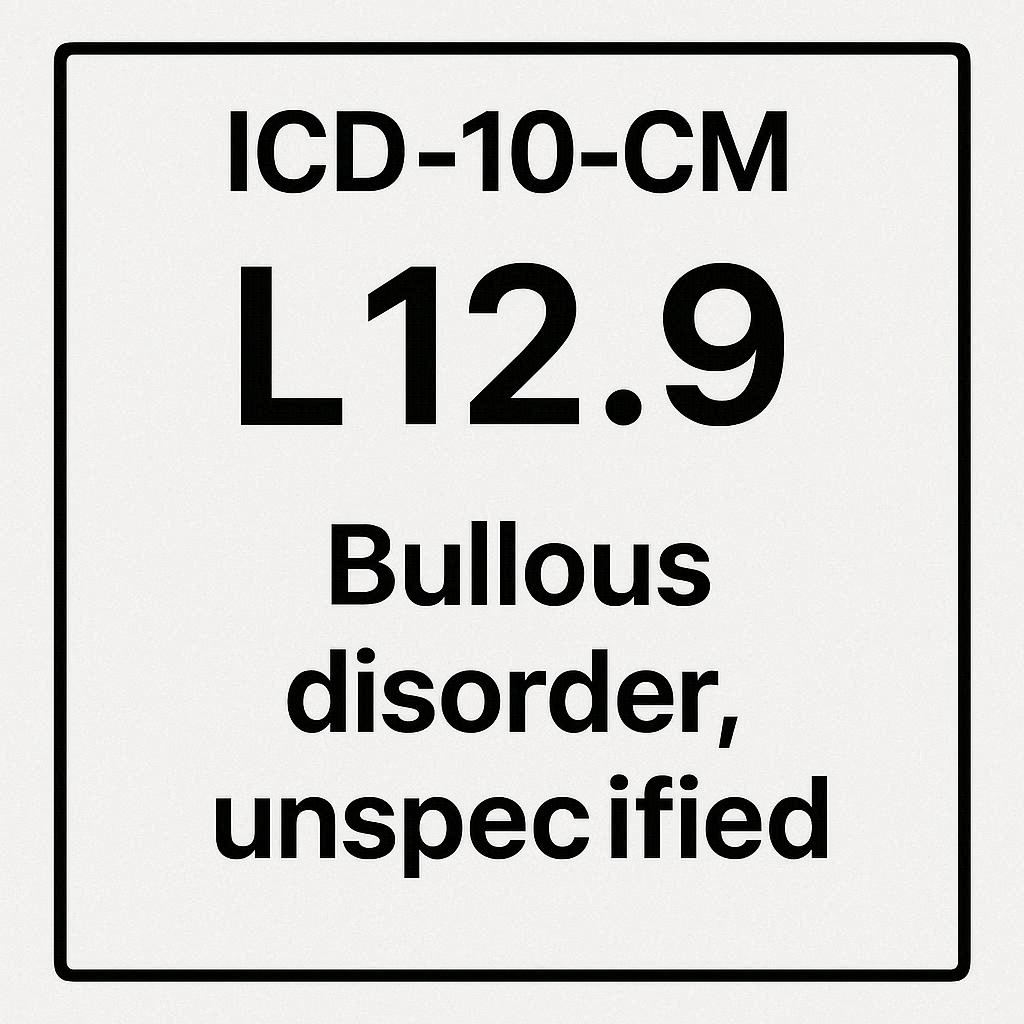
L13.9 – Bullous disorder, unspecified
- Category: L13 – Other bullous disorders
- Subcategory: L13.9 – Unspecified
- Use this code: Only when the medical record gives no further detail about the nature of the bullous disease.
Realistic warning: Many payers scrutinize unspecified codes. Using L13.9 too often can trigger audits. Always try to obtain a more specific diagnosis from the provider.
Complete Table of ICD 10 Codes for Bullous Diseases
Here is a practical, clinical-facing table of the most relevant bullous disease codes.
| ICD 10 Code | Diagnosis | Clinical Clues for Coders |
|---|---|---|
| L10.0 | Pemphigus vulgaris | Flaccid bullae, positive Nikolsky sign, oral lesions common |
| L10.1 | Pemphigus vegetans | Vegetating plaques in flexural areas |
| L10.2 | Pemphigus foliaceus | Superficial erosions, no oral involvement |
| L10.3 | Brazilian pemphigus (fogo selvagem) | Endemic in certain regions, similar to foliaceus |
| L10.4 | Pemphigus erythematosus | Lupus-like facial rash + pemphigus features |
| L10.5 | Drug-induced pemphigus | Onset after medication exposure |
| L10.8 | Other pemphigus | Rare forms, documentation required |
| L10.9 | Pemphigus, unspecified | Use with caution |
| L12.0 | Bullous pemphigoid | Tense bullae in elderly, itch often precedes |
| L12.1 | Cicatricial pemphigoid | Mucosal scarring (eyes, mouth, genitals) |
| L12.2 | Chronic bullous disease of childhood | Self-limiting, children under 5 years |
| L12.3 | Acquired epidermolysis bullosa | Autoimmune, adult onset, trauma-induced blisters |
| L12.8 | Other pemphigoid | Specific variants per provider |
| L12.9 | Pemphigoid, unspecified | Avoid when possible |
| L13.0 | Dermatitis herpetiformis | Intensely itchy papulovesicles, gluten-sensitive |
| L13.1 | Subcorneal pustular dermatosis (Sneddon-Wilkinson) | Flaccid pustules, truncal |
| L13.8 | Other specified bullous disorders | Rare conditions clearly documented |
| L13.9 | Bullous disorder, unspecified | Last resort code |
| Q81.0 | Epidermolysis bullosa simplex | Congenital, blistering at birth or early infancy |
| Q81.1 | Epidermolysis bullosa letalis | Severe, often fatal in infancy |
| Q81.2 | Epidermolysis bullosa dystrophica | Scarring, nail loss, mitten deformities |
| Q81.8 | Other epidermolysis bullosa | Specific variants |
| Q81.9 | Epidermolysis bullosa, unspecified | Congenital bullous disease NOS |
Always double-check: The tabular list of ICD-10-CM. This table is a guide, not a substitute for official coding references.
Pemphigus vs. Pemphigoid: Why the Difference Matters for Coding
If you remember only one distinction from this article, make it this one.
Pemphigus and pemphigoid sound nearly identical. But they are fundamentally different diseases. Mixing them up leads to wrong codes, denied claims, and potential medical errors.
Quick Comparison Table
| Feature | Pemphigus | Bullous Pemphigoid |
|---|---|---|
| Blister location | Inside the epidermis (intraepidermal) | Below the epidermis (subepidermal) |
| Blister firmness | Flaccid (wobbly, easily ruptured) | Tense (firm like a balloon) |
| Nikolsky sign | Positive (skin shears with light pressure) | Negative (skin stays intact) |
| Mucosal involvement | Very common (mouth, throat, genitals) | Less common |
| Typical patient age | Middle-aged (40–60) | Elderly (over 70) |
| ICD 10 code range | L10.- | L12.- |
Why This Matters for Your Coding
A physician who writes “bullous pemphigoid” guides you to L12.0. A physician who writes “pemphigus vulgaris” guides you to L10.0.
But what if they write “pemphigus, type not specified”? Then you must use L10.9 — pemphigus unspecified. That is better than L13.9 because the provider at least indicated pemphigus rather than another bullous disorder.
Pro tip: When you see “bullous disease” in a note, scan for any mention of “pemphigus” or “pemphigoid.” These two keywords dramatically narrow your code choice.
Unspecified Bullous Disorder (L13.9) – When Can You Honestly Use It?
Let’s be realistic. Physicians do not always provide perfect documentation.
You will encounter notes that say exactly this: “Patient has bullous skin disease.” No more. No less.
In that specific situation, L13.9 (Bullous disorder, unspecified) is your correct code. You are not cheating or miscoding. You are working with the information available.
Acceptable scenarios for L13.9
- Initial visit with no biopsy results yet
- Poorly documented history from another facility
- Patient unable to provide history (dementia, language barrier)
- Provider explicitly writes “bullous disorder NOS”
When you should never use L13.9
- The note says “bullous pemphigoid” (use L12.0)
- The note says “pemphigus” (use L10.9 or more specific)
- Biopsy results are available but not yet interpreted
- The patient has a known genetic bullous disorder (use Q81 series)
Real-world example
Poor documentation:
“68-year-old female with rash and blisters on trunk. Diagnosed with bullous skin disease.”
Code: L13.9 (for now)
Better approach: Query the provider: “The patient has a documented bullous skin disease. Please clarify if this is pemphigoid, pemphigus, dermatitis herpetiformis, or another specific condition. Thank you.”
Coding by Clinical Presentation – A Practical Guide
Sometimes you will not have a formal diagnosis yet. Maybe the biopsy is pending. Maybe the patient is new. But you still need to code the encounter.
In those cases, code the symptoms first. Then add the provisional diagnosis if documented.
Common symptom codes before a bullous disease diagnosis
| Symptom | ICD 10 Code |
|---|---|
| Bullous rash | R23.8 (Other skin changes) |
| Pruritus (itching) | L29.9 (Unspecified) |
| Localized blistering | L74.8 (Other eccrine sweat disorders) — not ideal |
| General rash | R21 (Rash and other nonspecific skin eruption) |
Honest advice: Symptom coding is temporary. As soon as a definitive diagnosis is established, use the correct bullous disease code. Do not keep using R21 or R23.8 for chronic bullous patients.
Documentation Tips for Physicians (Share This Section)
Many coding errors begin with incomplete physician documentation. If you work in a practice or hospital, consider sharing these tips with your clinical team.
What coders need from physicians
- Specific diagnosis name – “Bullous pemphigoid,” not just “blistering disease”
- Location of blisters – Trunk, extremities, mucosa, intertriginous areas
- Chronicity – New onset, acute flare, or chronic stable condition
- Related factors – Medication exposure, trauma, family history
- Biopsy status – Pending, completed with results, or planned
Example of excellent documentation
“Patient presents with a 3-week history of tense bullae on the forearms and lower legs. No oral lesions. Nikolsky sign negative. Clinical presentation strongly suggests bullous pemphigoid. Awaiting biopsy confirmation and direct immunofluorescence. Current medications include losartan and metformin.”
Correct codes: L12.0 (bullous pemphigoid) + Z09 (follow-up after biopsy, if appropriate)
Example of poor documentation (to avoid)
“Blister rash. Bullous disease.”
Code you are forced to use: L13.9
Laterality, Encounter Type, and Other Modifiers
Bullous skin disease codes typically do not require laterality (left vs. right) because they are generally not localized to one side of the body.
However, you do need to pay attention to:
1. Encounter type (7th character)
For most L10–L13 codes, no 7th character is required. But for trauma-related or surgical bullous conditions, you may need:
- A – Initial encounter
- D – Subsequent encounter
- S – Sequela
Example: Acquired epidermolysis bullosa with a new traumatic wound → L12.3 + appropriate injury code + encounter character.
2. Combination codes
Some bullous diseases are tied to other conditions.
- Dermatitis herpetiformis (L13.0) is strongly associated with celiac disease (K90.0). Consider coding both.
- Paraneoplastic pemphigus → L10.8 + underlying neoplasm code.
3. Z codes for history
If the patient has a past bullous disease that is currently inactive, use a Z code for personal history.
- Z87.0 (Personal history of diseases of the skin and subcutaneous tissue)
Common Coding Mistakes and How to Avoid Them
Even experienced coders slip up. Here are the most frequent errors seen with bullous skin disease codes.
Mistake #1: Using L13.9 for everything
Why it happens: It is the closest thing to a “bullous disease default code.”
Why it is wrong: Bullous pemphigoid (L12.0) is completely different from pemphigus vulgaris (L10.0) in treatment and prognosis. Coding them the same way is inaccurate.
How to avoid: Read the entire note. If the physician uses a disease name, search for it in the alphabetical index first.
Mistake #2: Confusing L10.- with L12.-
Why it happens: The words look similar.
Why it is wrong: As explained earlier, these are different families of diseases.
How to avoid: Remember this mnemonic:
Pemphigus → flaccid blisters → Fatal if untreated (historically) → L10
Pemphigoid → tense blisters → Treatable → L12
Mistake #3: Not coding associated conditions
Why it happens: Tunnel vision on the skin condition.
Why it is wrong: Dermatitis herpetiformis without celiac disease coding misses the systemic connection.
How to avoid: Always ask: “Does this bullous disease come with something else?”
Mistake #4: Coding an unspecified code after biopsy results exist
Why it happens: Coder does not check the pathology report.
Why it is wrong: The biopsy results likely provide a specific diagnosis.
How to avoid: Always review lab and pathology reports before finalizing the code.
Real-World Case Studies
Let us walk through three patient scenarios together.
Case 1: The Elderly Patient with Tense Blisters
Note from dermatology:
“85-year-old male with a 2-month history of intensely pruritic, tense bullae on the bilateral lower legs. No oral or ocular lesions. Biopsy with direct immunofluorescence pending. Clinical diagnosis: bullous pemphigoid.”
Your codes:
- L12.0 – Bullous pemphigoid
- L29.9 – Pruritus, unspecified (if documented as significant)
Why not L13.9? The physician gave a specific clinical diagnosis.
Case 2: The Young Adult with Oral Lesions
Note from emergency department:
“32-year-old female with painful oral erosions and flaccid bullae on the chest. Positive Nikolsky sign. Suspect pemphigus vulgaris. Admitted for biopsy.”
Your codes:
- L10.0 – Pemphigus vulgaris (suspected diagnosis is allowed if documented as “probable” or “suspected” per outpatient coding rules)
- K12.1 – Other forms of stomatitis (for oral lesions)
Case 3: The Child with Blisters Since Birth
Note from pediatrics:
“4-year-old male with blistering on hands and feet since infancy. Nails dystrophic. Family history positive. Diagnosed as epidermolysis bullosa dystrophica.”
Your codes:
- Q81.2 – Epidermolysis bullosa dystrophica
- Z82.8 – Family history of other disabilities and chronic diseases (if documented)
Note: The Q81 codes are congenital malformations. Do not use L10–L13 codes for inherited epidermolysis bullosa.
Dermatitis Herpetiformis – A Special Case (L13.0)
Dermatitis herpetiformis deserves its own mention. This condition is intensely itchy and symmetrically distributed on the elbows, knees, buttocks, and scalp.
Key coding facts:
- Code: L13.0
- Strongly associated with celiac disease (K90.0)
- Responds to dapsone and a gluten-free diet
- If the patient has both, code L13.0 and K90.0
Documentation tip: Physicians should specify “dermatitis herpetiformis” rather than “celiac rash” or “gluten rash.”
Drug-Induced Bullous Disorders – What to Code
Many medications can trigger bullous reactions. The coding approach depends on the type of reaction.
| Reaction type | Typical code | Example drug (not a complete list) |
|---|---|---|
| Drug-induced pemphigus | L10.5 | Penicillamine, captopril |
| Fixed drug eruption with bullae | L27.1 | NSAIDs, barbiturates |
| Stevens-Johnson syndrome / TEN | L51.1 or L51.2 | Allopurinol, anticonvulsants, sulfa drugs |
| Bullous drug reaction, unspecified | L27.1 | Various |
Important: For drug-induced bullous disorders, also code the adverse effect using the appropriate T code (e.g., T36-T50) plus the 5th or 6th character 5 for adverse effect.
Example: Drug-induced pemphigus from penicillin → L10.5 + T36.0x5A
The Role of Biopsy and Pathology Reports in Coding
Biopsies are the gold standard for diagnosing bullous skin diseases. As a coder, the pathology report is your best friend.
What to look for in a pathology report
- Level of blister: Intraepidermal (pemphigus) vs. subepidermal (pemphigoid)
- Immunofluorescence findings: IgG, C3 deposition patterns
- Specific cell types: Acantholytic cells, eosinophils, neutrophils
- Final pathological diagnosis: Often explicit (e.g., “Direct immunofluorescence consistent with bullous pemphigoid”)
When pathology disagrees with clinical diagnosis
If the clinician writes “bullous pemphigoid” but the pathology says “dermatitis herpetiformis,” which do you code?
Answer: Code the diagnosis the physician ultimately accepts. If the physician updates the note to reflect pathology, use the new diagnosis. If not, query the provider.
Do not code based only on pathology without physician confirmation. The final diagnosis is the physician’s clinical judgment.
Pediatric Bullous Diseases – Special Coding Considerations
Children get blistering diseases too, but the codes differ.
Common pediatric bullous disorders
| Condition | Typical age | ICD 10 code |
|---|---|---|
| Chronic bullous disease of childhood | 2–5 years | L12.2 |
| Epidermolysis bullosa (genetic) | Birth/infancy | Q81.- |
| Bullous impetigo | Any age, but common in children | L01.03 |
| Staphylococcal scalded skin syndrome | Infants, young children | L00 |
Important: Do not use adult pemphigus or pemphigoid codes for children unless the condition is truly the adult form (rare but possible).
Coding example – pediatric
“3-year-old with tense bullae on perineal area and lower abdomen. No mucosal lesions. Healthy otherwise. Diagnosed as chronic bullous disease of childhood.”
Code: L12.2
Not: L13.9 or L12.0
Emergency Department Coding for Bullous Disease
In the ED, you often see bullous diseases for the first time. The patient may not have a diagnosis yet.
ED coding hierarchy
- If the patient has a known bullous disease (e.g., pemphigus vulgaris flare) → code the specific L10 or L12 code
- If the patient has a suspected bullous disease but no biopsy yet → code signs/symptoms (R21, R23.8) plus the suspected diagnosis as “probable” if documented
- If the patient has a severe bullous reaction (SJS/TEN) → code L51.1 or L51.2 as primary
ED example
“29-year-old with fever, malaise, and targetoid lesions on trunk and palms. Conjunctival injection. Concern for early Stevens-Johnson syndrome. Started on IV fluids. Admitted to ICU.”
Codes:
- L51.1 – Stevens-Johnson syndrome
- R50.9 – Fever, unspecified
- Z03.89 – Encounter for observation for other suspected diseases (if observation)
How to Query a Physician for Better Bullous Disease Codes
Queries are not accusations. They are collaborative tools to improve documentation and coding accuracy.
When to query
- The note says “bullous disease” without specific type
- The note uses an outdated term (e.g., “bullous dermatosis” with no modifier)
- Clinical description and code seem mismatched
Sample query
RE: Patient [Name, MRN] – Encounter date [Date]
The documentation describes a bullous skin disorder. Please clarify the specific diagnosis to ensure accurate coding.
□ Pemphigus (specify type if known: _________________________________)
□ Bullous pemphigoid
□ Dermatitis herpetiformis
□ Epidermolysis bullosa (specify type)
□ Other (please specify): _________________
□ Bullous disorder, not otherwise specified (no further detail available)Thank you for your clarification.
[Coder name, credentials]
Do not query when
- The specific diagnosis is already clear
- The patient is being discharged without a definitive diagnosis (use unspecified temporarily)
Insurance and Reimbursement Implications
Payers treat different bullous disease codes differently. Here is what you need to know.
High-risk codes for audits
- L13.9 – Unspecified bullous disorder. Overuse raises flags.
- L10.9 – Pemphigus unspecified. Better than L13.9, but still scrutinized.
Codes with good reimbursement
- L12.0 – Bullous pemphigoid (well-defined, common in elderly)
- L10.0 – Pemphigus vulgaris (serious condition, intensive treatment)
- L51.1 – L51.2 – SJS/TEN (high acuity, high cost)
Medical necessity tips
Some bullous disease treatments (rituximab, IVIG, dapsone, rituximab) are expensive. Carriers often require:
- Biopsy confirmation in the medical record
- Specific ICD 10 code matching the drug’s FDA indication
- Documentation of failed first-line therapies (if applicable)
Honest advice: If you code bullous diseases for prior authorization, always attach the pathology report. It saves weeks of back-and-forth.
Frequently Asked Questions (FAQ)
1. Is there a single ICD 10 code for “bullous skin disease” as a general term?
No. The closest option is L13.9 (Bullous disorder, unspecified). However, best practice is to use the specific code for the diagnosed condition (e.g., L12.0 for bullous pemphigoid, L10.0 for pemphigus vulgaris).
2. What is the ICD 10 code for autoimmune bullous skin disease?
There is no single “autoimmune bullous” code. Autoimmune blistering diseases fall under:
- Pemphigus group: L10.-
- Pemphigoid group: L12.-
- Dermatitis herpetiformis: L13.0
3. Can I use L13.9 for a newborn with blisters?
No. For congenital blistering disorders (inherited epidermolysis bullosa), use Q81.-. For transient neonatal pustular melanosis or other neonatal conditions, use appropriate P codes or Q codes.
4. What code should I use when a biopsy is pending but the physician strongly suspects bullous pemphigoid?
You may code L12.0 (Bullous pemphigoid) if the physician documents it as “probable,” “suspected,” or “likely.” Outpatient coding guidelines permit coding suspected diagnoses as if they were confirmed when the provider clearly states the suspicion.
5. How do I code a bullous disease flare?
Use the same specific L10, L12, L13, or Q81 code. No separate “flare” code exists. You can add an acute exacerbation code if available in the specific subcategory, but most do not require one.
6. What is the difference between L13.9 and L12.9?
- L13.9 = Bullous disorder, unspecified (no subtype identified)
- L12.9 = Pemphigoid, unspecified (provider specified pemphigoid but no further detail)
L12.9 is more specific because it at least identifies the disease family.
7. Can I code both a bullous disease and a skin infection?
Yes. If the patient has infected bullae (cellulitis, impetiginization), code:
- Primary bullous disease code (e.g., L12.0)
- Secondary infection code (e.g., L08.9 for localized skin infection, or specific L01.03 for bullous impetigo)
8. What is the ICD 10 code for paraneoplastic pemphigus?
L10.8 (Other pemphigus). You must also code the underlying neoplasm (e.g., C83.00 for non-Hodgkin lymphoma, C34.90 for lung cancer).
9. How do I code a patient with a history of bullous disease now cured?
Use Z87.0 (Personal history of diseases of the skin and subcutaneous tissue). Do not use an active L10–L13 code.
10. Where can I find the official guidelines for bullous disease coding?
The Centers for Medicare & Medicaid Services (CMS) publishes the official ICD-10-CM coding guidelines yearly. Additionally, the American Academy of Dermatology offers coding resources for members.
Additional Resource
For the most current ICD-10-CM coding guidelines and official code updates, visit the CMS ICD-10 webpage:
🔗 https://www.cms.gov/medicare/coding/icd10 (Copy and paste this link into your browser)
You can also download the complete ICD-10-CM tabular list and alphabetical index for free from the WHO or CDC websites.
Conclusion
Bullous skin disease coding requires specific diagnosis (pemphigus vs. pemphigoid vs. dermatitis herpetiformis vs. epidermolysis bullosa). Use L13.9 (unspecified) only as a last resort when documentation lacks detail. Always review pathology reports and query providers when needed to secure accurate, auditable codes.
Disclaimer:
This article is for informational and educational purposes only. It does not constitute medical advice, legal advice, or official coding guidance. Always refer to the latest ICD-10-CM coding manuals and consult a certified medical coder or physician for specific patient cases.
Author: Clinical Coding Team
Date: APRIL 24, 2026