If you are searching for the right Zepbound ICD-10 code, you likely have a prescription, a billing form, or a medical record in front of you. Maybe you are a patient trying to understand your paperwork. Or you could be a medical coder, nurse, or doctor looking for clarity.
You are in the right place.
This guide gives you the exact codes you need. More importantly, it explains why each code matters. We will cover obesity classifications, related conditions, and common mistakes to avoid.
Let us start with the most important fact.
What Is Zepbound and Why Does It Need a Code?
Zepbound (tirzepatide) is a prescription medicine for chronic weight management. The FDA approved it for adults with obesity or overweight who also have at least one weight-related condition. These conditions include high blood pressure, type 2 diabetes, or high cholesterol.
Zepbound works by mimicking hormones that regulate appetite and food intake.
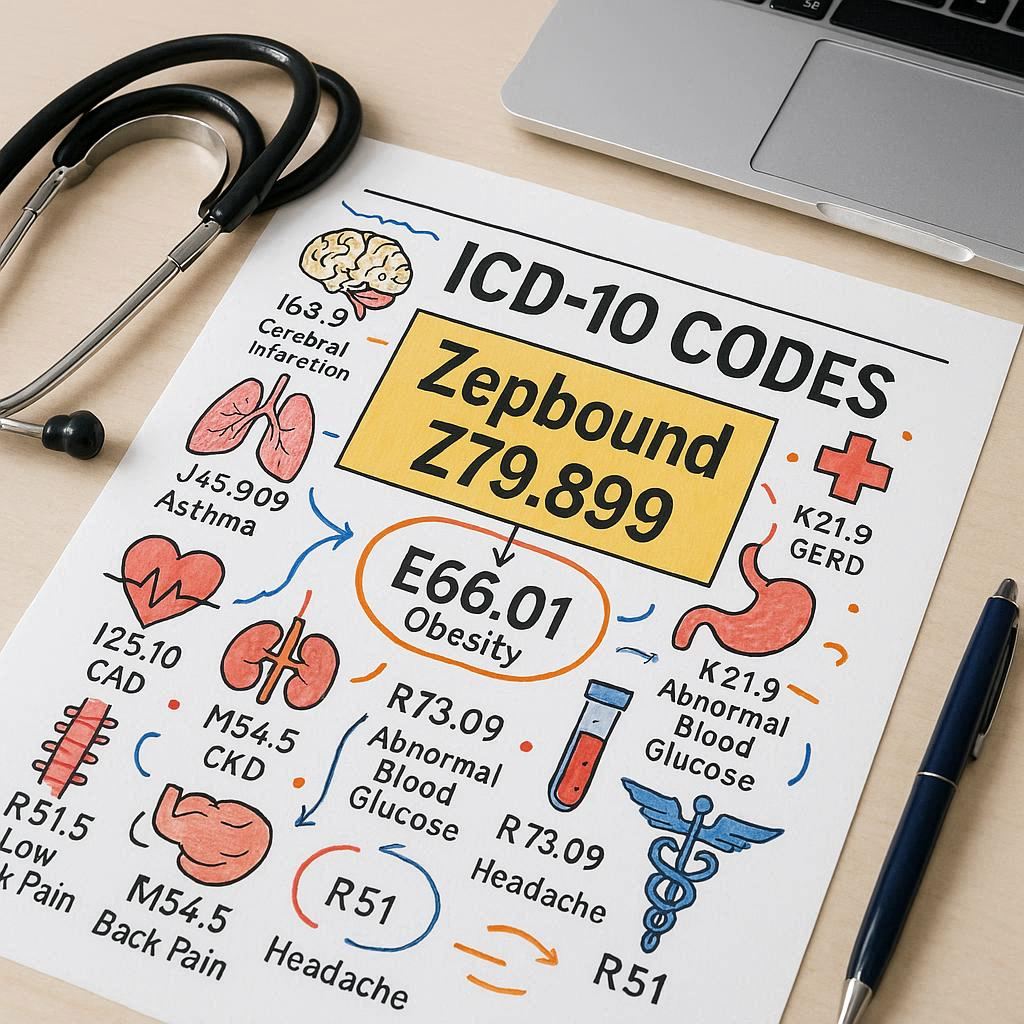
But here is the key point for coding: Zepbound itself does not have a unique ICD-10 code. No medication does. ICD-10 codes describe diagnoses, not treatments.
So when we talk about the “Zepbound ICD-10 code”, we really mean: Which diagnosis code should a doctor use when prescribing Zepbound?
That distinction is critical for insurance claims and medical records.
The Main Zepbound ICD-10 Code (Most Common)
For most patients receiving Zepbound, the correct primary code is:
E66.9 – Obesity, unspecified
This is the most commonly used code in clinical practice. It applies when a patient has a body mass index (BMI) of 30 or higher. No further specification is required.
However, many insurance companies prefer more specific codes. Let us look at those next.
Specific ICD-10 Codes for Obesity and Overweight
The table below shows the exact codes you need. Use this as your quick reference.
| Condition | BMI Range | ICD-10 Code | Notes |
|---|---|---|---|
| Obesity, unspecified | BMI 30.0 or higher | E66.9 | Default code for most adult obesity |
| Morbid (severe) obesity | BMI 40.0 or higher | E66.01 | Also called class III obesity |
| Severe obesity with alveolar hypoventilation | BMI 40.0+ with breathing issues | E66.02 | Pickwickian syndrome – rare |
| Overweight | BMI 25.0 – 29.9 | R63.5 | Not a true obesity code but often used |
| Obesity due to excess calories | BMI 30.0+ | E66.1 | Requires documentation of dietary cause |
| Drug-induced obesity | BMI 30.0+ | E66.1 | Some medications cause weight gain |
Important note: Always check your payer guidelines. Some insurers reject R63.5 (overweight) for Zepbound because the FDA label requires a BMI of 30 or higher or BMI 27+ with a weight-related comorbidity.
Coding for Zepbound When a Weight-Related Condition Exists
Many patients taking Zepbound have another condition linked to excess weight. In these cases, you often need two codes:
- The obesity code (E66.9 or E66.01)
- The comorbidity code
Here are common examples.
Zepbound with Type 2 Diabetes
If your patient has both obesity and type 2 diabetes, list:
- E66.9 (Obesity)
- E11.9 (Type 2 diabetes without complications)
Some payers require the diabetes code as primary. Confirm with each plan.
Zepbound with Hypertension
- E66.9
- I10 (Essential hypertension)
Zepbound with High Cholesterol
- E66.9
- E78.5 (Hyperlipidemia, unspecified)
Zepbound with Obstructive Sleep Apnea
- E66.9
- G47.33 (Obstructive sleep apnea)
Realistic advice: Do not assume one code works for all insurers. Prior authorization forms often ask for BMI and related diagnoses.
How to Document BMI for Zepbound Coding
Medical coders cannot guess a patient’s BMI. It must be clearly documented in the medical record.
Best practice: Write the BMI value and the calculation date.
Examples of good documentation:
“BMI 38.2 as of April 15, 2026”
“BMI 41.5 – class III obesity”
“BMI 28.7 with history of hypertension”
If the BMI is not documented, the coder must use E66.9 without BMI details. That can lead to claim denials.
ICD-10 Codes to Avoid with Zepbound
Some codes look related but will likely cause claim rejections. Avoid these unless the patient truly meets the criteria.
| Avoid This Code | Why |
|---|---|
| Z68.3 – BMI 30-34.9 | This is a secondary BMI code, not a primary obesity diagnosis. |
| Z68.4 – BMI 35-39.9 | Same issue – it supplements a primary code. |
| Z68.5 – BMI 40+ | Do not use alone. Pair with E66.01. |
| E66.8 – Other obesity | Only for rare genetic or syndromic obesity. |
| R63.6 – Morbid eating without obesity | Does not meet Zepbound criteria. |
“The biggest mistake I see is using BMI codes as primary diagnoses. They are meant for additional detail only.” – Certified Professional Coder (CPC)
Step-by-Step Guide: How to Select the Right Zepbound ICD-10 Code
Follow these simple steps every time.
- Check the patient’s BMI – Document the number and date.
- Identify obesity class – BMI 30-34.9 (class I), 35-39.9 (class II), 40+ (class III).
- Choose primary code – E66.9 (unless BMI 40+ then E66.01).
- Add comorbidity codes – Diabetes, hypertension, dyslipidemia, etc.
- Do not add Z68 codes unless payer requires them – Most do not.
- Review prior authorization requirements – Some insurers demand specific wording.
Common Billing Scenarios (Real Examples)
Let us walk through three realistic patient cases.
Scenario 1: No Comorbidities
- Patient A: BMI 34, otherwise healthy.
- Correct codes: E66.9
- Likely outcome: Approved if plan covers weight management.
Scenario 2: Obesity and Prediabetes
- Patient B: BMI 38, A1c 6.1%
- Correct codes: E66.9 + R73.03 (Prediabetes)
- Likely outcome: Approval higher than scenario 1.
Scenario 3: Morbid Obesity with Sleep Apnea
- Patient C: BMI 46, uses CPAP machine.
- Correct codes: E66.01 + G47.33
- Likely outcome: Strong approval odds.
Why Insurance Companies Care About the Exact Code
Insurance plans review every claim. They check if the diagnosis matches FDA-approved uses for Zepbound.
If you use an incorrect or vague code, the payer may:
- Deny the claim
- Request medical records
- Delay approval for weeks
- Require a peer-to-peer review
The correct ICD-10 code is your first line of defense against denials.
Zepbound Coding for Preventive vs. Treatment Services
Most Zepbound prescriptions fall under treatment of established obesity. However, some plans cover obesity prevention in high-risk patients.
Prevention coding is less common. But if a patient has a BMI of 27+ and strong family history of heart disease or diabetes, some coders use:
- Z68.2 (BMI 25-29.9) as secondary
- Z13.89 (Encounter for screening for other disorder)
Realistic warning: Most commercial insurers will reject prevention codes for Zepbound. Stick to obesity diagnosis codes unless you have written payer confirmation.
How ICD-10 Codes for Zepbound May Change in the Future
As of April 2026, no new obesity-specific ICD-10 codes have been announced. However, the American Medical Association (AMA) reviews code updates annually.
Potential future changes could include:
- Separate codes for class I, II, and III obesity (already exist but underused)
- Codes for “resistant obesity” (not yet available)
- Combination codes for obesity with specific complications
For now, use the existing E66 series and R63.5.
Frequently Asked Questions (FAQ)
1. Does Zepbound have its own ICD-10 code?
No. ICD-10 codes are for diagnoses, not medications. You code the obesity or overweight condition.
2. Can I use E66.9 for a patient with BMI 27?
No. E66.9 requires BMI 30 or higher. For BMI 27-29.9 with a comorbidity, use R63.5 (overweight) plus the comorbidity code.
3. Will my insurance deny Zepbound if I use R63.5?
Possibly. Many plans follow FDA labeling closely. Always check your specific plan’s medical policy.
4. Do I need to add a Z68 BMI code?
Only if the payer explicitly requests it. Most do not require Z68 codes for Zepbound.
5. What is the difference between E66.9 and E66.01?
E66.9 is general obesity (BMI 30+). E66.01 is morbid (severe) obesity with BMI 40+. E66.01 often signals higher medical necessity.
6. Can a medical assistant assign these codes?
In many clinics, yes. But a certified coder should review complex cases. Always follow your clinic’s compliance policies.
7. What happens if I use the wrong code?
The claim may be denied. You can appeal with corrected documentation.
8. Is coding different for Medicare or Medicaid?
Yes. Medicare Part D plans may have specific obesity coding rules. Medicaid varies by state. Always verify.
Helpful Checklist Before Submitting a Zepbound Claim
- Patient BMI documented (value + date)
- Primary obesity code selected (E66.9 or E66.01)
- All comorbidities included (diabetes, hypertension, etc.)
- No Z68 code used as primary
- Prior authorization completed (if required)
- Payer-specific medical policy reviewed
Additional Resource
For the most current Zepbound prescribing information and prior authorization forms, visit the official manufacturer’s resource page:
🔗 Zepbound Healthcare Professionals Hub (Eli Lilly) – Always verify coding with your local payer, as policies change.
Conclusion
Zepbound does not have its own ICD-10 code. Instead, use E66.9 (obesity) or E66.01 (morbid obesity). Add R63.5 for overweight only when a comorbidity exists. Always document BMI clearly. Avoid using Z68 codes as primary diagnoses. Check payer policies before submitting claims.
Disclaimer: This article is for informational and educational purposes only. It does not constitute medical advice, legal advice, or billing compliance guidance. Coding rules vary by payer, region, and time. Always consult a certified medical coder or your insurance plan’s medical policy before submitting claims.
Author: Medical Coding & Billing Team
Date: APRIL 27, 2026