Walking into an urgent care center is different from visiting your family doctor or a hospital emergency room. The pace is faster. The cases are mixed. One moment you see a child with an ear infection. The next, you stitch a cut on a carpenter’s hand.
For medical coders and billers, this variety creates a unique challenge. You need the right CPT urgent care codes ready for almost any situation. A small coding mistake can delay payment or trigger an audit. But getting it right? That keeps your revenue cycle healthy and your patients happy.
This guide covers the most common procedure codes you will use daily. We focus on realistic scenarios, payer expectations, and simple rules to remember. Let us turn complex coding guidelines into something clear and useful.
Why Urgent Care Coding Is Different
Urgent care sits between primary care and the emergency room. You treat problems that need attention now but are not life-threatening. This middle ground affects how you choose codes.
The High Mix of Problems
A typical urgent care shift includes respiratory infections, minor fractures, skin rashes, and vaccinations. You cannot memorize just one set of codes. You need a flexible mental library.
The Fast Documentation Challenge
Providers move quickly. Notes can be short. As a coder, you must learn to find the key details. Did the doctor do a single system exam or a multi-system exam? Did they review old records? These details change the level of service.
Payer Expectation Gaps
Some insurance companies treat urgent care like a doctor’s office. Others have special rules for freestanding centers. Knowing these differences saves you from nasty surprises.
Understanding Evaluation and Management (E/M) Codes for Urgent Care
The backbone of most urgent care visits is the E/M code. For 2026, the rules remain mostly stable after recent changes. But you still need to choose wisely.
New Patient vs. Established Patient
Urgent cares see many first-time visitors. But you also see repeat patients for follow-up issues. The distinction matters for payment.
- New patient (99202-99205): No face-to-face service from any provider in the same group specialty within the last three years.
- Established patient (99212-99215): Seen by a provider in the same group specialty within the last three years.
Important note: If a patient visited your urgent care for a sore throat two years ago and now returns for a ankle injury, they are an established patient. Do not use new patient codes.
Level Selection Simplified
You no longer need to count bullet points in history and exam like the old days. Selection now depends on medical decision making (MDM) or total time on the date of the encounter.
Medical Decision Making (MDM) Levels
| Level | Problem Points | Data Points | Risk | Common Urgent Care Example |
|---|---|---|---|---|
| Straightforward (99202/99212) | Minimal | Minimal or none | Minimal | Single, self-limited problem like insect bite |
| Low (99203/99213) | Low | Limited | Low | Uncomplicated UTI or otitis media |
| Moderate (99204/99214) | Moderate | Moderate | Moderate | Pneumonia, moderate dehydration, minor laceration repair |
| High (99205/99215) | High | Extensive | High | Severe chest pain (ruled out MI), possible DVT |
Time-Based Coding Option
For 2026, you can code based on total time spent on the encounter day. This includes pre-visit work, documentation, and care coordination.
- New patient: 99202 (15-29 min), 99203 (30-44 min), 99204 (45-59 min), 99205 (60-74 min)
- Established patient: 99212 (10-19 min), 99213 (20-29 min), 99214 (30-39 min), 99215 (40-54 min)
Pro tip: Time-based coding works well for complex visits with lots of coordination but fewer exam findings. Keep accurate logs of your start and stop times.
The Most Common CPT Urgent Care Codes by Category
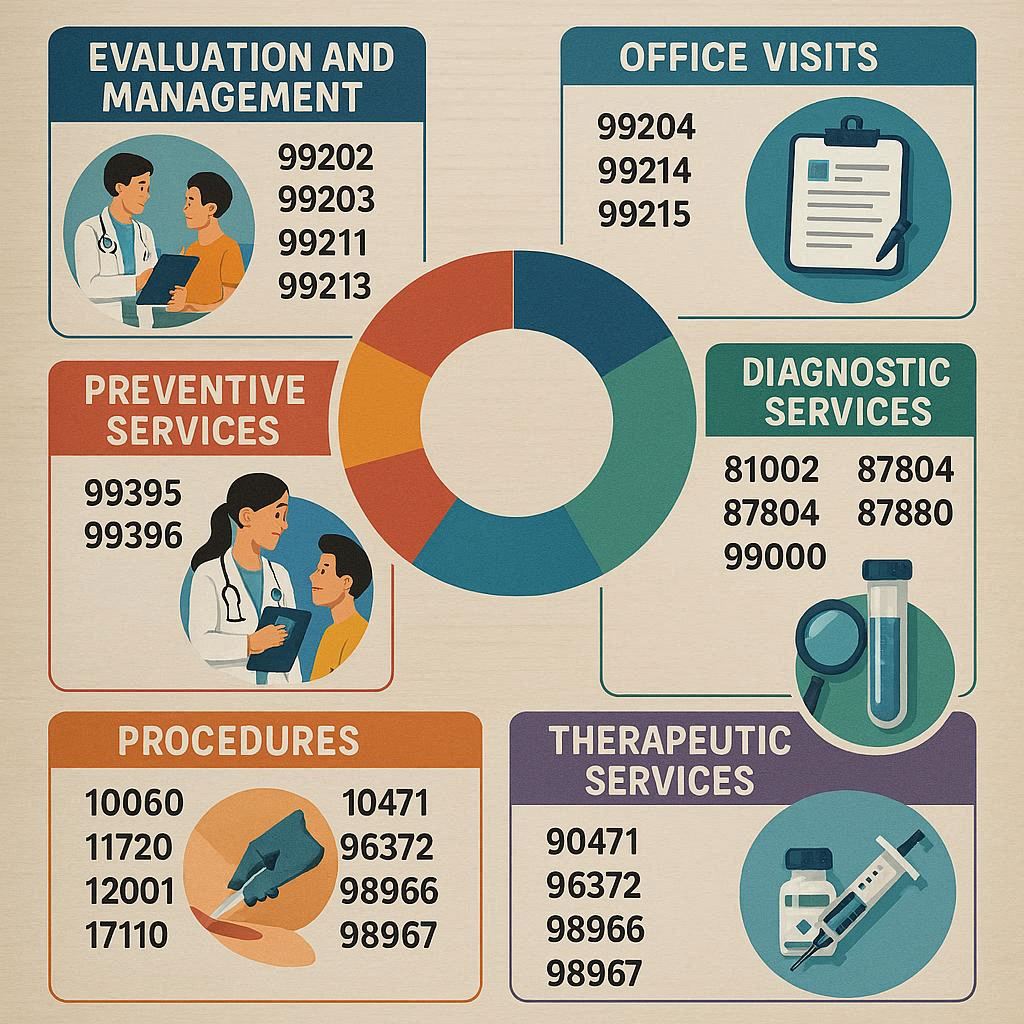
Let us build your core code set. These are the codes you will use every single week. Bookmark this list.
Office or Other Outpatient Visits (New Patient)
- 99202 – Straightforward MDM or 15-29 minutes
- 99203 – Low MDM or 30-44 minutes
- 99204 – Moderate MDM or 45-59 minutes
- 99205 – High MDM or 60-74 minutes
Office or Other Outpatient Visits (Established Patient)
- 99212 – Straightforward MDM or 10-19 minutes
- 99213 – Low MDM or 20-29 minutes
- 99214 – Moderate MDM or 30-39 minutes
- 99215 – High MDM or 40-54 minutes
Prolonged Services
When a visit goes beyond the typical time, use 99417 (each additional 15 minutes beyond the max time of 99205 or 99215). You can only use this with time-based coding, not MDM-based coding.
Preventive Medicine
Some patients come for sports physicals or work clearances. Do not use E/M codes for these. Use preventive codes instead.
- 99381-99387 – New patient preventive visit (by age range)
- 99391-99397 – Established patient preventive visit (by age range)
If a patient comes for a physical but also mentions a new sore throat, you may bill both the preventive code and an E/M code with modifier 25.
Procedure Codes for Minor Injuries and Lacerations
Urgent cares repair many cuts. Knowing the difference between simple, intermediate, and complex repairs is essential.
Laceration Repair Codes
Wound repair codes are based on the length of the wound and the complexity of the closure.
| Code | Type | Length | Examples |
|---|---|---|---|
| 12001-12007 | Simple repair | 2.5 cm or less to 30+ cm | Single-layer closure using adhesive strips or staples |
| 12031-12037 | Intermediate repair | 2.5 cm or less to 30+ cm | Layered closure of deeper tissues (subcutaneous) |
| 13131-13153 | Complex repair | 1.1 cm to over 30 cm | Requires scar revision, stents, or extensive debridement |
Simple repair (12001-12007): The wound is only in the skin (epidermis and dermis). You close it with one layer. Think small cuts closed with skin glue or simple sutures.
Intermediate repair (12031-12037): You close deeper layers like subcutaneous tissue. This requires more skill and time. Use this for wounds that need layered closure.
Complex repair (13131-13153): This involves debridement, complex undermining, or revision of scarred tissue. Rare in urgent care but happens with dog bites or crush injuries.
Nail Avulsion and Removal
Finger and toe nail injuries are urgent care staples.
- 11730 – Avulsion of nail plate, partial or complete, simple
- 11750 – Excision of nail and nail matrix (permanent removal)
Use 11730 for removing a damaged nail that will grow back. Use 11750 when you destroy the nail matrix so the nail never returns (often for ingrown nails).
Incision and Drainage (I&D)
Abscesses, boils, and paronychias need drainage.
- 10060 – I&D of simple or single abscess (skin or subcutaneous)
- 10061 – I&D of complicated or multiple abscesses
Do not use these codes for punctures or debridement. They are only for draining pus collections.
Splinting and Casting Codes
Many urgent cares apply splints. Fewer do full casts. Know when to use which codes.
Application of Splints
| Code | Description | Common Use |
|---|---|---|
| 29105 | Long arm splint | Forearm or wrist fracture |
| 29125 | Short arm splint | Wrist sprain, minor fracture |
| 29130 | Finger splint | Finger fracture or dislocation |
| 29505 | Long leg splint | Ankle or lower leg fracture |
| 29515 | Short leg splint | Ankle sprain or fracture |
Splints are temporary. You do not need to bill a separate supply code if you include the splint materials. But check your payer policies. Some want a supply code plus the application code.
Strapping and Taping
For simple sprains without fractures, use strapping codes.
- 29200 – Strapping of thorax (rib injuries)
- 29280 – Strapping of hand or finger
- 29540 – Strapping of ankle
These codes include the tape or elastic wrap. Do not add a separate supply code.
Respiratory and Chest Codes
Upper respiratory infections are the most common urgent care diagnosis. But sometimes you perform procedures.
Nebulizer Treatments
When a patient has wheezing or asthma symptoms, a nebulizer treatment is common.
- 94640 – Pressurized or nonpressurized inhalation treatment for acute airway obstruction
This code covers one treatment session. Document the start and stop time. Some payers want you to show that the patient could not use a metered-dose inhaler.
Oxygen Therapy
- 94760 – Noninvasive ear or pulse oximetry for oxygen saturation (single measurement)
- 94761 – Multiple or continuous oximetry (monitoring over time)
Use 94760 for a one-time reading. Use 94761 if the patient stays on a monitor for 15+ minutes.
Immunization Administration Codes
Urgent cares give many vaccines. Flu shots, tetanus boosters, and COVID-19 vaccines are common. Billing vaccines requires two parts: the vaccine product code and the administration code.
Vaccine Administration for 2026
| Patient Age | Route | Code |
|---|---|---|
| Under 8 years | Intramuscular (IM) or oral | 90460 (first component) + 90461 (each additional component) |
| Under 8 years | Intranasal or subcutaneous | 90473 (first component) + 90474 (each additional) |
| 8 years and older | Any route | 90471 (first vaccine) + 90472 (each additional) |
Example: A 7-year-old gets a flu shot (IM). You bill 90460 for the first component. No additional component code needed because influenza has only one antigen.
Example: A 9-year-old gets a tetanus booster. You bill 90471.
Common Vaccine Product Codes
- 90715 – Tdap (tetanus, diphtheria, pertussis) for ages 7+
- 90658 – Influenza virus vaccine (quadrivalent, IM)
- 90714 – Td (tetanus and diphtheria) for ages 7+
- 91304 – COVID-19 vaccine (2025-2026 formula)
Critical reminder: Never bill an E/M visit just to give a vaccine. The administration code includes the nursing time and counseling. Only add an E/M code if the provider treats a separate, significant problem.
Injections and Infusions
Urgent cares give antibiotics, steroids, and pain medications. The coding depends on the route and substance.
Therapeutic Injections
- 96372 – Intramuscular or subcutaneous injection of a therapeutic agent
This is your workhorse code. Use it for IM antibiotics (ceftriaxone), steroids (dexamethasone), and nausea meds (promethazine). You can bill this code once per injection site. If you give two IM injections in two different arms, you may use 96372 twice with modifier 59.
Do not use 96372 for: Vaccines (use 90471 or 90460), allergen immunotherapy (use 95115-95117), or local anesthesia for a procedure (bundled).
Intravenous (IV) Infusions
IV hydration and antibiotics are less common in urgent care but do happen.
- 96360 – IV infusion, hydration, first hour
- 96361 – Each additional hour of hydration
- 96365 – IV infusion, therapeutic (drug), first hour
- 96366 – Each additional hour of therapeutic infusion
Hydration codes (96360-96361) are for fluids only. Therapeutic codes (96365-96366) are for medications like IV antibiotics. You cannot bill both for the same hour.
EKGs and Cardiac Monitoring
Chest pain patients often get an EKG to rule out a heart attack.
- 93000 – Routine EKG with at least 12 leads, including interpretation and report
This code includes the tracing, the provider’s reading, and the written report. Do not also bill 93005 (tracing only) or 93010 (interpretation only).
If your urgent care uses a handheld device (like a Kardia or similar), you may need a different code. Check with your payer. Many accept 93000 for any FDA-cleared device that produces a standard 12-lead tracing.
Urgent Care Coding Scenarios (Real-Life Examples)
Let us walk through common patient visits. Each scenario shows the correct CPT codes and why.
Scenario 1: Ear Infection in a 4-Year-Old
Visit: Parent brings child for fever and ear pain. Provider examines ears, confirms acute otitis media. Prescribes oral antibiotics. No procedure performed.
Coding:
- 99213 (Established patient, low MDM) – Problem is low severity. Data is minimal. Risk is low.
Why not 99214? No prescription drug management as a controlled substance or high-risk medication. No advanced imaging. No significant social determinants discussion.
Scenario 2: Stitches on a Forearm
Visit: Adult with 3 cm cut on forearm. Provider cleans wound, injects lidocaine, and closes with 4 sutures in two layers (deep and superficial).
Coding:
- 12032 – Intermediate repair, 2.6 cm to 7.5 cm
- 99213 – E/M for the rest of the visit (history, exam, MDM about tetanus and infection)
Modifier needed: Append modifier 25 to 99213 to show the E/M was separate and significant from the procedure.
Important note: The local anesthesia (lidocaine) is bundled into the repair code. Do not bill 96372 for the lidocaine injection.
Scenario 3: Sore Throat and Strep Test
Visit: Teen with sore throat. Provider does a rapid strep test (in-house). It is positive. Provider prescribes amoxicillin.
Coding:
- 99213 – Low MDM (one test, prescription drug)
- 87081 – Strep test (throat culture, screening)
Note: Do not use 87880 (immunoassay for strep) unless your test kit specifically matches that code. Check your test manufacturer’s guidance.
Scenario 4: Flu Shot Only
Visit: Adult walks in, no appointment. Only wants a flu shot. Nurse gives injection. No doctor visit.
Coding:
- 90471 – Vaccine administration for age 8+
- 90658 – Influenza vaccine product
Do not bill: Any E/M code. No provider visit occurred.
Scenario 5: Sprained Ankle with Splint
Visit: Patient twisted ankle. X-ray negative. Provider applies a short leg splint, gives crutch training, prescribes ibuprofen.
Coding:
- 99214 – Moderate MDM (sprain diagnosis, prescription drug, splint application)
- 29515 – Application of short leg splint
- Modifier 25 on 99214
Why 99214? The provider interpreted the X-ray (if read onsite), prescribed a drug, and applied a splint. That meets moderate risk criteria.
Modifiers That Save Your Urgent Care Claims
Modifiers are two-digit codes that tell payers, “This visit has a special circumstance.” Use them wrong, and your claim denies. Use them right, and you get paid fairly.
Modifier 25 (Significant, Separately Identifiable E/M Service)
This is your most important modifier. Append it to the E/M code when you do a procedure on the same day.
Rule: The E/M service must be above and beyond the usual pre- and post-procedure work.
Good use: Patient comes for cough (E/M) and also gets a laceration repaired (procedure). The E/M is separate.
Bad use: Patient comes only for a laceration repair. You still try to bill an E/M with modifier 25. This is incorrect. The procedure includes the simple history and exam.
Modifier 59 (Distinct Procedural Service)
Use modifier 59 when you perform two procedures that usually bundle together, but they happen on different sites or at different times.
Example: You drain an abscess on the left arm (10060) and on the right leg (another 10060). Append modifier 59 to the second 10060.
Modifier 95 (Synchronous Telemedicine)
If your urgent care does video visits, append modifier 95 to the E/M code. This tells the payer the service happened in real-time video.
Modifier -RT and -LT (Right and Left)
Use these for bilateral procedures or injections. They help payers understand you treated both sides.
Example: Patient gets injection for tennis elbow in both arms. Bill 96372-RT and 96372-LT.
Documentation Requirements for Urgent Care
You cannot code what you cannot read. Clear documentation protects you during audits and makes coding faster.
Critical Elements for E/M Coding (MDM Method)
Your provider’s note must show:
- Problem(s): List all issues addressed. Note if a problem is stable, worsening, or new.
- Data reviewed and ordered: Labs, imaging, old records. Number each item.
- Risk: Any prescription drugs, procedures ordered, or social determinants discussed.
Elements for Procedure Coding
For laceration repair, the note must include:
- Wound location (e.g., left forearm)
- Length in centimeters
- Depth (skin only vs. subcutaneous vs. deeper)
- Closure type (sutures, staples, adhesive)
- Number of layers
- Any debridement or complication
For injections, document:
- Medication name and dose
- Route (IM, subQ, IV)
- Anatomical site (deltoid, vastus lateralis)
- Signature of person giving the injection (nurse or provider)
Payer-Specific Policies for 2026
Not all insurers follow the same rules. Here are common variations.
Medicare and Urgent Care
Medicare recognizes urgent care centers as outpatient settings. You can bill regular E/M codes (99202-99215). However, Medicare does not pay for most preventive visits in urgent care. Direct patients to their primary care for annual wellness visits.
Medicare Part B vaccines: Flu, pneumococcal, hepatitis B, and COVID-19 vaccines have no deductible and no copay. Bill the administration code based on patient age (90471 or 90460).
Commercial Insurers (UnitedHealthcare, Cigna, Aetna, BCBS)
Most follow the CPT guidelines. However, some have specific lists of codes they consider “non-urgent.” For example, billing a level 5 E/M (99205 or 99215) in urgent care may trigger a review. Be ready to justify the high level of service.
Workers’ Compensation
Work comp has unique rules. Many states require you to use specific injury codes and may not accept modifier 25 for the same visit. Check your state’s fee schedule. Always document the exact mechanism of injury (e.g., “fell from ladder at construction site”).
Common Urgent Care Coding Mistakes
Avoid these errors. They cause denials and lost revenue.
Mistake 1: Overcoding the E/M Level
Just because the patient has a serious diagnosis does not automatically mean a level 5 code. Look at the MDM table. A broken arm with splinting is often moderate risk (99214), not high risk.
Mistake 2: Forgetting Modifier 25
You perform a procedure. You also perform a separate E/M. If you forget modifier 25 on the E/M code, the payer may bundle both into the procedure payment. You lose the E/M fee.
Mistake 3: Using 96372 for Vaccines
This is a major compliance risk. Vaccines have their own administration codes. Using 96372 for a flu shot is incorrect coding and can trigger audits.
Mistake 4: Billing a Separate Supply Fee for Splints
Most splint application codes include the materials. Do not add an HCPCS supply code like A4575 unless the payer explicitly allows it. Many will deny the supply as bundled.
The Future of Urgent Care Coding
Coding rules evolve. Here is what to watch in coming years.
AI-Assisted Coding
More revenue cycle vendors offer AI that reads notes and suggests codes. These tools are helpful but not perfect. Always review AI suggestions. A human coder catches the nuance that AI misses.
Expanded Telemedicine Parity
Telehealth urgent care visits remain popular. Many payers extended virtual visit coverage through 2026. Use modifier 95 and expect similar reimbursement to in-person visits.
Value-Based Bundles
Some markets experiment with flat fees for urgent care visits (e.g., $150 for any level 3 or 4 visit). In these models, you still code for data tracking, but payment does not vary by level. If your center joins such a plan, your coding focuses on accuracy, not maximizing revenue.
Quick Reference Table: Top 20 CPT Urgent Care Codes
| CPT Code | Description | When to Use |
|---|---|---|
| 99213 | Established patient, low MDM | Most simple sick visits |
| 99214 | Established patient, moderate MDM | Sprains, minor procedures, prescription drugs |
| 99203 | New patient, low MDM | First visit for simple illness |
| 99204 | New patient, moderate MDM | First visit for fracture or complex issue |
| 12031 | Intermediate repair, ≤2.5 cm | Layered closure of small deep cut |
| 12032 | Intermediate repair, 2.6-7.5 cm | Typical laceration requiring sutures |
| 10060 | I&D simple abscess | One boil without complication |
| 29125 | Short arm splint | Wrist sprain or buckle fracture |
| 29515 | Short leg splint | Ankle sprain or stable fracture |
| 96372 | IM or subQ injection | Antibiotic or steroid shot |
| 94640 | Nebulizer treatment | Asthma exacerbation |
| 93000 | Routine EKG with report | Chest pain evaluation |
| 90471 | Vaccine admin, age 8+ | Flu, Tdap, COVID for older patients |
| 90460 | Vaccine admin, under 8 | First component of pediatric vaccine |
| 90715 | Tdap vaccine product | Tetanus booster for age 7+ |
| 87081 | Strep test screen | Sore throat with rapid test |
| 11730 | Nail avulsion | Removing bruised or damaged nail |
| 29200 | Thorax strapping | Rib injury without fracture |
| 99417 | Prolonged service | Extended visit beyond max time |
| 96361 | Additional hour hydration | IV fluids beyond first hour |
Important Notes for Readers
- Always verify payer policies. This guide reflects general CPT rules. Individual insurers may have different requirements.
- Local coverage determinations (LCDs) matter. Some Medicare regions limit which codes they pay for in urgent care settings.
- Do not copy this guide into your billing software without updates. CPT codes change annually. Always reference the current year’s CPT manual.
- When in doubt, query the provider. A two-minute conversation can clarify whether a repair was simple or intermediate.
- Keep a coding cheat sheet at your desk. The table above works well printed and laminated.
Conclusion
Mastering CPT urgent care codes comes down to three core ideas. First, choose your E/M level based on medical decision making or time, not on habit. Second, match procedure codes to the exact work performed, including wound length and closure type. Third, use modifiers like 25 correctly to separate E/M services from procedures. Keep this guide handy, review payer policies regularly, and always document clearly. Your accuracy directly improves your center’s revenue and compliance.
Frequently Asked Questions (FAQ)
1. Can I bill an E/M code for every patient who gets a vaccine?
No. Only bill an E/M code if the provider treats a separate, significant problem. A vaccine-only visit uses only the administration and product codes.
2. What is the most common CPT code used in urgent care?
99213 (established patient, low MDM) is the most common. It fits the majority of simple sore throats, ear infections, and coughs.
3. How do I code a visit that includes both a strep test and a prescription?
That is usually 99213 (low MDM). The strep test is one data point. The prescription adds low risk. Do not use 99214 unless there is higher risk or more data.
4. Can urgent cares bill for X-ray interpretation?
Yes, if your provider reads the X-ray and documents the interpretation. Use the appropriate radiology code (e.g., 73630 for ankle X-ray). Do not split the interpretation into a separate E/M service.
5. What modifier do I add to an E/M code when I also perform a laceration repair?
Use modifier 25 on the E/M code. This tells the payer the E/M was separate from the procedure.
6. Are there different codes for COVID-19 vaccine administration in 2026?
No. Use standard administration codes (90460 for young children, 90471 for older patients). The product code changed to 91304 for the 2025-2026 formula.
7. How do I bill a telephone or video visit?
For video visits with real-time audio and visual, use regular E/M codes plus modifier 95. For telephone-only (audio-only), use 99441-99443 depending on time.
8. What happens if I use the wrong level of E/M code?
Payers may downcode to the level they think is correct, leading to lower payment. Frequent errors can trigger an audit. Always be accurate, not ambitious.
9. Can a nurse bill a separate code for giving a injection?
No. All services bill under the supervising provider’s NPI. The provider who orders the injection is responsible for the code.
10. Where can I find official updates to CPT codes?
The American Medical Association (AMA) publishes the official CPT manual each fall for the next year. Your billing software should also update annually.
Additional Resource
For the most current official guidelines and coding changes, visit the American Medical Association (AMA) CPT Network:
https://www.ama-assn.org/cpt