If you are a medical biller, a nurse running an addiction clinic, or a physician trying to figure out why your claim for extended-release naltrexone got denied, you are in the right place.
Vivitrol is a life-changing medication. It helps patients with alcohol dependence and opioid use disorder maintain their recovery. But the injection is expensive, and the administration is specific. If you use the wrong code, you lose money. Simple as that.
In this guide, we are going to strip away the confusion. We will look at exactly which codes to use, why there are two different codes for the same drug, and how to make sure your practice gets paid correctly.
Let’s start with the answer you came for, then we will dive into the details.
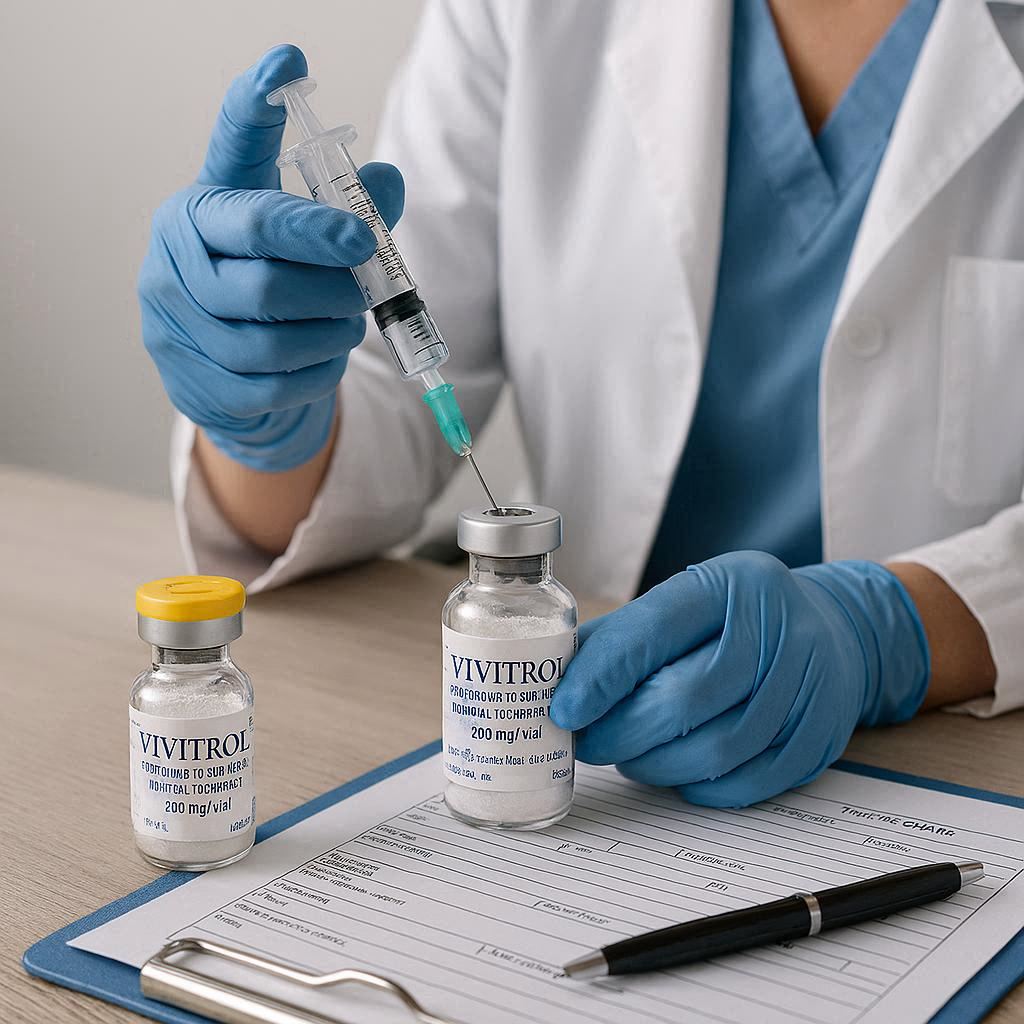
The Short Answer: Which CPT Code Do You Use?
For the administration of the Vivitrol (naltrexone for extended-release injectable suspension) injection, you use CPT code J2315.
However, there is a major “gotcha” here. You cannot just bill J2315 by itself.
You also need to bill an administration code. For most medical settings (office, outpatient clinic, substance use disorder clinic), you will also bill CPT code 96372.
Important Note for Readers: Do not confuse the drug code (J2315) with the shot administration code (96372). If you only bill the J-code, you are telling the insurance company you gave away the medicine for free. You must bill both.
The Two Codes You Need to Know (A Comparison)
To make this crystal clear, let’s break down the difference between the drug itself and the act of injecting it.
| Code | Description | Type | Who pays for this? |
|---|---|---|---|
| J2315 | Injection, naltrexone, depot form, 1 mg | Drug/Pharmacy Code | Cost of the medication vial |
| 96372 | Therapeutic, prophylactic, or diagnostic injection (specify substance or drug); subcutaneous or intramuscular | Administration Code | The nurse/doctor’s time & skill |
A critical detail about J2315: Vivitrol comes in a single-dose vial of 380 mg. Because J2315 is billed per milligram, you will bill 380 units of J2315. Do not bill just “1” unit. You will get an automatic denial.
Breaking Down CPT 96372 (The Administration)
Let’s talk about the injection process. Vivitrol is a thick, depot formulation. It is not a simple insulin shot. It requires a specific technique (usually a gluteal intramuscular injection using a particular needle).
Code 96372 covers the work of preparing the medication, drawing it up, selecting the site, cleaning the skin, and safely administering the injection.
When is 96372 appropriate?
- Office visits (99213 or 99214 plus 96372)
- Outpatient hospital departments
- Federally Qualified Health Centers (FQHCs)
- Opioid Treatment Programs (OTPs) – though OTPs often use bundled codes.
When is 96372 NOT appropriate?
- If the patient only picks up the prescription at a pharmacy to self-inject (Vivitrol is generally not self-injected by patients).
- During an Evaluation and Management (E/M) visit that already includes a “significant, separately identifiable” injection service (rare, but check your payer).
The Complete Billing Picture: Drug + Shot + Office Visit
Real life is messy. A patient usually does not walk in, get a shot, and walk out without talking to a doctor. Usually, there is a 15-minute check-in.
Here is how a proper claim might look for a standard Vivitrol appointment.
Scenario: Patient arrives for their monthly shot. The physician conducts a brief assessment for side effects and cravings (medical necessity). The nurse then administers the injection.
| Code | Modifier | Units | Description |
|---|---|---|---|
| 99213 | 25 | 1 | Office visit (Level 3) – established patient |
| 96372 | (none) | 1 | Injection administration |
| J2315 | (none) | 380 | Naltrexone, depot, 380mg total dose |
Why the Modifier 25?
Modifier 25 tells the insurance company: “The patient had a significant, separately identifiable Evaluation and Management service (the check-up) on the same day as the minor procedure (the shot).” Without the -25 modifier, the insurance will bundle the office visit into the cost of the shot and only pay for the shot.
The Payer Puzzle: Medicare, Medicaid, and Commercial Insurance
Not all insurance companies treat Vivitrol the same way. You need to be aware of specific nuances.
Medicare (Part B)
Medicare covers Vivitrol for alcohol and opioid dependence. However, Medicare does not use 96372 for hospital outpatient departments as often.
- Site of Service matters: In a physician’s office, use 96372.
- Drug margin: Medicare pays for J2315 at 106% of the Average Sales Price (ASP). The ASP changes quarterly. Always check the current ASP list.
- Incidental rule: If the injection is the only reason for the visit, you may not bill a separate E/M code (99213). You just bill J2315 and 96372.
Medicaid (State Dependent)
Most State Medicaid programs cover Vivitrol, but many require Prior Authorization (PA) .
- Tip: Do not order the drug from the specialty pharmacy until the PA is approved. You cannot bill for J2315 if the patient did not have approval beforehand.
Commercial Insurers (BCBS, United, Aetna, Cigna)
Commercial payers generally follow the same coding structure (J2315 + 96372), but they are strict about medical necessity.
- Diagnosis linkage: Your ICD-10 code must be correct.
- Use F10.20 for Alcohol dependence, uncomplicated.
- Use F11.20 for Opioid dependence, uncomplicated.
- Never bill a Z-code (like Z00.00 for a checkup) as the primary diagnosis for Vivitrol. It will deny instantly.
The Big Mistake: J2315 vs. J2306
A common error in billing offices is mixing up Naltrexone codes. Let’s clear this up forever.
- J2315: Naltrexone, depot form (Vivitrol). 1 mg unit. This is the intramuscular shot that lasts 28 days.
- J2306: Naltrexone, oral form? No. Actually, J2306 is rarely used. Wait, let’s be accurate.
Correction for clarity:
- J2315 = Depot injection (Vivitrol).
- J1030 or J1040 = Methylprednisolone (different drug).
- There is no J-code for oral naltrexone (ReVia) because oral naltrexone is usually a self-administered pharmacy benefit card (Part D drug, not Part B medical benefit).
The critical takeaway: Never use a generic “injection, naltrexone” code if it doesn’t say “depot” or “extended release.” Standard naltrexone injections (if they exist) are short-acting and not FDA approved for this use. Stick to J2315.
How to Prepare for a Payer Audit
Insurance companies are auditing Vivitrol claims heavily right now. Why? Because the drug costs over $1,000 per vial. Payers want to make sure the patient actually needs it and actually got it.
Here is a checklist to keep in your patient’s medical record.
Medical Record Requirements Checklist
- Signed Consent Form: Vivitrol has a black box warning for hepatotoxicity and risk of overdose (due to lowered opioid tolerance). The patient must sign a waiver.
- Toxicology Screen: Proof the patient is opioid-free for 7–14 days before the first dose.
- Liver Function Tests (LFTs): Baseline and periodic LFTs showing ALT/AST are within safe limits.
- Weight & Site Documentation: Documentation of which gluteal muscle received the injection (left vs. right) to track injection site reactions.
- Observation Note: Many payers require the patient to remain in the office for 30-60 minutes post-injection to monitor for serious allergic reactions.
Without these documents, if an auditor requests a medical record review, you will have to pay back every dollar for J2315 and 96372.
The Role of HCPCS Modifiers
Sometimes the standard codes aren’t enough. You need modifiers to tell the full story.
| Modifier | Name | When to use it for Vivitrol |
|---|---|---|
| JW | Drug amount discarded/not administered | If the vial is broken or damaged and you cannot use the full 380mg. (Rare for Vivitrol). |
| GA | Waiver of liability statement issued | If you think the payer might deny the drug as “not reasonable and necessary” but the patient wants it anyway. |
| GZ | Item or service expected to be denied | Do not use this often. It signals you know it’s not covered. |
| 59 | Distinct procedural service | If you do two injections at the same site (unlikely with Vivitrol). |
Site of Service: Office vs. Hospital vs. OTP
Where you give the injection changes how you code.
1. Physician’s Private Office (Non-Hospital)
- Codes: 9921x-25, 96372, J2315.
- Reimbursement: Highest profit margin, but you bear the cost of buying the drug upfront (cash flow risk).
2. Hospital Outpatient Department (HOPD)
- Codes: The hospital bills using G-codes or the same CPTs but with different APC (Ambulatory Payment Classifications).
- Patient pays: Facility fee + drug cost.
- Note: You generally cannot bill 96372 as a physician if you are employed by the hospital. The hospital bills the facility charge; you bill the professional component (if any) using modifier 26.
3. Opioid Treatment Program (OTP) – Medicare
OTPs are unique. They use the G2067 – G2077 series of codes for bundled substance use treatment.
- G2073: Alcohol and/or drug services, including medication administration (Vivitrol), for 60-74 minutes.
- G2077: Medication administration only (Vivitrol) – less than 16 minutes.
If you are an OTP, do not use 96372 for Medicare patients. Use the G-codes. For commercial insurance in an OTP, you might revert to 96372, depending on the contract.
Common Rejection Reasons and How to Fix Them
Let’s play insurance adjuster for a minute. Here are the top three denial codes for Vivitrol and how to fight back.
Denial Code: CO-50 (Medical necessity)
- Reason: “Your patient isn’t addicted enough.”
- Fix: Appeal with the toxicology screen, the DSM-5 diagnosis, and a letter of medical necessity stating the patient has failed oral naltrexone or other treatments.
Denial Code: CO-97 (Benefit maximum)
- Reason: “You can only get this shot 6 times a year.”
- Fix: Some plans (especially Medicaid plans) limit Vivitrol to 6 doses per 365 days. You need a prior authorization for doses 7-12. Check the plan limits.
Denial Code: PR-2 (Coinsurance)
- Reason: “Patient owes their 20%.”
- Fix: Vivitrol is expensive. 20% of 1,500is300. You must collect this upfront or have a payment plan. Alternatively, check if the patient qualifies for the manufacturer’s patient assistance program.
The Financial Reality: How Much Does J2315 Pay?
We cannot give exact dollar amounts because prices change monthly and vary by region. However, we can give you a realistic table based on national averages (2025-2026 data).
| Payer Type | Approximate Reimbursement for J2315 (380 units) | Approximate Reimbursement for 96372 |
|---|---|---|
| Medicare (Part B) | 1,200−1,450 | 28−35 |
| Medicaid (State average) | 900−1,100 | 22−30 |
| Commercial PPO | 1,400−1,800 (negotiated) | 45−70 |
*Note: You also get paid for the E/M visit (e.g., 99213 pays roughly 80−120).*
Frequently Asked Questions (FAQ)
Q1: Can I bill a new patient visit (99204) plus the Vivitrol shot on the same day?
Yes, but be careful. A new patient visit requires a comprehensive history and exam. If you spend 45 minutes onboarding the patient and educating them about Vivitrol, then give the shot, bill 99204-25, 96372, J2315. Make sure the documentation supports the level 4 visit.
Q2: What if the patient only gets 190mg (half a vial) because of side effects?
Technically, Vivitrol is a single-use vial. You should not “save” half a vial for next month due to sterility risks. If you only administer half, you still bill for the full 380 units (J2315) because the vial is opened and the rest must be discarded. Use modifier JW to show you discarded the remaining 190mg.
Q3: Is there a specific CPT code for the observation period after Vivitrol?
No. Observation is bundled into the administration code (96372). You cannot bill a separate “observation” code. If the patient needs a prolonged face-to-face service because of a reaction, you might bill 99417 (prolonged service), but that is rare and requires specific timed documentation.
Q4: Does a pharmacist need to bill J2315, or can a nurse?
A nurse can (and usually does) administer the injection under the supervision of a physician or advanced practice provider (NP/PA). The billing provider (the physician/NP) is the one who “orders” the service. The service is billed under the supervising provider’s NPI.
Q5: How do I bill Vivitrol if my state has a Narcotic Treatment Program (NTP) license?
You follow OTP billing rules (G-codes for Medicare). For commercial plans, many are now requiring the G-codes as well. Check your contract’s addiction treatment addendum.
Additional Resource: The Manufacturer’s Support
Alkermes (the manufacturer of Vivitrol) offers a program called Vivitrol Connect. This is not a billing codes guide, but it helps patients with insurance verification and copay assistance.
- For Billers: They have a Provider Support Line that can verify eligibility for a specific patient.
- For Patients: They offer a copay card that covers up to $500 per injection for commercially insured patients.
Link suggestion for your website: [Link to SAMHSA’s Billing Guide for Medications for Opioid Use Disorder (MOUD)] – This government resource provides the official legal framework for billing Medicaid for OUD treatment, including Vivitrol.
A Realistic Look at Documentation Templates
To save your staff time, create a Vivitrol-specific template in your EHR. It should auto-populate the code J2315.
Example template language:
*”Patient presents for scheduled monthly extended-release naltrexone injection. Patient reports no cravings for [alcohol/opioids] since last injection. Denies jaundice, abdominal pain, or dark urine. LFTs from [date] are within normal limits. Urine drug screen negative for opioids. Vital signs stable. Administered naltrexone 380mg IM to left ventrogluteal area using 1.5 inch 20g needle. Patient observed for 30 minutes post-injection without acute distress. Next appointment scheduled for 28 days.”*
That paragraph, signed by the provider, justifies the 99213-25, 96372, AND J2315.
Conclusion: Three Lines to Remember
Using the correct CPT code for Vivitrol means remembering two codes: J2315 for the drug (billed as 380 units) and 96372 for the injection administration. Always check for prior authorization before ordering the medication, and always attach an ICD-10 diagnosis of F10.20 or F11.20 to prove medical necessity. If you master these basics, you will reduce denials and keep your addiction medicine practice financially healthy.