Are you drawn to healthcare but crave direct, hands-on patient interaction? Do you value work-life balance and a stable income? The dental hygienist career path offers a compelling blend of science, artistry, and personal connection.
This isn’t just a job. It is a profession where you become a clinician, an educator, and a detective of oral disease. You spend your days not just cleaning teeth, but potentially saving lives. The link between oral health and systemic conditions like heart disease and diabetes makes your role critical.
But what does the journey actually look like? How long does it take? What are the real daily challenges? This guide cuts through the fluff. We will walk you through every single stage, from the first prerequisite class to the pinnacle of your career. We will discuss the financial reality, the physical demands, and the surprising opportunities that await beyond the dental chair.
Let’s map out your future in dental hygiene.
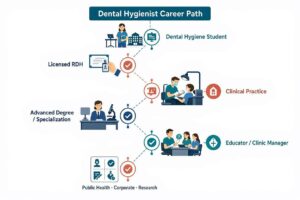
Dental Hygienist Career Path
What Exactly Does a Dental Hygienist Do?
Before mapping the route, we must define the destination. Many people picture a hygienist as the person who “scrapes teeth.” That description sells the profession dramatically short. You are a licensed prevention specialist. Your license allows you to perform critical therapeutic and diagnostic tasks that the dentist relies on.
Core Clinical Responsibilities
Your hands are your primary tools. You use ultrasonic scalers, hand curettes, and airflow polishers. Your goal isn’t just cosmetic shine. You remove hard and soft bacterial deposits from below the gum line. This process, called debridement, stops the inflammatory process that destroys bone. You are literally saving the foundation of the teeth.
The Role of the Medical Detective
You spend more time with the patient than the dentist usually does. This makes you the first line of defense. You screen for oral cancer by checking the tongue, cheeks, and throat. You spot suspicious lesions. You take blood pressure readings and review medical histories. You connect the dots between a patient’s diabetes and their bleeding gums. Dentists trust your comprehensive periodontal charting to create a diagnosis.
The Educator and Coach
This is the most underrated part of the dental hygienist career path. You cannot force a patient to floss. But you can translate complex scientific jargon into a motivating reality. You teach a pregnant mother about how hormones affect her gums. You show a teenager the decay caused by constant snacking. You coach a heart patient on the importance of inflammation control. When a patient returns with healthier gums, that is your victory.
Step 1: The Foundation—High School and Prerequisites
Your journey starts long before hygiene school. It starts with a strategic decision in high school or early adulthood. If you know this is your path, load your schedule with heavy science courses. Biology and chemistry are non-negotiable. Anatomy and physiology give you a massive head start.
Psychology is an overlooked but brilliant choice. You will deal with anxious, phobic people every single day. Understanding the human psyche helps you calm a terrified patient.
College Prerequisites: The Gateway Hurdle
Dental hygiene programs are competitive. You don’t just sign up; you have to earn your seat. Most accredited programs require a cluster of college-level prerequisite courses with a high Grade Point Average (GPA). The typical required GPA floats around a 2.8 to 3.0 minimum, but the actual acceptance average is usually much higher (3.5+).
You must complete courses like:
-
Human Anatomy & Physiology (I and II)
-
General Chemistry
-
Microbiology
-
English Composition
-
Introductory Psychology
-
Sociology
Important Note: Do not underestimate these classes. Admissions committees view A’s in Anatomy and Microbiology as proof you can handle the rigorous curriculum of the dental sciences.
The Observation Requirement
Most schools demand proof that you know what you are signing up for. They require documentation of observation hours. Shadow a dental hygienist for a day. Watch the pace. Notice the ergonomics. Listen to the sounds. This step confirms your stomach can handle the clinical sights and sounds before you invest thousands in tuition.
Step 2: Selecting the Right Educational Degree
Here comes the first major fork in the road. The dental hygienist career path is not a one-size-fits-all degree track. You have choices. Your decision shapes your future job prospects, your salary ceiling, and your ability to leave clinical practice later.
The Associate Degree in Dental Hygiene (AS)
This is the most common and fastest route to the chair. Offered by community colleges and technical schools, it usually takes 20 to 24 months after prerequisites.
-
The Advantage: Cost-effectiveness and speed. You enter the workforce fast with minimal debt.
-
The Curriculum: A dense package of lectures on head and neck anatomy, dental materials, periodontology, and local anesthesia. The afternoon is spent in a supervised clinic treating the public.
-
The Limitation: If you ever dream of teaching, working in public health program management, or pursuing a master’s degree, this is not your terminal stop.
The Bachelor’s Degree in Dental Hygiene (BSDH)
A four-year university program. Many people complete an associate degree first, pass the board, and enter a “degree completion” bridge program. This is a popular strategic move: you earn money as an RDH while finishing your bachelor’s online or part-time.
-
The Advantage: Doors open. Corporations like Procter & Gamble hire BSDH holders for product research. Government agencies hire you for community coordinator roles. You can teach in accredited hygiene programs.
-
The Content: Beyond the clinical skills, you study research methodology, evidence-based decision-making, public health policy, and advanced education concepts.
The Master’s Degree (MSDH)
This degree moves you entirely away from the operatory for most careers. It focuses on education, administration, and research.
-
Career Outcomes: Program director at a dental hygiene school, public health administrator, pharmaceutical sales specialist, or doctoral candidate.
-
Reality Check: An MS is rarely a “raise” in a private practice. A dentist pays for clinical production, not academic letters. Pursue this degree if you want out of clinical hygiene or wish to teach as a primary income.
A Comparative Look at Degree Options
Choosing your degree path is the most critical structural decision of your career. The following table distills the key differences into a clear, visual guide to help you align your education with your long-term life goals.
| Degree Type | Typical Duration | Best For… | Long-Term Career Ceiling |
|---|---|---|---|
| Associate (AS) | 20-24 months | Rapid workforce entry with low tuition costs. | Clinical practice only; limited advancement to corporate or academic roles. |
| Bachelor’s (BSDH) | 4 years (or AS + 2) | Aspiring public health workers, educators, and corporate consultants. | Mid-level management, sales, marketing, and entry-level teaching. |
| Master’s (MSDH) | 1-2 years (post-BS) | Future program directors, researchers, and high-level administrators. | Leadership in education, policy making, and large-scale program direction. |
Note: Graduates from all three degree levels take the same national board exam for initial licensure. An AS holder and an MS holder are equally qualified to clean teeth on their first day of clinical work.
Step 3: Inside the Hygiene School Gauntlet
Everyone talks about the prerequisites. Few tell you the truth about the experience once you get in. It is transformative and grueling. You are not just a student; you are training to handle a motor-skilled procedure inside a dark, wet, and sensitive space.
Didactic Pain: The Science Explosion
The first two semesters hit hard. You will memorize the origin and insertion of every muscle in the face and neck. You will know the cranial nerves by number, function, and consequence of damage. Pharmacology teaches you that the patient’s Lisinopril is causing their gingival overgrowth. Histology forces you to see oral tissue through a microscope. This is a heavy science curriculum compressed into a short window.
The Psychomotor Grind
Working on a typodont (a plastic dummy mouth) is deceptive. It is easy. Then you recruit a classmate as your first “patient.”
Your fingers cramp. You can’t find the fulcrum point. The mouth mirror fogs instantly. You are blinded by your own hand blocking the light. This phase is humiliating. But by hour 50, something clicks. Your brain stops trying to control your ring finger independently. Instrumentation becomes an extension of your touch, not a battle with fine motor skills.
The Hunt for Clinical Boards
This is the single greatest stressor of the final year. National Board Dental Hygiene Examination (NBDHE) is the written test. The clinical board exam is different. You must find a patient who meets specific calculus (tartar) requirements. The deposit must be heavy enough to demonstrate your skill but the patient must be reliable. Many students lose sleep and savings offering free cleanings to strangers just hoping they qualify as a board patient. It is a rite of passage that tests your grit more than your scaling ability.
“Hygiene school doesn’t just teach you how to clean teeth. It teaches you time management, resilience, and how to perform under impossible scrutiny.”
Step 4: The Licensing Gateway
You graduated. Can you work? No. You need a license. Each state has a distinct legal requirement, but the core components are universal.
National Board Dental Hygiene Examination (NBDHE)
A computerized test administered by the Joint Commission on National Dental Examinations. It is a marathon of a test covering basic sciences, clinical hygiene, and community health. You must pass this to even think about applying for a state license.
Regional or State Clinical Exams
This is the manual skills test. The five regional testing agencies (CDCA, WREB, CRDTS, SRTA, CITA) or specific state boards evaluate you on a live patient. The examiners check for tissue trauma, calculus removal, and infection control breaches. You pay a significant fee for the privilege.
The Jurisprudence and Anesthesia Trap
Many states require a law exam (jurisprudence) on the state dental practice act. Breaking a rule of sterilization or delegation can suspend your license, so you must know the law.
Additionally, local anesthesia and nitrous oxide sedation are often licensed separately. If your school didn’t cover the exact hours required by your state, you must take a board-approved continuing education course to inject legally.
Step 5: Entering the Workforce—Finding Your Niche
You hold a license. Now, the real “career path” begins to branch. The traditional image is a single doctor’s private practice, but the landscape is far more varied.
Private General Practice (The Baseline)
Most hygienists start here. A solo or group family practice.
-
The Pace: Fast. You often work out of one column (one chair) with an assistant, or you run two columns (two rooms) with an assistant flipping rooms. You see a patient every 40 to 60 minutes.
-
The Skill Set: Breadth. You see children, elderly patients, deep pockets, and light stain. You become a jack-of-all-trades.
-
The Risk: Production pressure. In many offices, hygiene is the economic engine. You may feel pushed to shorten appointment times.
Periodontal Specialty Practice
You work for a gum specialist. Every patient has Stage III or IV periodontitis.
-
The Pace: Slow and meticulous. Appointments often last 90 minutes for quadrant scaling and root planing. You run surgical post-op visits.
-
The Skill: Highly advanced instrumentation, laser therapy, and reading CBCT scans.
-
The Pay: Significantly higher hourly rate than general practice, reflecting the complexity.
Pediatric Dentistry
You don’t treat small adults; you treat children. This is behavioral management disguised as dentistry.
-
The Mindset: An extrovert’s playground. You sing, you use non-verbal cues, you negotiate with toddlers.
-
The Pathology: Minimal deep cleaning. Heavy fluoride varnish, sealants, and orthodontic monitoring for eruption patterns.
Correctional Facilities and Public Health
You don’t do this for the money—the pay is usually lower. You do it for loan repayment programs or service.
-
The Reality: You see advanced disease. Years of neglect. You are providing pain relief and extraction follow-up care. The security protocols are strict; your instruments are counted like a surgical suite.
Licensure Portability and Mobility
Dental hygiene is historically a “state-locked” profession. Unlike a nursing license, which has a multistate compact, the RDH license is rigid. If you move from New York to Florida, you cannot simply endorse your license instantly. You must analyze a complex map of regional exams, jurisprudence tests, and sometimes additional clinical hours.
The table below breaks down the general pathways of licensure by credential, giving you a framework for understanding how portability works.
| Licensure Pathway | Who Uses It? | Process | Wait Time/Complexity |
|---|---|---|---|
| Direct Reciprocity | RDHs moving between states with identical regional exam acceptance. | Submit current license verification, proof of clinical hours, and pass the new state’s law exam. | Low to Moderate |
| Licensure by Credential | RDHs who have practiced clinically for a set number of years (often 3-5). | Provide employer verification and CE transcripts; sometimes a board interview. No retaking clinical exams. | Moderate |
| Retesting/Board Exam | RDHs from a region not accepted by the new state board. | Apply as a new graduate candidate; retake the live-patient regional clinical exam. | High and Expensive |
Important: Always check the receiving state’s Board of Dentistry website before moving. A “buyer beware” mentality saves you months of unemployment.
Continuing Education: The Price of a Living License
Your license isn’t a trophy; it’s a fire that needs constant fueling. Every state mandates Continuing Education (CE) units. 15 hours, 20 hours, 30 hours—it varies. But the concept is non-negotiable.
The CPR Mandate
Every two years, you renew a Basic Life Support (BLS) for Healthcare Providers card. If it lapses, your license is invalid. No excuses.
Substance Abuse and Ethics
Many states now require specific credits in opioid prescribing awareness, human trafficking identification, and professional ethics. You don’t just take fun clinical classes; you must fit in these mandatory “safety” courses.
Expanding Your Legal Scope
CE is how you grow your toolkit.
-
Laser Certification: This is a high-demand CE. A diode laser for bacterial reduction and sulcular debridement lets you market yourself as a cutting-edge provider.
-
Myofunctional Therapy: A growing niche for airway-focused providers. You help retrain tongue posture and breathing. This is often out-of-pocket for the patient and increases your production value.
-
Orofacial Myology: Overlapping with myofunctional therapy, this dives deep into the muscle dysfunction causing orthodontic relapse.
Career Ladder: From Probation to Mastery
Not all years of experience are equal. The dental hygienist career path follows a clear, observable ladder of clinical maturity and professional influence.
Stage 1: The Rookie (Years 0-2)
Residency is not required like in medicine, but this is your de facto residency. Your hands hurt. Your neck aches. You feel incredibly slow. You miss a speck of calculus on the mandibular linguals.
-
Mindset: Imposter syndrome hits hard. You feel like a fraud because patients look to you as an expert, but you just watched a YouTube video the night before on mesial-distal instrumentation on fused roots.
-
Focus: Speed will come with time. Prioritize accuracy. Develop a rigid routine of assessment. Learn to speak to patients without looking at the ceiling for answers.
Stage 2: The Competent Clinician (Years 3-7)
Your body has physically adapted. You can hold a conversation while scaling because the hand movements are subconscious. You “see” calculus on an X-ray instantly. You don’t just note a 6mm pocket; you feel the tenacious fibers of the junctional epithelium and know exactly where the root concavity is.
-
Economic Leverage: This is your first chance to negotiate a raise. You are not replaceable by a new grad. You have a patient following. You are profitable.
Stage 3: The Mentor Specialist (Years 8-15)
You stop counting the hours until lunch. You start mentoring the assistant who is thinking of hygiene school. You start looking at the practice’s accounts receivable and suggesting supply cost reductions.
-
Side Ventures: Many hygienists at this stage start independent consulting. You might train front desk staff on how to optimize the hygiene schedule to prevent burnout.
Stage 4: The Exit Architect (Years 16+)
The body speaks loudly. Neck flexion, carpal tunnel syndrome, and hearing loss (from the high-pitched ultrasonic whistles) become daily realities. You cannot scale 8 patients a day forever. You pivot hard into teaching, dental sales, insurance reviewing, or writing. This is the stage where having a bachelor’s degree is a life raft.
The Ergonomics of Survival
We cannot discuss a 20-year career without talking about the body. Musculoskeletal disorders are the number one reason hygienists leave clinical practice prematurely. Loupes (magnification glasses) are not a luxury accessory; they are safety equipment.
Loupe Selection
-
Through-The-Lens (TTL): Custom-built to your pupillary distance and working length. You cannot tilt your head; you must sit with perfect posture. This is the gold standard.
-
Flip-Up Loupes: More adjustable, easier to share, but they are heavy on the nose and can pull your head into a forward tilt.
Ergonomic Saddles and Stools
A static flat chair ruins your lumbar spine. A saddle stool opens the hip angle wider than 90 degrees, tilting the pelvis forward and stacking the spine naturally. If your boss won’t buy it, buy it yourself. It costs less than a month of physical therapy.
Hand Care Routine
You rely on vibration devices daily. Hand-arm vibration syndrome is real. Do finger tendon-gliding exercises between patients. Use a stress ball for counter-tension. If your fingers tingle at night, see an occupational therapist immediately; do not “work through” nerve impingement.
Specializations and Advanced Certifications
Your initial license is the launchpad, not the ceiling. Once you have a few years of clinical comfort, specializing transforms you from a generalist into a high-demand expert. Unlike dentists, hygienists do not have a formal “specialty license,” but advanced certifications serve the same purpose for career advancement.
Local Anesthesia Expanded Functions
In some restrictive states, a hygienist cannot even inject. In expanded-function states, you administer block injections, infiltrations, and periodontal ligament injections. If you are in a restrictive state, lobbying and legislative action by your association is the only path to expanding this scope.
Restorative Functions (Advanced Dental Therapy)
Alaska and Minnesota pioneered the Dental Health Aide Therapist (DHAT) and Dental Therapist models. In these states, hygienists with advanced training can drill and fill teeth. They perform simple extractions. This model aims to bring care to tribal and rural areas where a full-time dentist is unavailable.
-
The Controversy: The American Dental Association has historically pushed back against this path, citing safety. But studies show therapists deliver restorative care comparable to dentists for limited procedures. This is a frontier career path to watch.
Orofacial Myofunctional Therapy (OMT)
A paradigm shift. You stop thinking about “teeth” and start thinking about the “airway.” OMT providers correct dysfunctional tongue posture, mouth breathing, and incorrect swallowing patterns. This often addresses the root cause of orthodontic relapse and sleep-disordered breathing. This is a cash-based service line often not covered by insurance, allowing you to set your own fees.
Financial Reality: Salary, Benefits, and the Ceiling
Let’s talk numbers honestly. The U.S. Bureau of Labor Statistics publishes median pay figures. But medians hide the reality of stagnant wages and the “hygiene ceiling.”
The Hourly Trap
You are paid for your time, not your output. A dentist produces a crown and earns a percentage. You produce a cleaning and earn the same hourly rate. You reach maximum clinical efficiency around year five. After that, you cannot scale any faster. There are only so many hours in a day. Your income plateaus unless you move into sales, teaching, or practice ownership (where legal).
Geographic Arbitrage
A hygienist in Seattle, Washington, or the San Francisco Bay Area may earn $65–$80 per hour. A hygienist in rural Louisiana might earn $28–$35 per hour. The cost of living does not fully justify the gap. There are regions in the Pacific Northwest and parts of the Northeast where high reimbursement rates and strong union influence create pockets of high earning potential.
Benefits—The Disappointment
This is a major shock for new grads. Most clinical hygiene positions are part-time (3-4 days a week). Part-time status means no health insurance, no 401(k) match, and zero paid parental leave. You might work for a dental service organization (DSO) like Heartland or Aspen Dental specifically to get full-time benefits, sacrificing the “private practice” vibe for a W-2 with PTO and health insurance.
A Realistic Breakdown of Earning Stages
-
Entry Level (0-2 yrs): Temping frequently. No guarantees. Building patient base. $32/hr – $40/hr (Range varies heavily by state).
-
Mid-Career (3-10 yrs): Cemented in a practice. Bonus systems for production over baseline. $42/hr – $55/hr.
-
Specialist/Temp Elite (5+ yrs): Periodontal practice or daily “super temp.” $50/hr – $70/hr + (rare).
-
Non-Clinical Exit (10+ yrs): Corporate educator, sales rep, insurance auditor. $75,000 – $120,000 annual salary.
The “Temping” Life: A Career Choice, Not a Backup
Many guides treat temporary work as a stepping stone. For a growing number of professionals, it is a deliberate, permanent segment of their dental hygienist career path.
The Economics of Independence
You are paid a premium because the office is desperate. You don’t get paid vacation, but you control your schedule entirely. You book yourself zero days on holidays. You take a month off for travel with no guilt. The freedom is intoxicating.
The Pitfalls of the Gun-for-Hire
-
No Equipment: You walk into a disaster operatory with dull instruments and a chair that tilts sideways.
-
Patient Animosity: “Where is my normal hygienist? You won’t hurt me, will you?” You rebuild trust from scratch ten times a day.
-
Taxes: You are a 1099 independent contractor. You pay self-employment tax. You must calculate quarterly estimated tax payments or face painful penalties.
The Corporate Track vs. Private Practice
The tug-of-war between independent dentists and Dental Service Organizations (DSOs) defines the modern employment landscape.
The Private Practice Sanctuary
You work for Dr. Smith, who owns the building. He knows your kids’ names. He gives you a turkey on Thanksgiving.
-
Pro: Autonomy in treatment planning. A true “team” feel. No micro-management by regional managers.
-
Con: No maternity leave policy. Minimal retirement contributions. Raises are emotionally difficult because Dr. Smith feels it comes directly from his pocket.
The DSO Machine
Heartland, Pacific Dental Services, Aspen Dental. They treat hygiene like a scalable production line.
-
Pro: Clear KPIs (Key Performance Indicators). You know exactly how much production you need for a bonus. Benefits, vision insurance, 401(k) with match, and paid time off are standard.
-
Con: “Flavor of the month” product quotas. You might be told to push specific mouthwashes or whitening trays. The schedule pressure can be brutal.
Leaving the Chair: Alternative Roles
What if your body breaks down? What if the monotony of the 50-minute hour erodes your sanity? The dental hygienist career path does not have to end in a dead end.
Dental Sales and Product Education
Straumann, Dentsply Sirona, Hu-Friedy, Philips Sonicare. These giants need people who speak the language. You can become a territory manager demonstrating ultrasonic scalers or an oral health educator creating continuing education content. You travel, you present, you wince when you see a poorly taken X-ray on screen. The pay is salary plus commission. Closing a sale feels different than finishing a scale but can be far more lucrative.
Insurance Utilization Review
Dental insurers need clinicians to audit claims. Is that quadrant of scaling and root planing justified? You review X-rays and periodontal charts remotely. You work from home. This is a massive shift from the operatory, requiring strict adherence to guidelines and sometimes leading to moral distress when you deny care you think a patient needs.
Higher Education Instruction
A two-year community college hires tenured faculty. The dean of health sciences likely has an MS in Dental Hygiene. You teach head and neck anatomy, preclinical instrumentation, or radiology. You manage the sterilization center. You tell war stories to terrified first-year students. The salary is often lower than clinical hygiene, but the retirement system (state pension) and student loan forgiveness potential for non-profit workers is life-changing.
Legal Consulting
A plaintiff claims a dentist extracted the wrong tooth. An oral surgeon nicks the lingual nerve. A hygienist leaves a broken scaler tip in a sulcus. Lawyers need experts to review the standard of care. As a licensed clinician with hundreds of hours of clinical experience, you write expert witness reports. You testify. It is adversarial, high-pressure, and pays extremely well per hour.
The Emotional Muscle: Burnout and Resilience
You might notice a pattern. The career sounds excellent, but the attrition rate is high. Why? Emotional labor.
The Compassion Drain
Every patient sits down defensive. “I hate the dentist.” You absorb this negative energy. You do the deepest cleaning your instruments allow, and a patient complains, “That hurt.” You must smile, apologize, and adapt your technique while internally calculating the time remaining. You do this twelve times a day. It chips away at you.
The Isolation
You sit alone in a small room for hours. You have no workstation to walk to for a break. Your break is walking a patient to the front desk and racing to the restroom before the next patient is seated. You don’t have co-workers popping in for a chat; they all have patients too.
Building Resilience
-
Leaving Work at Work: You must physically and mentally shake off the day. A commute podcast, a loud song, a shower ritual—choose a hard boundary.
-
Ethical Alignment: Do not work for a dentist who pressures you to diagnose “watch spots” as fillings. Once your integrity is compromised, burnout follows immediately.
-
Part-Time Norms: Embrace the 3-day week if finances allow. The career is intense enough that four days often feels physically full-time.
Continuing Education: Deep Dives for Real Growth
CE isn’t just a checkbox. Strategic CE shapes the second half of your career.
Dental Sleep Medicine Integration
Snoring and sleep apnea are destroying health. Your role is screening. A STOP-BANG questionnaire in your room identifies high-risk patients. You take a 3D CBCT scan to check airway volume. You work with a medical sleep physician to treat the airway with an oral sleep appliance. This brings a medical billing code into your hygiene department. Medical billing for obstructive sleep apnea (OSA) bypasses restrictive PPO dental insurance. This is a revenue stream.
Functional Nutrition for Oral Health
You cannot out-scale a poor diet. You learn to counsel patients on arginine-rich diets for remineralization. You discuss xylitol, pH buffering, and the dangers of constant snacking. You become a health coach, not just a cleaner. This adds deep meaning and patient trust.
Salivary Diagnostics
Gingivitis and periodontitis are inflammatory cascades. We can test saliva now. OralDNA, HR5, MyPerioPath—these tests find specific bacterial strains and genetic markers. If a patient is an “interleukin-1 positive” genetic responder, you know an 8mm pocket means they are at high risk for rapid breakdown. You treat more aggressively. You become a predictive analyst.
A Real Timeline: College to Retirement
It helps to visualize the journey on a calendar. While life varies, the structural milestones are predictable. The following timeline gives you a realistic 20-year projection.
| Age / Year | Milestone | Financial/Professional Implication |
|---|---|---|
| Age 18-20 | General Education and Science Prerequisites. | Low cost; crucial for GPA strength. High risk of changing majors. |
| Age 20-22 | Core Dental Hygiene Program (Associate). | High intensity. Inability to work full-time. Potential first major student debt. |
| Age 22 | NBDHE & Regional Clinical Board. | Very high stress and exam fees ($1,000+). Immediate earning potential upon pass. |
| Age 22-25 | The Apprenticeship Years. | Low autonomy. Physical pain. Building speed and a CV. Earning entry-level hourly rate. |
| Age 26-35 | Peak Clinical Performance & BSDH Completion. | Highest clinical hourly wage; heavy production. Online classes to finish bachelor’s. |
| Age 36-45 | Physical Moderation & Alternative Path Exploration. | Reduced clinical days. Entering teaching, sales, or public health. Pivot zone. |
| Age 46-60+ | The Exit Strategy & Legacy Career. | Full-time non-clinical role or “extreme part-time” clinical (1 day/week). Delayed retirement savings catch-up. |
The Tech Revolution Reshaping the Operatory
Intraoral scanners are replacing goopy impressions. Artificial intelligence is reading bitewing X-rays and circling areas of bone loss or calculus. You will work with AI, not against it.
AI-Assisted Periodontal Charting
Systems that listen. You voice-command the pocket depths. The system builds a predictive model of future attachment loss. This is objective data for the patient who denies having a problem. The machine substantiates your diagnosis.
Teledentistry and Remote Supervision
Under “Public Health Supervision” models in certain states, a hygienist travels to a nursing home or school. You collect X-rays and scans. The dentist reviews them remotely later and authorizes the cleaning. This decouples the hygienist from the physical bricks of a dental office. It expands care access and creates a “traveling hygienist” career.
Building a Professional Network
Your dental hygiene class is your first network. But your local dental hygiene association component is your second.
The Power of the ADHA
The American Dental Hygienists’ Association fights for your license on Capitol Hill. But local meetings are a support group. A room full of people who know exactly why your rhomboid muscle is spasming. Senior hygienists share job leads for rare gem offices with no micromanagement. They know which periodontist respects his staff.
LinkedIn Profile Optimization
Do not hide. Post your case studies. Did you blanch a mandibular block perfectly? Post about it. Did you debride a hopeless dentition to give a patient a break from active infection? Share anonymized photos. Recruiters for high-level sales jobs mine LinkedIn for clinical voices.
Frequently Asked Questions
Is dental hygiene a good career for mothers?
The flexible, part-time nature of the job is a massive draw. However, the lack of paid parental leave is a significant financial strain. Hygienists working for large DSOs or government clinics are more likely to access paid leave. You must plan your pregnancy around your firm’s short-term disability policy dates; otherwise, maternity leave is fully unpaid vacation.
Can I transfer my license easily to another state?
Not easily. The transfer process takes months. You must research “Licensure by Credential” policies. If your state did not require a live-patient clinical board, some states will reject your application outright. Never move without a license in hand.
How physically hard is the job?
Extremely. High-force pinch grip, cervical neck flexion, and high-frequency vibration. You must lift the patient’s chin, head, and jaw (dead weight). If you exercise, prioritize back muscle groups, core strength, and hand grip exercises. Pilates is the hygienist’s unofficial workout.
Is the market saturated?
It is highly localized. Urban centers like Phoenix, Dallas, or Orange County often see saturation, with temp platforms like Cloud Dentistry fully booked with hygienists. Rural areas and some inner cities face crippling shortages. If you are mobile and willing to commute 45 minutes outside a metro hub, you will command a higher rate and find work faster.
Do I need a bachelor’s degree to work?
No, an associate degree is the minimum for clinical licensure. However, if you see yourself on the backend of a career wanting to work in education, sales management, or public policy, get the BSDH now. Online completion programs take two years while you work.
Summary and Conclusion
The dental hygienist career path is a vibrant blend of science, human connection, and precise technical skill. It offers a uniquely fast track to a living wage and flexible schedule, yet it demands unyielding physical resilience and proactive career management to avoid burnout. By charting your course from education to advanced specialization, you can transform a job in a dental chair into a lifetime of growth, service, and professional evolution.
Disclaimer: This article provides educational information regarding the dental hygienist profession. It does not constitute legal, medical, or financial career advice. State dental practice acts vary dramatically. You must verify all licensing requirements, scope of practice regulations, and certification prerequisites directly with your specific State Board of Dentistry before enrolling in any academic program or changing states of employment. The salary figures provided are broad estimates for illustrative purposes and are not guarantees of individual income.