If you work in dermatology, family medicine, or any surgical specialty, you perform punch biopsies regularly. They are quick, effective, and help you diagnose everything from skin cancer to inflammatory rashes. But when it comes time to bill for that small, circular sample of skin, things can get confusing.
What is the correct CPT code for a punch biopsy? Is it always the same? Does the location on the body matter? What about the number of biopsies you take?
You are not alone if you find yourself second-guessing these codes. Many billers and clinicians struggle with the nuances of skin biopsy coding. The good news is that once you understand a few simple rules, you can code punch biopsies with confidence.
This guide walks you through everything you need to know. We will cover the primary codes, how to use modifiers, common pitfalls to avoid, and real-world examples. By the end, you will have a reliable reference you can use every day.
Let us start with the most important question first.
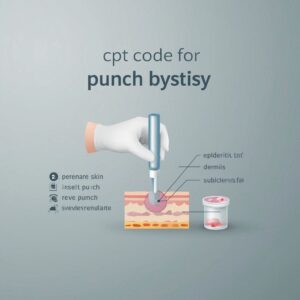
CPT Code for Punch Biopsy
What Is the Exact CPT Code for a Punch Biopsy?
The most common CPT code for a punch biopsy is 11104. This code represents a punch biopsy of a single skin lesion that includes simple closure.
However, that is not the only code you might use. The CPT manual divides punch biopsies into two main families:
-
11104 – Punch biopsy of a single skin lesion with simple closure.
-
11105 – Punch biopsy of each additional skin lesion with simple closure (used in conjunction with 11104).
But wait. There is more. In recent years, the American Medical Association (AMA) revised the biopsy codes. You might also encounter codes like 11102 and 11103. So which one is correct for a punch biopsy?
The answer depends on whether you perform a tangential biopsy (shave) or a punch biopsy. Let us clarify this because confusion here leads to denied claims.
Punch Biopsy vs. Shave Biopsy: Different Codes
Many providers mistakenly use shave biopsy codes for punch procedures. This is incorrect and can trigger audits.
-
Tangential biopsy (shave): Codes 11102 (first lesion) and 11103 (each additional lesion). This technique removes a superficial portion of the lesion level with the skin surface.
-
Punch biopsy: Codes 11104 (first lesion) and 11105 (each additional lesion). This technique uses a circular blade to remove a full-thickness core of skin down to the subcutaneous fat.
So the clear answer is: For a standard punch biopsy, you will use 11104 for the first lesion and 11105 for each additional lesion biopsied at the same patient encounter.
Important note: Code 11104 includes simple closure. That means you do not bill separately for closing the punch site with a suture or Steri-Strip. The closure is part of the biopsy code.
When to Use Code 11104 (Primary Punch Biopsy)
Code 11104 is your workhorse code for a single punch biopsy. But “single lesion” does not always mean one punch. You need to understand what counts as a separate lesion.
A lesion is a distinct area of abnormal tissue. If a patient has three separate moles on their back, each mole is a separate lesion. You would bill 11104 for the first mole and 11105 for the second and third moles.
However, if you perform three punch biopsies from different areas of the same large lesion (for example, sampling the edge and center of a large atypical nevus), that still counts as one lesion. You only bill one unit of 11104.
Documentation Requirements for 11104
To support the use of 11104, your medical record must clearly show:
-
The type of biopsy performed (punch).
-
The specific location of the lesion (e.g., “left upper back, 2 cm lateral to T4”).
-
The size and appearance of the lesion.
-
That simple closure was performed (or that closure was not needed because the site was small).
-
The number of lesions biopsied.
Without clear documentation, payers will deny the claim or downcode it to an evaluation and management service only.
Understanding Code 11105 (Each Additional Punch Biopsy)
Code 11105 is an add-on code. You can never bill 11105 alone. It always follows 11104.
Add-on codes have special rules. They do not require a separate modifier (like -59) in most cases because the CPT manual already defines them as dependent on the primary procedure.
For example, a patient presents with four suspicious lesions on their forearm. You perform a punch biopsy on each lesion. Your billing would look like this:
-
11104 – Punch biopsy, first lesion
-
11105 – Punch biopsy, second lesion
-
11105 – Punch biopsy, third lesion
-
11105 – Punch biopsy, fourth lesion
Some billers make the mistake of using multiple units of 11104. That is incorrect. Use 11104 only once per encounter, then 11105 for each additional lesion.
How Many Additional Lesions Can You Bill?
There is no official limit to the number of 11105 units you can bill. However, medical necessity must be clear. If you perform ten punch biopsies on a single patient in one visit, expect scrutiny. The documentation must explain why so many samples were necessary.
In practice, most payers accept up to four or five punch biopsies per encounter without automatic review. Beyond that, you should include a detailed medical necessity statement in the note.
Simple Closure: What Does It Mean?
The term “simple closure” often confuses clinicians. In the context of punch biopsy codes 11104 and 11105, simple closure includes:
-
Approximating the wound edges with one or two simple interrupted sutures.
-
Closing with Steri-Strips or tissue adhesive (e.g., Dermabond).
-
Leaving the wound open to heal by secondary intention.
That last point surprises many people. Even if you do not place a suture, you can still bill 11104. The code includes simple closure whether you close it or not. The key is that you do not perform a layered or complex closure.
What About Intermediate or Complex Closure?
If you perform a punch biopsy and then realize the wound requires a layered closure (deep sutures plus skin sutures), you cannot bill 11104. In that rare situation, you would bill the appropriate closure code separately (e.g., 12031 for intermediate closure). However, this is unusual for a standard punch biopsy. Most punch sites are small enough that a single suture or no suture suffices.
If you routinely need complex closure after punch biopsies, you may be using a punch that is too large. Consider using a smaller punch (e.g., 2 mm or 3 mm) to avoid this issue.
Comparing Punch Biopsy Codes at a Glance
Here is a quick reference table to help you choose the right code every time.
| Procedure | CPT Code | Type | Includes Closure? | Billing Rule |
|---|---|---|---|---|
| Punch biopsy, first lesion | 11104 | Primary | Yes (simple) | Bill once per encounter |
| Punch biopsy, each additional lesion | 11105 | Add-on | Yes (simple) | Bill per additional lesion |
| Tangential biopsy (shave), first lesion | 11102 | Primary | No | For shave techniques only |
| Tangential biopsy, each additional | 11103 | Add-on | No | For shave techniques only |
| Incisional biopsy | 11106 | Primary | Varies | Deeper, larger sample |
Remember: Do not use 11102 or 11103 for a punch biopsy. Payers are increasingly auditing this distinction.
Modifiers and Punch Biopsy Coding
Modifiers tell payers that something about the procedure changed. For punch biopsies, you will use modifiers in specific situations.
Modifier -59 (Distinct Procedural Service)
You might need modifier -59 when you perform a punch biopsy on the same day as another procedure that could be considered bundled. For example, if you excise one lesion and perform a punch biopsy on a different lesion at the same visit, some payers may bundle the biopsy into the excision.
Adding modifier -59 to 11104 tells the payer: “This biopsy was separate and distinct from the other procedure performed today.”
Modifier -51 (Multiple Procedures)
Technically, you do not need modifier -51 for add-on codes like 11105. However, some older billing systems still expect it. Check with your clearinghouse or software vendor. In most modern systems, you simply list 11104 once and then 11105 with multiple units.
Modifier -LT and -RT (Left and Right)
If you perform punch biopsies on the left arm and right arm, you do not need -LT or -RT unless a specific payer requires them. The code 11104 and 11105 are not laterality-specific. Your documentation of location is usually enough.
Billing Punch Biopsies with E/M Services
One of the most common questions we hear is: “Can I bill an evaluation and management (E/M) code on the same day as a punch biopsy?”
The answer is yes, but only if the E/M service is separately identifiable from the decision to perform the biopsy.
Here is the rule from Medicare and most commercial payers. When you perform a procedure (like a punch biopsy) that has a global period of 0 days, the decision to perform that procedure is included in the procedure code. You cannot bill a separate E/M code just for saying, “I decided to do a biopsy.”
However, you can bill an E/M code if:
-
The patient presents with a new or unrelated problem that you evaluate separately.
-
The E/M service goes above and beyond the usual pre-biopsy workup.
-
You document a separate and distinct history, exam, and medical decision making for the other problem.
Example of Correct E/M with Biopsy
A patient comes in for a rash on their chest. During the exam, you notice a suspicious mole on their back. You evaluate the rash (separate problem) and also decide to biopsy the mole.
In this case, you can bill:
-
An E/M code (e.g., 99212 or 99213) for the rash evaluation, with modifier -25.
-
CPT 11104 for the punch biopsy of the mole.
The documentation must clearly separate the work for the rash from the work for the biopsy.
Example of Incorrect E/M with Biopsy
A patient comes in specifically for you to look at a mole. You examine the mole, decide it looks atypical, and perform a punch biopsy.
You cannot bill a separate E/M code here. The decision to biopsy is part of 11104. You only bill the biopsy code.
Common Billing Mistakes and How to Avoid Them
Even experienced coders make errors with punch biopsy codes. Here are the most frequent mistakes we see, along with solutions.
Mistake #1: Using Shave Codes for Punch Biopsies
As mentioned earlier, this is a major compliance risk. Some providers think, “A biopsy is a biopsy,” but payers disagree.
Solution: Train your clinicians to document the specific technique used. The note should say “punch biopsy” or “shave biopsy.” Do not let them write just “biopsy.”
Mistake #2: Billing 11104 for Each Lesion
We have seen bills with three units of 11104 for three lesions. That is incorrect.
Solution: Remember: 11104 is for the first lesion only. Use 11105 for lesions two, three, four, and beyond.
Mistake #3: Forgetting the -25 Modifier on E/M Codes
If you bill an E/M code and a biopsy on the same day without modifier -25, the payer will likely bundle the E/M into the biopsy and pay only for the procedure.
Solution: Add modifier -25 to the E/M code whenever you bill it with a same-day procedure.
Mistake #4: Billing Closure Separately
Some billers add a suture code (e.g., 12001) for closing the punch site. This is incorrect because 11104 and 11105 already include simple closure.
Solution: Do not bill any separate closure code with 11104 or 11105.
Mistake #5: Not Documenting the Number of Lesions
If your note says “multiple punch biopsies performed” but does not list each lesion, you cannot support billing for more than one.
Solution: Document each lesion individually. Include location, size, appearance, and the fact that you biopsied it.
Real-World Coding Scenarios
Let us apply these rules to common clinical situations. These examples will help you see the codes in action.
Scenario 1: Single Punch Biopsy
A 45-year-old man has a changing nevus on his right shoulder. You perform one 4 mm punch biopsy. You close the site with one simple suture.
Correct coding: 11104
Scenario 2: Three Punch Biopsies on Three Different Lesions
A 60-year-old woman has three suspicious lesions on her back. You perform a punch biopsy on each one. You close each site with Dermabond.
Correct coding:
-
11104 (first lesion)
-
11105 (second lesion)
-
11105 (third lesion)
Scenario 3: Punch Biopsy with Separate E/M for a Different Problem
A 30-year-old man comes in for a cough (new problem). During the exam, you see a worrisome mole on his chest. He asks you to look at it. You examine the mole and perform a punch biopsy. You also fully evaluate his cough, order a chest X-ray, and prescribe an inhaler.
Correct coding:
-
99213 -25 (for the cough evaluation)
-
11104 (for the punch biopsy)
Scenario 4: Punch Biopsy and Excision of Another Lesion
A patient has two lesions. One is a small basal cell carcinoma on the nose that you excise. The other is an atypical mole on the arm that you punch biopsy.
Correct coding:
-
Excision code for the nose (e.g., 11640)
-
11104 -59 (punch biopsy on the arm, distinct from the excision)
Scenario 5: Multiple Punches from One Large Lesion
A patient has a large, irregular pigmented lesion on the thigh. You perform three punch biopsies from different areas of the same lesion to rule out melanoma.
Correct coding: 11104 only. Even though you took three samples, they are from one lesion. You cannot bill 11105 for the additional punches.
Payer-Specific Policies to Watch
While CPT codes are standardized, payer policies vary. Medicare and commercial insurers sometimes have different rules for punch biopsy coding.
Medicare Guidelines
Medicare follows the CPT manual closely for 11104 and 11105. However, Medicare has Local Coverage Determinations (LCDs) that may affect coverage. Some LCDs list specific diagnoses that justify punch biopsy. For example, a punch biopsy for cosmetic reasons (e.g., a patient wants a benign mole removed for appearance) is not covered.
Always check your local MAC’s LCD before billing.
Commercial Payer Variations
Some commercial payers consider punch biopsy codes 11104 and 11105 as “bundled” into other procedures more aggressively than Medicare. For example, Aetna and UnitedHealthcare may require modifier -59 more often.
Other payers may have different unit limits. We have seen policies that only reimburse up to four punch biopsies per encounter unless you submit prior authorization.
Tips for Navigating Payer Policies
-
Create a cheat sheet for your top five payers.
-
Review each payer’s medical policy for skin biopsies annually.
-
When in doubt, call the provider line and ask a specific question (e.g., “Do you require modifier -59 on 11104 when performed with an excision?”).
-
Document the name and date of any phone call with a payer.
What About Punch Biopsies on Mucous Membranes?
The codes we have discussed (11104, 11105) are for skin lesions. What if you perform a punch biopsy inside the mouth, on the lip, or on the genital mucosa?
In most cases, you still use 11104 and 11105. The CPT manual does not restrict these codes to keratinized skin. However, some payers prefer different codes for mucosal biopsies.
For oral mucosa, some coders use 40808 (biopsy of oral cavity). For vaginal or vulvar mucosa, codes like 56605 (biopsy of vulva) may be more appropriate.
Our advice: When in doubt, check with the specific payer. For most routine mucosal punch biopsies of the lip or oral cavity, 11104 is acceptable and widely reimbursed.
How Pathology Fits Into the Picture
The CPT codes for punch biopsy cover the surgical part of the service (taking the tissue). They do not include the pathology examination of that tissue.
Pathology codes are separate. Your practice may bill for pathology internally, or you may send the specimen to an outside lab.
The most common pathology code for a punch biopsy is 88305 (Level IV surgical pathology). This code covers the examination of a small skin biopsy.
If you perform three punch biopsies (one 11104 and two 11105), you would also bill three units of 88305, assuming each specimen goes to pathology separately.
However, there is an important rule. If you take multiple punches from the same lesion and place them in the same container, pathology may bill only one unit of 88305. If you place each punch in a separate container, you can bill multiple units.
Always check your pathology lab’s policy.
The Global Period for Punch Biopsy
Punch biopsy codes 11104 and 11105 have a 0-day global period. That means the payment for the biopsy includes the procedure itself and any follow-up care on the day of the procedure. It does not include separate follow-up visits.
If a patient returns the next week for suture removal, you can bill that visit as a separate E/M code (assuming the patient has a medical need for the visit beyond routine suture removal).
For most punch biopsies, the patient removes their own suture at home or returns for a free suture removal. Many practices do not bill for simple suture removal after a biopsy.
Documentation Templates for Punch Biopsy
Good documentation protects you from audits and denials. Here is a simple template you can adapt for your EHR.
Procedure: Punch Biopsy
Indication: [e.g., Suspicious pigmented lesion concerning for melanoma]
Lesion Description:
-
Location: [e.g., Left posterior shoulder]
-
Size: [e.g., 6 mm x 5 mm]
-
Color: [e.g., Brown with black speckles]
-
Borders: [e.g., Irregular]
-
Other features: [e.g., Recent change noted by patient]
Procedure Details:
-
Type of biopsy: Punch biopsy
-
Punch size: [e.g., 4 mm]
-
Number of lesions biopsied today: [e.g., One]
-
Anesthesia: [e.g., 1% lidocaine with epinephrine, 1 mL]
-
Closure method: [e.g., Simple interrupted suture, 5-0 Prolene]
-
Specimen handling: [e.g., Specimen placed in formalin, labeled with patient name and location]
-
Complications: None
Post-procedure instructions: [e.g., Keep site dry for 24 hours. Remove suture in 7 days.]
This template supports the use of 11104 and justifies medical necessity.
How to Handle Denials for Punch Biopsy Codes
Even with perfect coding, denials happen. Here is how to appeal the most common denials for 11104 and 11105.
Denial: “Procedure not separately payable”
This often happens when you bill 11104 without an add-on code but the payer expected one. Or you billed 11105 without 11104.
Appeal strategy: Review your claim. Make sure 11104 is present and that 11105 is listed as an add-on (usually with no modifier). Resubmit with a corrected claim.
Denial: “Missing modifier”
You may see this when billing 11104 with another same-day procedure. The payer wants modifier -59.
Appeal strategy: Add modifier -59 to 11104 and resubmit. Include a copy of the operative note showing the biopsy was on a different lesion or body site.
Denial: “Not medically necessary”
The payer reviewed the diagnosis code and determined it does not support a punch biopsy.
Appeal strategy: Submit the full medical record. Highlight the lesion characteristics that made it suspicious (asymmetry, irregular borders, color variation, diameter >6 mm, evolution). Include any family history of skin cancer.
If the diagnosis was something like “benign nevus” or “cosmetic concern,” the denial may be correct. Not all skin lesions need a biopsy.
Frequently Asked Questions (FAQ)
1. Can I use 11104 for a 2 mm punch biopsy?
Yes. The CPT code does not specify punch size. You can use 11104 for any size punch biopsy, from 1 mm to 8 mm or larger. However, very large punches (e.g., 8 mm or 10 mm) may cross over into incisional biopsy territory (11106). Use clinical judgment.
2. What if I do not close the punch site at all?
You still use 11104. The code includes simple closure, but you are not required to close the site. Leaving it open to heal by secondary intention is included.
3. Do I need a separate consent form for each punch biopsy?
No. One consent form that lists “punch biopsy of suspicious skin lesions” is sufficient. However, the consent form should mention that multiple biopsies may be performed.
4. Can a nurse or medical assistant perform a punch biopsy?
No. In most states, punch biopsy is a surgical procedure that requires a licensed independent practitioner (physician, NP, or PA). Check your state scope of practice laws.
5. How do I bill a punch biopsy performed by a resident?
If a resident performs the biopsy under direct supervision (the attending is present in the room), you bill under the attending’s NPI as usual. There is no special code.
6. What about punch biopsies done in the emergency department?
The same codes apply: 11104 and 11105. However, ED coders sometimes use wound repair codes instead. If the primary purpose is diagnostic biopsy, use the biopsy code. If the primary purpose is wound repair and you happen to get a small tissue sample, use the repair code.
7. Does insurance always cover punch biopsy?
No. Insurance covers punch biopsy when it is medically necessary to diagnose a suspected disease (usually skin cancer or inflammatory dermatosis). Cosmetic biopsies are not covered. The patient may be responsible for payment if the biopsy is not medically necessary.
8. What is the 2026 update for punch biopsy codes?
As of April 2026, no major changes have been made to codes 11104 and 11105. They remain the correct codes for punch biopsy. Always check the AMA website for mid-year updates.
9. Can I bill 11104 if the patient is on a blood thinner?
Yes. Being on anticoagulation does not change the code. However, you should document the medication and any bleeding complications.
10. How do I code a punch biopsy that turns into an excision?
If you start a punch biopsy, take a sample, and then realize the lesion needs complete excision, you have two options. If you remove the entire lesion with the punch, bill an excision code (e.g., 11400 series). If you take a punch sample and then excise the remaining lesion separately, bill both the biopsy (11104) and the excision (with modifier -59). Most payers prefer the second option.
Additional Resources for Skin Biopsy Coding
Coding guidelines change frequently. Bookmark these resources to stay current.
-
AMA CPT Network: The official source for CPT codes and guidelines. They offer a subscription for updates.
-
AAD Coding Resources: The American Academy of Dermatology provides member-only coding guides and webinars.
-
CMS MedLearn Matters: Search for articles on skin biopsy coding. Medicare publishes clear guidance here.
-
Local MAC websites: Your Medicare Administrative Contractor publishes Local Coverage Determinations specific to your state.
Recommended external link: AMA CPT Code Lookup Tool (Use this to verify code descriptors and guidelines directly from the source.)
Conclusion
You now have a complete guide to the CPT code for punch biopsy. To summarize the key points: use 11104 for the first punch biopsy and 11105 for each additional lesion at the same encounter. Remember that these codes include simple closure, so do not bill suture codes separately. Always document each lesion individually and avoid the common mistake of using shave biopsy codes for punch procedures.
With clear documentation and attention to modifier rules, you can code punch biopsies accurately, reduce denials, and focus on what matters most: your patients.
Disclaimer: This article is for educational purposes only. Coding and billing rules change frequently. Always verify with the latest CPT manual and your local payer policies.
Author: Medical Coding Team
Date: APRIL 04, 2026