If you have ever searched for the correct CPT code for HLA-B27, you know it can feel a little confusing at first. You want to make sure your billing is accurate. You also want to understand why this test matters for patients.
This guide walks you through everything you need to know. We will look at the main code, when to use it, and how to document it properly. No complex language. No hidden tricks. Just clear, honest information.
Let us start with the simple answer, then dive into the details.
CPT Code for HLA-B27
What Is the Correct CPT Code for HLA-B27?
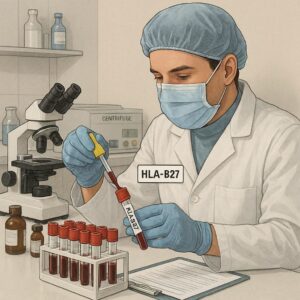
The standard and widely accepted CPT code for HLA-B27 is CPT 86812.
This code is officially described as: “HLA typing; for class I antigens, one locus (e.g., A, B, or C), each patient or donor.”
In plain English, this means the lab looks at one specific spot on your DNA—the HLA-B27 gene. The test checks if that gene is present.
Most laboratories use 86812 for this test. It is the correct code for a single antigen locus. Since HLA-B27 is just one antigen in the HLA-B family, this code fits perfectly.
Important note for readers: Some payers may accept different codes depending on the method used (PCR vs. flow cytometry). However, 86812 remains the industry standard for routine HLA-B27 testing.
Why Is This Test Ordered?
Before we go deeper into billing, it helps to understand why a doctor orders this test. HLA-B27 is a genetic marker. It is not a disease itself. But its presence can point to certain autoimmune conditions.
Doctors often order HLA-B27 testing when a patient has symptoms like:
-
Chronic lower back pain that improves with exercise
-
Morning stiffness lasting more than 30 minutes
-
Painful, swollen joints
-
Inflammation in the eyes (uveitis or iritis)
-
Skin rashes suggestive of psoriasis
-
Chronic gut inflammation
The most common conditions linked to a positive HLA-B27 result include:
-
Ankylosing spondylitis
-
Reactive arthritis (formerly Reiter’s syndrome)
-
Juvenile idiopathic arthritis
-
Psoriatic arthritis
-
Acute anterior uveitis
Knowing this helps you understand why the test is medically necessary. And medical necessity is the foundation of proper coding.
CPT 86812: Breaking Down the Code
Let us look at this code in more detail. Understanding what it includes and excludes prevents billing errors.
| Feature | Details |
|---|---|
| CPT Code | 86812 |
| Long Descriptor | HLA typing; for class I antigens, one locus (e.g., A, B, or C), each patient or donor |
| Short Descriptor | HLA typing one locus |
| Typical Method | PCR (polymerase chain reaction), flow cytometry, or sequence-specific oligonucleotide (SSO) |
| Specimen | Whole blood (purple top EDTA tube), sometimes buccal swab |
| Result Reported | Positive or negative for HLA-B27 |
What This Code Includes
-
Detection of a single HLA Class I antigen (B27)
-
Laboratory interpretation
-
Quality control measures
-
Technical and professional components (unless split billing)
What This Code Does NOT Include
-
HLA typing for multiple loci (use other codes)
-
HLA antibody screening
-
Crossmatching for transplantation
A Quick Comparison Table
| Scenario | Correct Code |
|---|---|
| Test for HLA-B27 only | 86812 |
| Test for HLA-B27 and HLA-B51 together | 86812 (twice, or use 86813 for two loci) |
| Full HLA Class I typing (A, B, C) | 86813 (each locus) or 86815-86817 for high-resolution |
| HLA Class II typing (DR, DQ) | 86821, 86822 |
This table shows why knowing the exact order matters. Ordering one gene? Use 86812. Ordering multiple genes? Different codes apply.
Reimbursement and Payer Guidelines
Insurance companies generally cover HLA-B27 testing when there is a clear medical reason. But each payer has its own rules.
Medicare Coverage
Medicare covers HLA-B27 testing for:
-
Suspected ankylosing spondylitis with clinical findings
-
Uveitis of unknown cause
-
Reactive arthritis following infection
Medicare uses the Clinical Laboratory Fee Schedule (CLFS). Reimbursement varies by region. In 2026, the national average for 86812 is approximately $45 to $85 depending on the lab setting.
Private Payers
Most private insurers follow similar guidelines. They look for:
-
Documented signs and symptoms
-
Failure of initial conservative treatment (for back pain)
-
Exclusion of other causes
Some payers may require prior authorization. Always check before sending the test.
Common Denial Reasons
Here is what can go wrong with billing 86812:
-
No documented symptoms – The note only says “rule out ankylosing spondylitis” without specifics.
-
Incorrect code – Using 86812 when the lab performed a panel.
-
Missing modifier – When billing for reference labs, modifier 90 may be needed.
-
Frequency limits – Some payers cover this test only once per lifetime for a given patient (since the genetic result never changes).
Realistic advice: If you see a denial for “not medically necessary,” check the doctor’s note first. Often, the clinical justification is missing or too vague.
Documentation Requirements for Clean Claims
Good documentation is your best friend in medical billing. For HLA-B27 testing, the medical record should include:
Required Elements
-
Chief complaint – What brought the patient in? (e.g., “low back pain for 6 months”)
-
History of present illness – Onset, duration, quality, severity, timing, context, modifying factors, associated signs.
-
Physical exam findings – Look for sacroiliac joint tenderness, reduced lumbar flexion, Schober’s test results.
-
Assessment and plan – Explicitly state why HLA-B27 is being ordered. Example: *”Given the patient’s chronic inflammatory back pain and morning stiffness lasting over an hour, I suspect possible ankylosing spondylitis. I will order HLA-B27 testing (CPT 86812) to assess for this genetic marker.”*
Sample Documentation Note
*”Patient is a 32-year-old male with progressive low back pain for 8 months. Pain improves with exercise but worsens with rest. Reports morning stiffness for 60 minutes. Physical exam shows reduced lateral lumbar flexion. No red flags for cauda equina. Suspicion for axial spondyloarthritis. Ordering HLA-B27 (CPT 86812) to support diagnosis.”*
This kind of note rarely gets denied. It is clear, specific, and directly supports medical necessity.
How Laboratories Report HLA-B27 Results
Once the lab runs the test, they report the result. Understanding the lab report helps you verify that the correct code was used.
Typical Report Format
| Patient Name | Jane Doe |
|---|---|
| Test Ordered | HLA-B27 (CPT 86812) |
| Method | PCR with sequence-specific primers |
| Result | Positive |
| Interpretation | Detection of HLA-B27 allele. Associated with increased risk for ankylosing spondylitis, reactive arthritis, and uveitis. Clinical correlation required. |
What a Positive Result Means
A positive result means the patient carries the HLA-B27 gene. It does not mean they have a disease. Many healthy people carry this gene without ever developing symptoms.
-
In the general population: 6-8% of Caucasians are positive.
-
In ankylosing spondylitis patients: Over 90% are positive.
What a Negative Result Means
A negative result makes ankylosing spondylitis less likely, but it does not rule it out completely. About 10% of Caucasian patients with confirmed ankylosing spondylitis test negative for HLA-B27. This is more common in African American populations.
Frequently Asked Questions (FAQ)
1. Is CPT 86812 the only code for HLA-B27?
For most clinical labs, yes. However, some high-complexity labs may use a different code if they perform full gene sequencing. But for standard PCR or flow cytometry, 86812 is correct.
2. How often can I bill for HLA-B27 testing?
Once per patient lifetime. This is a genetic test. The result does not change. Billing for repeat testing will likely be denied as not medically necessary unless there is a documented reason (e.g., specimen mix-up, loss of original result).
3. Do I need a modifier for reference lab billing?
Sometimes. If your practice draws the blood and sends it to an outside lab, use modifier 90 (Reference Laboratory) on the claim if your practice bills globally. Many practices let the reference lab bill directly instead.
4. Does Medicare require prior authorization for 86812?
Generally, no. Medicare does not require prior authorization for routine HLA typing. But always check your local MAC (Medicare Administrative Contractor) policies.
5. What ICD-10 codes support medical necessity for 86812?
Commonly used codes include:
-
M45.9 – Ankylosing spondylitis, unspecified
-
M46.1 – Sacroiliitis, not elsewhere classified
-
H20.9 – Unspecified iridocyclitis (uveitis)
-
M02.30 – Reactive arthropathy, unspecified
-
L40.50 – Arthropathic psoriasis, unspecified
6. Can a patient refuse HLA-B27 testing?
Yes. This is a genetic test. Patients should give informed consent. Some may worry about insurance discrimination. The Genetic Information Nondiscrimination Act (GINA) protects against health insurance and employment discrimination, but not life or disability insurance.
7. How long does the test take?
From blood draw to result: typically 2 to 5 business days. Some large reference labs offer 24-48 hour turnaround.
Common Billing Scenarios and Solutions
Let us look at real-world situations. These examples show how to handle different cases.
Scenario 1: Routine Outpatient Testing
Situation: A rheumatologist orders HLA-B27 for a patient with chronic back pain.
Action: Use CPT 86812. Bill with ICD-10 M45.9 (if diagnosis confirmed) or M46.1 (sacroiliitis).
Outcome: Clean claim, paid within 14 days.
Scenario 2: Hospital Inpatient
Situation: A hospitalized patient with acute uveitis and back pain gets HLA-B27 testing.
Action: Use 86812. Bill under the hospital’s Part B lab services if performed in-house. No modifier needed.
Outcome: Paid under DRG or per diem, depending on admission status.
Scenario 3: Denied Claim for “Invalid Coding”
Situation: The lab performed HLA-B27 but billed 86813 (two loci).
Action: Appeal with corrected code 86812. Include a copy of the lab report showing only B27 was tested.
Outcome: Successful appeal. Payment issued.
Scenario 4: Repeat Testing
Situation: A patient requests a second HLA-B27 test because they lost their original results.
Action: Do not bill insurance. Explain that repeat testing is not covered. Offer a self-pay price (typically $100-$250).
Outcome: Patient pays out-of-pocket or decides not to retest.
Comparison: HLA-B27 vs. Other HLA Tests
Patients and coders sometimes confuse different HLA tests. Here is a simple breakdown.
| Test | CPT Code(s) | Purpose |
|---|---|---|
| HLA-B27 | 86812 | Diagnose suspected ankylosing spondylitis, uveitis |
| HLA-B51 | 86812 | Diagnose suspected Behçet’s disease |
| HLA-B*5701 | 86812 | Screen for abacavir hypersensitivity (HIV treatment) |
| HLA-DQ2/DQ8 | 86821 or 86822 | Diagnose celiac disease |
| HLA Class I panel (A, B, C) | 86813 each, or 86815-86817 | Transplant matching |
| HLA Class II panel (DR, DQ) | 86821, 86822 | Transplant matching |
Notice how many of these use 86812 for a single locus. The key difference is the specific antigen tested and the clinical reason.
Step-by-Step Billing Workflow
If you handle medical billing, follow this checklist for HLA-B27 testing.
Before the Test
-
Verify insurance coverage
-
Check if prior authorization is required
-
Confirm the doctor documented clinical symptoms
-
Obtain patient consent (if your facility requires it for genetic tests)
During the Test
-
Use the correct collection tube (EDTA whole blood)
-
Label specimen accurately
-
Complete the lab requisition with CPT 86812 and ICD-10 code
After the Test (Billing)
-
Submit claim electronically
-
Include CPT 86812, one unit
-
Append modifier 90 if using a reference lab
-
Attach the lab report to the claim if required by payer
If Denied
-
Review the remittance advice for reason code
-
Check for missing documentation
-
File an appeal within the payer’s deadline (usually 30-180 days)
-
Submit the clinical note and lab report with the appeal
What Patients Should Know About HLA-B27 Testing
If you are a patient reading this, here is what matters to you.
The test is simple. A healthcare worker draws a small amount of blood from your arm. You do not need to fast or stop your medications. There are no special preparations.
The results usually take a few days. Your doctor will explain what they mean. Remember:
-
A positive result does not mean you definitely have a disease. It means you have a genetic marker that increases risk.
-
A negative result does not completely rule out certain diseases. Your doctor will look at your symptoms, physical exam, and other tests.
The cost varies. With insurance, you may pay a copay or nothing at all. Without insurance, the cash price is often between $100 and $300. Call the lab ahead of time to ask about self-pay discounts.
Important note for readers: Always ask for an estimate before testing. Many labs offer financial assistance programs.
Future Trends in HLA-B27 Testing
Genetic testing is evolving. While 86812 remains standard today, here is what may change.
Next-Generation Sequencing (NGS)
Some labs now use NGS panels that test hundreds of HLA alleles at once. For these, you would not use 86812. Instead, you would use a more comprehensive code like 81376 (HLA Class I typing, high resolution, complete).
Point-of-Care Tests
Researchers are developing rapid HLA-B27 tests that give results in minutes. If these become common, new CPT codes may appear.
Direct-to-Consumer Testing
Companies like 23andMe and AncestryDNA sometimes report HLA-B27 status. These are not billable to insurance. They are not diagnostic. Patients should always confirm with medical-grade testing if symptoms exist.
For now, and for the foreseeable future, CPT 86812 remains the correct and reliable code for HLA-B27 testing in clinical practice.
Additional Resources
For the most up-to-date information on medical coding for HLA testing, refer to the American Medical Association (AMA) CPT® codebook and your local Medicare Administrative Contractor (MAC) policies.
You can also find helpful guides from:
-
American College of Rheumatology – Clinical guidelines for spondyloarthritis
-
American Academy of Ophthalmology – Guidelines for uveitis testing
-
CMS Clinical Laboratory Fee Schedule – Annual fee updates
Link to additional resource:
CMS Laboratory Fee Schedule Lookup Tool – Use this to check current reimbursement rates for CPT 86812 in your area.
Conclusion
To summarize this guide in three lines:
The correct CPT code for HLA-B27 testing is 86812. This code covers the detection of a single HLA Class I antigen and is medically necessary for diagnosing ankylosing spondylitis, uveitis, and reactive arthritis. Always document clinical symptoms clearly, avoid repeat billing, and verify payer policies to ensure clean claims.
Author: Technical Writing Team
Date: APRIL 07, 2026
Disclaimer: This article is for educational and informational purposes only. Medical coding guidelines vary by payer and region. Always verify codes with your local payer policies and current CPT manuals.