If you have been searching for the right CPT code for liver elastography (FibroScan) , you are not alone. This is one of those areas in medical billing where things can get confusing quickly. Is it ultrasound? Is it a special test? Does insurance even cover it?
Let us clear that up right now.
The most commonly used and accepted CPT code for FibroScan (vibration-controlled transient elastography) is CPT 91200.
But wait—do not stop reading yet. Using the correct code is only half the battle. You also need to know when to use it, what documentation to attach, and how to avoid denials.
This guide will walk you through everything you need to know. No complicated medical jargon. No unrealistic promises. Just honest, practical information you can use today.
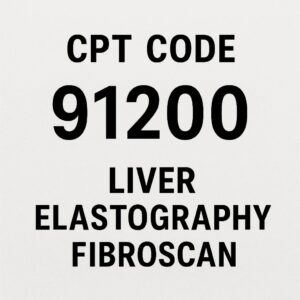
CPT Code for Liver Elastography FibroScan
What Exactly Is Liver Elastography (FibroScan)?
Before we talk about codes, let us quickly talk about the test itself. This will help you understand why a specific code exists.
Liver elastography is a non-invasive imaging test. It measures the stiffness of your liver. Why does stiffness matter? Because a stiff liver often means scarring. That scarring is called fibrosis. If fibrosis gets worse, it can lead to cirrhosis.
FibroScan is a brand name. Think of it like “Kleenex” for tissues. Many people say FibroScan when they mean any liver elastography. But technically, FibroScan is a specific device made by Echosens.
The test is painless. It works a bit like an ultrasound. A small probe is placed on your skin over your liver. Sound waves travel through the tissue. The machine measures how fast those waves move. Faster waves = stiffer liver.
Why Doctors Order This Test
Doctors order liver elastography for several reasons. Here are the most common ones:
-
Monitoring patients with chronic hepatitis B or C
-
Checking for liver damage in non-alcoholic fatty liver disease (NAFLD)
-
Assessing fibrosis in patients with alcohol-related liver disease
-
Avoiding unnecessary liver biopsies
-
Tracking disease progression over time
The test is incredibly useful. But from a billing perspective, it lives in a slightly awkward space. It is not quite a standard ultrasound. It is not quite a separate category. That is why CPT 91200 exists.
The Main CPT Code for Liver Elastography (FibroScan)
Let us get straight to the point.
CPT 91200: Liver elastography, mechanically induced shear wave (eg, vibration-controlled transient elastography), with interpretation and report.
That is the code you will use for a standard FibroScan.
Breaking Down CPT 91200
Here is what each part of that description means for you:
-
Liver elastography – The test is specifically for the liver. Not the spleen. Not the kidney.
-
Mechanically induced shear wave – The machine creates a vibration. That vibration sends a shear wave through the liver. This is different from ultrasound-based strain elastography.
-
Vibration-controlled transient elastography – This is the technical name for what FibroScan does. The description actually includes “eg, vibration-controlled transient elastography” as an example.
-
With interpretation and report – This is critical. The code includes the doctor’s analysis of the results and a written report. You cannot bill separately for interpretation unless you have a very specific reason (more on that later).
Is This Code Only for FibroScan?
No. And this is important.
CPT 91200 is for vibration-controlled transient elastography. The FibroScan device is the most common way to do this. But if another device uses the same mechanical shear wave technology, you would still use 91200.
What about ultrasound elastography (strain or shear wave done on a standard ultrasound machine)? That is different. Those tests use different codes. We will cover those differences later.
For now, remember: FibroScan = CPT 91200 in almost all cases.
When NOT to Use CPT 91200
Honesty matters here. Not every liver stiffness test uses code 91200. Using the wrong code is a fast track to a denial or even an audit.
Here are situations where you should not use CPT 91200.
If You Used Point Shear Wave Elastography (pSWE)
Some ultrasound machines offer a feature called point shear wave elastography. This is different from FibroScan. The technology is similar, but the CPT coding rules treat it separately.
For point shear wave elastography of the liver, you may need to look at unlisted codes or specific ultrasound codes depending on your payer. Many billers use CPT 76981 (ultrasound, elastography) for this, but check your local coverage determination (LCD).
If You Performed Strain Elastography
Strain elastography is another technique. It uses gentle compression to estimate tissue stiffness. This is not the same as mechanical shear wave.
For strain elastography, you are looking at CPT 76981 or CPT 76982 depending on whether it is done with a complete ultrasound exam.
If You Did Not Interpret the Results
CPT 91200 includes interpretation and report. That means the doctor reading the results cannot bill separately for just looking at the numbers.
However, there are rare cases where one doctor performs the test (technical component) and another doctor interprets it (professional component). In that situation, you would use modifiers. We will cover modifiers in the billing section.
If You Performed a Liver Biopsy Instead
A liver biopsy is a completely different procedure. That uses codes like CPT 47000 (percutaneous liver biopsy) or CPT 47100 (wedge biopsy). Do not confuse these with elastography. Biopsy is invasive. Elastography is not.
CPT 91200 vs. Other Elastography Codes: A Comparison Table
This table will help you see the differences at a glance.
| Procedure | CPT Code | Technology | Notes |
|---|---|---|---|
| FibroScan (VCTE) | 91200 | Mechanical shear wave | Includes interpretation & report |
| Ultrasound elastography (first lesion) | 76981 | Strain or shear wave (ultrasound-based) | For focal lesions |
| Ultrasound elastography (each additional lesion) | 76982 | Strain or shear wave | Add-on code |
| MR elastography (liver) | 76391 | Magnetic resonance elastography | Different modality entirely |
| Liver biopsy (percutaneous) | 47000 | Tissue sampling | Invasive, different purpose |
Important note: Some payers may consider 76981 or 76982 unlisted or investigational. Always verify coverage before performing the test.
Billing Guidelines for CPT 91200
Now we get into the practical part. You have the code. But how do you bill it correctly? Let us walk through the process step by step.
Technical vs. Professional Components
CPT 91200 is a global code. That means it includes both the technical component (the machine, the equipment, the technician’s time) and the professional component (the doctor’s interpretation).
However, you might need to split these in certain situations:
-
Global (TC + PC) – Bill 91200 with no modifier. This is the most common way.
-
Technical component only – Bill 91200 with modifier TC. Use this if your facility owns the equipment but an outside doctor reads the results.
-
Professional component only – Bill 91200 with modifier 26. Use this if you are the interpreting doctor but do not own the equipment.
Example: A hospital performs the FibroScan. A radiologist in private practice reads the results remotely. The hospital bills 91200-TC. The radiologist bills 91200-26.
Modifiers You Might Need
Besides TC and 26, here are other modifiers that can apply:
-
Modifier 59 – Distinct procedural service. Use this if the elastography is performed separately from another test on the same day.
-
Modifier XU – A more specific version of 59. Some payers prefer this.
-
Modifier 76 – Repeat procedure by same physician. If you repeat the FibroScan on the same day for a valid reason.
-
Modifier 77 – Repeat procedure by a different physician.
Use modifiers sparingly. Only when the documentation clearly supports them.
Place of Service Codes
Where you perform the test affects how you bill. Here are common place of service (POS) codes for FibroScan:
| POS Code | Location | Notes |
|---|---|---|
| 11 | Office | Doctor’s private office |
| 22 | Outpatient hospital | Hospital-based clinic |
| 24 | Ambulatory surgical center | Less common for FibroScan |
| 31 | Skilled nursing facility | For bedbound patients |
Diagnosis Codes (ICD-10) for FibroScan
A CPT code without a supporting diagnosis code is like a car without gas. It will not go anywhere.
Here are common ICD-10 codes that support medical necessity for liver elastography:
-
K76.0 – Fatty (change of) liver, not elsewhere classified
-
K75.81 – Nonalcoholic steatohepatitis (NASH)
-
K74.60 – Unspecified cirrhosis of liver
-
B18.2 – Chronic viral hepatitis C
-
B18.1 – Chronic viral hepatitis B without delta-agent
-
K70.30 – Alcoholic cirrhosis of liver without ascites
-
Z09 – Follow-up exam after treatment for other conditions
Do not bill FibroScan for vague symptoms like “abdominal pain” without a liver-related diagnosis. That is a denial waiting to happen.
Reimbursement and Coverage: What to Expect
Let us be realistic. Reimbursement for CPT 91200 varies widely. It depends on your payer, your location, and your contract.
Medicare Coverage for CPT 91200
Medicare covers liver elastography under certain conditions. As of 2026, most Medicare Administrative Contractors (MACs) have local coverage determinations (LCDs) for this test.
General Medicare coverage requires:
-
Documented chronic liver disease
-
Results that would change management
-
No recent (within 12 months) liver biopsy or elastography
Some MACs also require a specific fibrosis score (like FIB-4 or APRI) before approving the test. Check your local MAC’s LCD.
Private Payer Coverage
Private insurers are a mixed bag. Here is what we see in practice:
-
Aetna – Considers FibroScan medically necessary for certain liver diseases. Requires prior authorization in some plans.
-
UnitedHealthcare – Covers for hepatitis B, hepatitis C, NAFLD, and alcoholic liver disease. Does not cover for screening in low-risk patients.
-
Cigna – Covers when used to assess fibrosis stage. Requires documentation of chronic liver disease.
-
Blue Cross Blue Shield – Varies by state. Many cover but require prior authorization.
Pro tip: Always verify coverage before scheduling the test. A five-minute phone call can save you a denial letter.
Average Reimbursement Rates
These numbers are estimates. They change based on your contract and location. Use them as a rough guide only.
| Payer Type | Global Reimbursement (approx) |
|---|---|
| Medicare | $80 – $130 |
| Medicaid | $50 – $90 |
| Commercial PPO | $120 – $250 |
| Commercial HMO | $90 – $180 |
The technical component (TC) usually makes up about 70-80% of the global payment. The professional component (26) makes up the rest.
Documentation Requirements for CPT 91200
You cannot bill what you cannot prove. Documentation is everything.
Here is what your medical record must include for a clean claim:
Required Elements
-
Order – A physician’s order specifying liver elastography. Not just “liver imaging.”
-
Indication – The specific liver condition being monitored or diagnosed.
-
Prior testing – Results of any recent fibrosis scores (FIB-4, APRI, etc.) or prior biopsies.
-
Procedure note – Who performed the test, what device was used, number of valid measurements, IQR/M ratio (quality metrics).
-
Interpretation – A clear report stating the liver stiffness measurement (kPa) and the corresponding fibrosis stage (F0 to F4).
-
Report – A written document that goes into the patient’s chart.
What Raises Red Flags
Auditors look for these problems:
-
No documented medical necessity
-
Missing interpretation report
-
Repeat testing too frequently (more than once per year without good reason)
-
Billing global when only TC was performed
-
Using 91200 for ultrasound-based elastography
How Often Can You Bill CPT 91200?
There is no strict national frequency limit. But most LCDs suggest once per year for stable patients. More frequent testing may be allowed if there is a significant clinical change (e.g., new treatment, rapid progression).
Document the reason for repeat testing in the note. “Monitoring” is usually not enough. Be specific: “Patient started new antiviral therapy. Repeat elastography at 6 months to assess response.”
Common Billing Mistakes and How to Avoid Them
Let us learn from other people’s errors. Here are the most frequent mistakes we see with CPT 91200.
Mistake #1: Using Unlisted Codes
Some billers panic and use CPT 76497 (unlisted ultrasound procedure). Do not do this. CPT 91200 exists specifically for this test. Unlisted codes invite manual review and often result in lower payment.
Fix: Use 91200. Only use an unlisted code if your payer explicitly tells you to (rare).
Mistake #2: Billing a Separate E/M Visit on the Same Day
You can bill an evaluation and management (E/M) code on the same day as a FibroScan. But you need modifier 25 on the E/M code. And you need documentation that the E/M was separate and significant.
Example: Patient comes in for a scheduled FibroScan. During the visit, they also report new chest pain. The doctor evaluates the chest pain separately. That E/M can be billed with modifier 25.
Fix: Document the separate service clearly. Do not automatically add modifier 25 to every visit.
Mistake #3: Forgetting the Advance Beneficiary Notice (ABN) for Medicare
Medicare does not always cover FibroScan. If you think Medicare might deny the test, you need to give the patient an ABN (Advance Beneficiary Notice of Noncoverage). Without an ABN, you cannot bill the patient if Medicare denies.
Fix: When in doubt, have the patient sign an ABN. It protects you and informs the patient.
Mistake #4: Billing for Screening in Asymptomatic Patients
CPT 91200 is not a screening tool for the general population. If the patient has no liver disease risk factors and no symptoms, most payers will deny.
Fix: Only order the test when there is a clear, documented medical reason.
CPT 91200 vs. MR Elastography (MRE)
This is a common point of confusion. MR elastography (MRE) is a different test. It uses an MRI machine with special software to measure liver stiffness.
The CPT code for MR elastography of the liver is 76391 (Magnetic resonance (eg, vibration-controlled) elastography).
Which One Should You Order?
| Factor | FibroScan (91200) | MR Elastography (76391) |
|---|---|---|
| Cost | Lower | Higher |
| Time | 5–10 minutes | 45–60 minutes |
| Radiation | None | None |
| Claustrophobia | No issue | Can be an issue |
| Body habitus | Less accurate in obese patients | Works well in most patients |
| Incidental findings | None | Can see other liver lesions |
| Reimbursement | $80–$250 | $300–$600+ |
Clinical bottom line: Start with FibroScan for most patients. Reserve MRE for patients where FibroScan is technically difficult (severe obesity, ascites) or when you need additional anatomic information.
Sample Billing Scenarios for CPT 91200
Real-world examples help more than abstract rules. Here are three common scenarios.
Scenario 1: Routine FibroScan in a Gastroenterology Office
Patient: 54-year-old with NASH. Last FibroScan one year ago showed F2 fibrosis. Doctor wants to check progression.
What happens: Technician performs FibroScan in the office. Doctor reviews the results immediately and writes a report.
Billing: 91200 (global)
Diagnosis: K75.81 (NASH)
Modifiers: None
POS: 11 (Office)
Scenario 2: Hospital-Based Test with Outside Interpretation
Patient: 62-year-old with hepatitis C. Hospital outpatient department performs the FibroScan. A radiology group across town interprets the study.
Hospital bills: 91200-TC
Radiologist bills: 91200-26
Diagnosis: B18.2 (Chronic hepatitis C)
Scenario 3: Repeat Test at 6 Months
Patient: 48-year-old with alcoholic liver disease. Started abstinence and new medication 6 months ago. Doctor wants early assessment of response.
What you need: Documentation explaining why 6 months is justified. Note the clinical change (new treatment).
Billing: 91200 (global)
Diagnosis: K70.30 (Alcoholic cirrhosis without ascites)
Modifiers: None, but keep strong documentation
Tips for Reducing Denials
Denials are frustrating. They cost time and money. Here is how to minimize them for CPT 91200.
Before the Test (Pre-Authorization)
-
Check medical necessity against payer policy
-
Get prior authorization if required (many commercial plans require it)
-
Confirm the patient’s benefits (deductible, copay, coverage limits)
-
Document the reason for testing in the order
During the Test
-
Follow the manufacturer’s protocol (at least 10 valid measurements)
-
Note the IQR/M ratio (should be <30% for reliable results)
-
Record the device name and settings
After the Test (Billing)
-
Use the correct CPT code (91200)
-
Attach the correct diagnosis code (liver-specific)
-
Include the interpretation report with the claim if requested
-
Appeal denials promptly with supporting documentation
Sample Appeal Letter Language
If your claim is denied, try something like this:
“This claim for CPT 91200 (liver elastography) was denied as not medically necessary. However, the patient has [diagnosis] with documented [fibrosis score]. The test was performed to [monitor progression / assess treatment response]. Per [payer policy name], liver elastography is covered for this indication. Please reconsider this claim with the attached clinical documentation.”
The Future of CPT Coding for Liver Elastography
Medical coding is not static. It changes every year. Here is what you should watch for.
Current Status (2026)
CPT 91200 remains the primary code for vibration-controlled transient elastography. No major changes are expected for 2026.
Potential Changes on the Horizon
The American Medical Association (AMA) reviews CPT codes annually. Some experts predict:
-
Separate codes for different elastography techniques (ultrasound vs. mechanical)
-
Possible bundling into liver disease management packages
-
New add-on codes for serial measurements
For now, 91200 is your code. But check the CPT manual each year for updates.
Frequently Asked Questions (FAQ)
1. Is CPT 91200 the same for FibroScan and other devices?
Yes. CPT 91200 describes the technology (vibration-controlled transient elastography), not the brand. FibroScan is the most common device, but the code applies to any device using the same mechanical shear wave method.
2. Does Medicare cover CPT 91200?
Yes, but with conditions. Medicare covers liver elastography for chronic liver disease when results would change management. Check your local MAC’s LCD for specific requirements.
3. Can I bill CPT 91200 and an ultrasound on the same day?
Yes, if both are medically necessary and separately documented. Use modifier 59 or XU on the secondary procedure. However, payers may question why both were needed. Be prepared to justify.
4. What is the difference between CPT 91200 and CPT 76981?
CPT 91200 is for mechanical shear wave elastography (FibroScan). CPT 76981 is for ultrasound elastography (strain or shear wave performed on a standard ultrasound machine). They are not interchangeable.
5. How many times per year can I bill CPT 91200?
Most payers allow once per year for stable patients. More frequent testing requires documented clinical change (new treatment, rapid progression, etc.). Check your specific payer policy.
6. Do I need a separate interpretation report?
Yes. CPT 91200 includes “with interpretation and report.” You must have a written report in the patient’s chart. The report should include the liver stiffness value (kPa) and the corresponding fibrosis stage.
7. What diagnosis codes support medical necessity?
Liver-specific diagnoses like chronic hepatitis (B18.1, B18.2), NASH (K75.81), fatty liver (K76.0), and cirrhosis (K74.60). Avoid vague codes like R10.9 (abdominal pain).
8. Can a technician perform the FibroScan without a doctor present?
Yes, a trained technician can perform the test. But a doctor must interpret the results and write the report. The doctor does not need to be in the room during the scan.
9. Is CPT 91200 covered for screening in patients without liver disease?
Generally, no. Most payers do not cover liver elastography for general screening in asymptomatic patients without risk factors. Medical necessity is required.
10. What should I do if my claim for 91200 is denied?
First, review the denial reason. Common reasons: missing medical necessity, incorrect diagnosis, no prior authorization. Appeal with supporting documentation. Include the order, the interpretation report, and relevant clinical notes.
Additional Resources
For more information on liver elastography coding and coverage, visit the American College of Gastroenterology (ACG) website. Their practice management section offers free coding guides and updates on payer policies.
👉 Link: https://gi.org/coding-resources/ (Open in a new tab)
Note: Always verify coding and coverage information with your specific payer and local MAC. Rules change, and contracts vary.
Important Notes for Readers
-
This guide is for informational purposes only. It does not constitute legal or medical advice.
-
CPT codes are copyright of the American Medical Association. Always use the current CPT manual.
-
Payer policies change frequently. Verify coverage before billing.
-
When in doubt, consult a certified professional coder (CPC) or a medical billing specialist.
-
Documentation is your best defense in an audit. Keep it clean, clear, and complete.
Conclusion
Let us wrap this up in three lines.
First: The correct CPT code for liver elastography (FibroScan) is 91200 for vibration-controlled transient elastography with interpretation and report. Second: Use supporting liver-specific diagnosis codes, document medical necessity clearly, and check payer coverage before testing to avoid denials. Third: Avoid common mistakes like using unlisted codes or billing for screening, and always keep a written interpretation report in the patient’s chart.
Disclaimer
The information provided in this article is for general informational and educational purposes only. It is not a substitute for professional medical advice, coding advice, or legal advice. CPT codes and payer policies change frequently. Always consult the current CPT manual, your local MAC, and your specific payer contracts before submitting any claim. The author and publisher disclaim any liability for any adverse outcomes resulting from the use or misuse of this information.