If you have ever needed to bill for a pericardiocentesis, you already know that choosing the right code can feel like walking through a maze. One wrong number, and your claim comes back denied. Another wrong choice, and you could face a compliance audit.
This guide is here to clear things up.
We will walk through the exact CPT codes for pericardiocentesis, explain when to use each one, and show you real-life examples. No confusing medical-legal language. Just simple, practical advice that helps you get paid correctly and stay compliant.
Let us start with the most important question first.
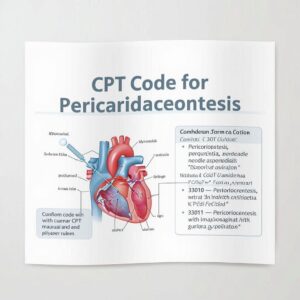
CPT Code for Pericardiocentesis
What Is Pericardiocentesis?
Pericardiocentesis is a procedure where a doctor removes fluid from the pericardium. That is the sac around the heart.
Why would someone need this? Several reasons. Fluid can build up due to infection, cancer, kidney failure, or after heart surgery. Too much fluid puts pressure on the heart. That pressure stops the heart from pumping well. Doctors call this cardiac tamponade. It is a medical emergency.
During the procedure, the doctor inserts a needle through the chest wall and into the pericardial sac. They may use an ultrasound or fluoroscopy to guide the needle. Once the needle is in place, they withdraw the fluid. Sometimes they leave a small tube called a catheter to drain fluid over time.
Now, let us look at the codes.
The Main CPT Code for Pericardiocentesis
The most common code you will use is 33016.
Here is the official descriptor:
33016 – Pericardiocentesis, including ultrasound guidance, with placement of a catheter for drainage.
This code covers the entire service. Needle insertion. Fluid removal. Catheter placement. Ultrasound guidance. Everything is bundled into one code.
You do not add a separate code for ultrasound guidance. You do not add a separate code for the catheter placement. It is all included.
When to Use 33016
Use 33016 when the doctor places a catheter and leaves it in for continued drainage. This is very common in the hospital. The patient may need fluid to drain for hours or days.
Real example: A patient with lung cancer develops a large pericardial effusion. The cardiologist performs a pericardiocentesis in the cardiac catheterization lab. She uses ultrasound to find the best spot. She inserts a needle, withdraws some fluid for testing, and then threads a soft catheter into the sac. The catheter stays in place. The patient goes to the ICU. You bill 33016.
Other CPT Codes for Pericardiocentesis
Not every pericardiocentesis involves a drainage catheter. Sometimes the doctor just wants to remove a small amount of fluid for diagnosis. Other times, they perform the procedure without imaging guidance. Here are the other codes you need to know.
33015 – Pericardiocentesis, without imaging guidance
Descriptor: Pericardiocentesis, without imaging guidance; for aspiration.
This is the simplest version. The doctor uses anatomical landmarks only. No ultrasound. No fluoroscopy. They insert a needle and withdraw fluid.
This code is rare today. Most doctors use ultrasound for safety. But you might see it in emergency situations where ultrasound is not available.
33017 – Pericardiocentesis, with imaging guidance, without catheter placement
Descriptor: Pericardiocentesis, with imaging guidance (e.g., ultrasound or fluoroscopy); for aspiration only, without placement of a catheter for drainage.
Use this code when the doctor uses imaging guidance but does not leave a catheter behind. They simply aspirate fluid and remove the needle.
Real example: A patient presents with a small, new pericardial effusion. The cause is unclear. The doctor uses ultrasound to guide a needle into the sac. He withdraws 30 mL of fluid for lab analysis. He removes the needle. No catheter is placed. You bill 33017.
33018 – Pericardiocentesis, with imaging guidance, for therapeutic or diagnostic aspiration, with or without catheter placement (add-on code)
Wait. This one needs a special explanation.
33018 is an add-on code. You cannot bill it alone. You use it with 33017 or 33015 for a repeat pericardiocentesis during the same session.
Let us say the doctor performs the initial aspiration (33017). Then the fluid reaccumulates quickly. The doctor decides to do a second aspiration during the same encounter. You bill 33017 for the first one and 33018 for the second.
Add-on codes are tricky. Most coders do not use 33018 often. In practice, if the fluid returns that fast, the doctor usually places a catheter and uses 33016 instead.
Quick Reference Table: CPT Codes for Pericardiocentesis
| CPT Code | Procedure Description | Imaging Guidance | Catheter Placed | Notes |
|---|---|---|---|---|
| 33015 | Aspiration only | No | No | Rare. Emergency use only. |
| 33016 | Aspiration with catheter drainage | Yes (included) | Yes | Most common code. Bundled service. |
| 33017 | Aspiration only | Yes | No | Use for diagnostic tap only. |
| 33018 | Repeat aspiration (add-on) | Yes | No | Bill with 33015 or 33017. |
Important note for readers: Do not use 33016 if the doctor only performs a diagnostic aspiration and removes the needle. That is 33017. Adding a catheter is the key difference. If there is any doubt, check the operative report. Look for words like “catheter secured,” “pigtail catheter placed,” or “drain left in place.”
What About Fluoroscopy and Ultrasound Guidance?
One of the most common questions we hear is: Do I need to code guidance separately?
The answer depends on the code.
-
33016 – Ultrasound guidance is included. Do not add 76942 or 76937.
-
33017 – Imaging guidance is included. Do not add a separate guidance code.
-
33015 – No guidance is used. Do not add anything.
Some coders try to add 76942 (ultrasound guidance for needle placement) to 33015. That is incorrect. The CPT guidelines explicitly state that these codes include guidance when performed.
If the doctor uses fluoroscopy instead of ultrasound, the same rule applies. It is included.
Real-World Scenarios: Which Code Should You Choose?
Let us practice with some case studies. Read each scenario. Pick the code. Then check the answer below.
Scenario 1
A 55-year-old man with kidney failure comes to the ER with shortness of breath. An echocardiogram shows a large effusion with signs of tamponade. The emergency physician uses bedside ultrasound to guide a needle into the pericardial space. He withdraws 200 mL of bloody fluid. He removes the needle. The patient feels better. No catheter is placed.
Your code: ________
Answer: 33017. Imaging guidance is used. No catheter is placed.
Scenario 2
A 70-year-old woman with breast cancer has a moderate effusion found on a routine scan. She is stable. The cardiologist performs a pericardiocentesis in the procedure room. He uses ultrasound to guide a needle. He places a 7 French pigtail catheter and connects it to a drainage bag. The catheter will stay in for 48 hours.
Your code: ________
Answer: 33016. Catheter is placed. Ultrasound guidance is included.
Scenario 3
A 32-year-old man has a small effusion of unknown cause. The cardiologist performs an ultrasound-guided aspiration. He obtains 15 mL of fluid for analysis. No catheter. Two hours later, the patient develops new symptoms. A repeat ultrasound shows the fluid has returned. The doctor performs a second aspiration. He removes another 20 mL. Still no catheter.
Your code(s): ________
Answer: 33017 for the first aspiration. 33018 (add-on) for the second aspiration.
Scenario 4
A rural emergency room without ultrasound capabilities. A patient presents in severe tamponade. The physician uses anatomical landmarks and a long spinal needle to aspirate 50 mL of fluid. The patient stabilizes. No catheter is placed.
Your code: ________
Answer: 33015. No imaging guidance. Aspiration only.
Billing Guidelines and Modifiers
You have the right code. Now you need to submit the claim correctly. Here are the most important billing rules.
Place of Service
Pericardiocentesis is almost always performed in a hospital setting. That means:
-
Place of service 21 (inpatient hospital)
-
Place of service 22 (outpatient hospital)
-
Place of service 23 (emergency room)
You rarely see this procedure in a doctor’s office. If you do, use place of service 11.
Modifiers
Modifier -26 (Professional component): Use this when you bill only for the physician’s work. The hospital or facility bills the technical component (use modifier -TC). Most private payers and Medicare expect separate billing for facility versus professional services.
Modifier -59 (Distinct procedural service): Use this if the doctor performs a pericardiocentesis and another unrelated procedure on the same day. For example, a pericardial window later the same day. Check your payer policies first. Some payers require modifier -XU instead of -59.
Important note for readers: Do not use modifier -50 (bilateral procedure). Pericardiocentesis is not a bilateral procedure. Do not use modifier -22 (increased procedural services) unless the documentation clearly supports significantly more work. Routine difficulty does not count.
National Average Reimbursement (Rough Estimates)
These numbers change every year. Always check your local Medicare fee schedule. But here are rough national averages for 2026 to give you a ballpark.
| CPT Code | Physician Fee (Modifier -26) | Facility Technical Fee (Modifier -TC) |
|---|---|---|
| 33015 | $85 – $110 | $180 – $250 |
| 33016 | $210 – $280 | $450 – $600 |
| 33017 | $150 – $200 | $300 – $420 |
| 33018 | $70 – $100 (add-on) | $140 – $200 (add-on) |
Private payers often pay higher. Medicaid pays lower. These are just estimates.
Common Billing Mistakes to Avoid
We have reviewed thousands of denied claims for pericardiocentesis. These are the top five mistakes we see over and over.
Mistake #1: Coding 33016 for a simple aspiration
This is the most common error. The doctor only withdraws fluid and removes the needle. The coder uses 33016 anyway. Wrong. Use 33017 if imaging is used. Use 33015 if no imaging is used.
How to avoid: Read the procedure note carefully. Look for “catheter,” “drain,” or “pigtail.” If those words are missing, do not use 33016.
Mistake #2: Adding a separate ultrasound code
Some coders add 76942 (ultrasound guidance for needle placement) to 33017 or 33016. Do not do this. The guidance is included in the primary code.
How to avoid: Remember the rule: If the code says “including ultrasound guidance,” stop. Do not add anything else.
Mistake #3: Using 33015 when ultrasound was used
A few coders still use 33015 because it pays slightly less than 33017. They think no one will notice. This is fraud. Payers audit ultrasound usage regularly. They will notice.
How to avoid: Bill what the doctor actually did. If an ultrasound machine was used and documented, use 33017.
Mistake #4: Forgetting the add-on code for repeat aspiration
Scenario 3 above is real. It happens. Coders often miss 33018 because they forget it exists.
How to avoid: When you see two aspirations in one encounter, ask yourself: Was a catheter placed? If no, the first is 33017, the second is 33018.
Mistake #5: Billing a separate E/M code on the same day without modifier -25
The doctor performs an evaluation and then decides to do a pericardiocentesis. You want to bill the E/M code (e.g., 99223 for inpatient) plus the procedure code. But the payer may bundle them.
How to avoid: Append modifier -25 to the E/M code. That tells the payer: “This was a separately identifiable service before the procedure decision.” Without modifier -25, the E/M code is often denied.
Documentation Requirements
Your claim is only as strong as your documentation. Here is what your operative note must include to support each code.
For 33015 (no imaging)
-
Statement that no ultrasound or fluoroscopy was used
-
Description of anatomical landmarks used
-
Needle type and size
-
Amount of fluid aspirated
-
Confirmation that no catheter was placed
For 33016 (with catheter)
-
Type of imaging guidance used (usually ultrasound)
-
Needle insertion site
-
Confirmation of needle position (e.g., “return of fluid”)
-
Description of catheter placed (size, type, length)
-
Statement that catheter was secured and connected to drainage
-
Final catheter position confirmed (e.g., “catheter in pericardial space”)
For 33017 (aspiration only, with imaging)
-
Type of imaging guidance used
-
Needle insertion site
-
Confirmation of needle position
-
Amount of fluid aspirated
-
Statement that no catheter was left in place
For 33018 (repeat aspiration)
-
Documentation of the first aspiration (33017 or 33015)
-
Reason for repeat aspiration (e.g., “fluid reaccumulated”)
-
Time between the two aspirations
-
Second needle insertion and aspiration amount
-
Statement that no catheter was placed
Important note for readers: If the doctor uses a pericardial drain that was placed by another physician (e.g., in interventional radiology), do not code pericardiocentesis. Code for drain management instead. Use 49419 (insertion of a tunneled catheter) or 49424 (drainage of fluid from a pre-existing catheter). Pericardiocentesis is for the initial needle puncture.
How Pericardiocentesis Codes Compare to Related Procedures
Sometimes the doctor performs a different procedure on the pericardium. Here is how those codes compare.
| Procedure | CPT Code(s) | Key Difference from Pericardiocentesis |
|---|---|---|
| Pericardial window (open) | 33025 | Surgical incision. General anesthesia. Opens the pericardium permanently. |
| Pericardial window (percutaneous) | 33026 | Uses a balloon or device. No catheter left for drainage. |
| Pericardiectomy | 33030, 33031 | Removes part of the pericardium. Major surgery. |
| Pericardial biopsy | 33019 | Takes a tissue sample. May be done with pericardiocentesis. |
| Thoracentesis | 32555 | Removes fluid from the lung space (pleural), not the heart sac. |
Do not confuse thoracentesis with pericardiocentesis. They sound similar but are completely different. Thoracentesis is for the pleural space around the lung. Pericardiocentesis is for the pericardial space around the heart.
Medicare and Payer-Specific Policies
Medicare covers pericardiocentesis as a medically necessary procedure. But they have specific requirements.
National Coverage Determination (NCD)
There is no specific NCD for pericardiocentesis. That means local Medicare Administrative Contractors (MACs) set their own policies. You need to check your MAC’s Local Coverage Determination (LCD).
Most LCDs require:
-
Documentation of a moderate or large effusion
-
Symptoms consistent with tamponade (hypotension, elevated jugular pressure, muffled heart sounds)
-
Or diagnostic need when cause of effusion is unknown
Some MACs also require an echocardiogram within 24 hours before the procedure. Check your local policy.
Commercial Payers
Private insurance companies generally follow CPT guidelines. But some have unique rules.
For example, UnitedHealthcare sometimes bundles pericardiocentesis with an echocardiogram if performed by the same physician on the same day. Aetna may require prior authorization for non-emergent cases. Cigna usually pays without prior auth for emergency procedures.
Always verify with the specific payer before you bill.
Frequently Asked Questions (FAQ)
Can I bill 33016 if the catheter is removed the same day?
Yes, if the catheter was placed with the intention of continued drainage. The code does not require a minimum dwell time. However, if the doctor places a catheter and removes it five minutes later, that is not true catheter drainage. Use 33017 instead.
Is sedation included in these codes?
No. Moderate sedation (codes 99152-99157) is not included in 33015, 33016, 33017, or 33018. If the doctor provides moderate sedation for patient comfort, you may bill it separately. Check your payer policy first. Some payers consider sedation inherent to the procedure.
What about fluoroscopy guidance for pericardiocentesis?
Use the same codes. 33016 and 33017 include “imaging guidance” without specifying ultrasound or fluoroscopy. Both are covered.
Can a nurse or PA perform pericardiocentesis and bill under the physician?
In most states, only physicians perform pericardiocentesis. If a non-physician practitioner (NPP) performs it, incident-to billing rules apply. The physician must be immediately available. Check state scope of practice laws first.
How do I code pericardiocentesis for a newborn?
Neonatal pericardiocentesis uses the same codes (33015, 33016, 33017). There are no separate pediatric codes for this procedure.
What if the doctor attempts but cannot aspirate fluid?
If the doctor makes a needle pass but obtains no fluid, you cannot bill a pericardiocentesis code. These codes require successful aspiration. You may bill an E/M code for the evaluation. Do not bill the procedure code for an unsuccessful attempt.
Additional Resources
For more official guidance, visit the American College of Cardiology Coding Resources page. They publish yearly updates on cardiovascular coding.
🔗 Recommended link: ACC Cardiovascular Coding Resources (external link, open in new tab)
You can also check the CPT® Assistant archives. The American Medical Association (AMA) publishes monthly guidance. Look for the May 2021 issue. It has a detailed article on pericardiocentesis coding.
Final Summary and Conclusion
Pericardiocentesis coding comes down to three simple questions: Was imaging used? Was a catheter placed? Was this a repeat aspiration?
33016 is your workhorse code for catheter drainage with imaging. 33017 covers diagnostic aspirations with imaging. 33015 is for rare cases without imaging. 33018 is the add-on for repeat aspirations.
Always document carefully. Always check your local payer policies. And when in doubt, read the operative note.
Disclaimer: This article is for educational purposes only. Coding and billing rules change frequently. Always verify current codes and payer policies before submitting claims. The author and publisher assume no responsibility for errors, omissions, or claims denied due to outdated information.