If you have been scrolling through your orthopedic coding manual or an EHR system looking for the specific “Silver bunionectomy” code, you might have hit a wall. Unlike the Keller or McBride procedures, the term “Silver” isn’t always listed as a primary index entry.
But don’t worry. You are in the right place.
The Silver bunionectomy is a classic, joint-preserving procedure used to correct a hallux valgus deformity (that painful bump on the side of your big toe). The key to coding it correctly lies not in the surgeon’s nickname for the procedure, but in the specific bones and joints being altered.
In this guide, we will walk you through exactly which CPT code applies, how to distinguish it from other bunion surgeries, and how to write a note that supports your claim.
CPT Code for Silver Bunionectomy
What Exactly Is a Silver Bunionectomy?
Before we look at the number, we need to understand the surgery.
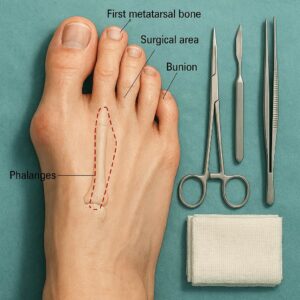
A standard Silver bunionectomy is a soft tissue and bony procedure performed on the first metatarsophalangeal (MTP) joint. It usually involves two specific actions:
-
Medial eminence resection: The surgeon shaves down the bony bump on the inside of the foot.
-
Lateral soft tissue release: The surgeon releases the tight tendons pulling the toe outward.
Unlike a Lapidus (fusion of the joint) or a closing base wedge osteotomy (cutting the bone far back), the Silver procedure focuses on the head of the first metatarsal and the joint capsule.
Why “Silver” Isn’t Always in the Index
The AMA’s CPT manual does not list “Silver” as a primary code descriptor. Instead, the code is selected based on the work performed.
In the world of podiatry and orthopedics, the Silver procedure is essentially a bunionectomy with a distal soft tissue release and partial resection of the joint.
The Exact CPT Code for Silver Bunionectomy
After reviewing the 2025-2026 CPT guidelines and cross-referencing with standard orthopedic references, the most accurate code for a classic Silver bunionectomy is:
CPT 28296
Descriptor: Correction, hallux valgus (bunionectomy), with sesamoidectomy, when performed; with metatarsal osteotomy (eg, Mitchell, Chevron, or concentric type procedures).
Wait, does a Silver use an osteotomy?
Yes. While the original Silver procedure was mostly a resection (shaving), modern adaptations (often called the “Silver-Chevron” or “Modified Silver”) include a “V” cut (Chevron osteotomy) to shift the metatarsal head back into alignment.
If there is NO osteotomy (just shaving and release):
If the surgeon literally only shaves the bump and releases the tendon without cutting the bone to shift it, you would use CPT 28290 (Correction, hallux valgus; simple resection of medial eminence, with or without soft tissue release).
However, most payers consider simple resection (28290) outdated for symptomatic hallux valgus. The gold standard for a true “Silver” today is 28296 because it includes realignment.
Silver vs. Other Bunion Codes (The Comparison Table)
This is where most coders get confused. You cannot guess the code based on the doctor’s favorite name. You must read the op report.
Here is a fluid, reader-friendly comparison of the most common bunion codes.
| CPT Code | Procedure Name | Key Feature (What the bone looks like) | Does this apply to Silver? |
|---|---|---|---|
| 28290 | Simple Resection | Shave the bump. No screws. No bone cutting. | Only for the “old school” Silver without osteotomy. Rarely paid. |
| 28292 | Keller Procedure | Partial removal of the base of the proximal phalanx (toe bone). | No. Silver works on the metatarsal, not the toe base. |
| 28296 | Chevron / Silver | “V” cut in the metatarsal head. Moved sideways. Held with 1-2 screws. | Yes. This is the modern Silver bunionectomy. |
| 28297 | Lapidus Procedure | Fusion of the metatarsal-cuneiform joint (midfoot). Plates and screws. | No. Silver preserves the joint; Lapidus kills the joint. |
| 28298 | Proximal Osteotomy | Cut high up near the midfoot (base of metatarsal). | No. Silver cuts near the toe joint (distal), not the base. |
A Quick Quote for Clarity
“If the surgeon makes a curved incision, shaves the bump, releases the tendon, and then makes a ‘V’ cut in the bone just behind the toe joint to slide it over—you are looking at CPT 28296. That is the Silver bunionectomy.”
When to Use 28296 (Silver) vs. 28297 (Lapidus)
This is a major denial risk.
Both codes fix a bunion, but they treat different patient populations.
-
CPT 28296 (Silver): Used for mild to moderate bunions. The joint is still flexible. The patient is usually younger or active. The goal is to preserve motion.
-
CPT 28297 (Lapidus): Used for severe bunions or hypermobility. The surgeon permanently fuses the joint. The toe will not bend much afterward.
Crucial Note for Billers: If the surgeon documents a “Silver bunionectomy” but describes removing the articular cartilage and placing hardware across the metatarsal-cuneiform joint, you do not have a Silver. You have a Lapidus (28297). Do not code what they call it; code what they did.
How to Read the Operative Report for Silver Bunionectomy
To confidently assign CPT 28296, you need to see three specific elements in the body of the operative report. If one is missing, the code changes.
Element 1: The Incision and Exposure
-
Look for: “Longitudinal incision over the medial aspect of the first MTP joint.”
-
Why: This allows access to the bump.
Element 2: The Lateral Release
-
Look for: “The adductor hallucis tendon was identified and released from the lateral sesamoid.”
-
Why: This relaxes the pull that is causing the toe to drift outward.
Element 3: The Osteotomy (The “Silver” part)
-
Look for: “A chevron osteotomy was performed at the metatarsal head. The capital fragment was translated laterally approximately 4mm and secured with a 2.0mm Herbert screw.”
-
Why: This is the bone realignment. Without this, you drop to 28290.
The “Sesamoidectomy” Question
You will notice CPT 28296 says “with sesamoidectomy, when performed.”
Do not automatically add a separate code for sesamoid removal. The work of removing a medial sesamoid (the tiny bone under the joint) is included in 28296. You cannot bill an extra code (e.g., 28315) unless the surgeon goes into a completely different area for a different reason.
Common Pitfalls and Denial Reasons
Even experienced coders slip up here. Avoid these three mistakes to keep your claim clean.
Pitfall 1: Using an Unlisted Code (28899)
The error: “I don’t see Silver in the book, so I will use unlisted code 28899.”
The fix: Do not do this. 28899 should be your last resort. Silver is clearly described by 28296 (or 28290 for simple resections). Using an unlisted code for a common procedure guarantees a denial and a records request.
Pitfall 2: Billing for “Tendon Release” Separately
The error: Billing CPT 28296 for the bone work and CPT 28270 (Capsulotomy) for the soft tissue release.
The fix: You cannot unbundle this. The lateral release is inherent to the bunionectomy code. Modifier -59 would not apply because these are not separate procedures; they are one surgical event.
Pitfall 3: Modifier Mismatch (Bilateral Bunions)
The error: The surgeon does Silver bunions on both feet. The coder bills 28296 and 28296-50.
The fix: This is correct, but watch your payer. Many commercial payers want 28296-LT and 28296-RT (two lines) rather than 28296-50 (one line). Medicare typically prefers the -50 modifier. Always check the specific fee schedule.
The 2026 Coding Environment for Bunion Surgery
As of April 2026, payers are increasing scrutiny on foot and ankle surgery codes. Why? Because many “simple” bunion surgeries are being upgraded to complex ones without medical necessity.
To ensure your Silver bunionectomy (28296) gets paid:
-
Document the angle: The surgeon should note the hallux valgus angle (usually >15 degrees) and the intermetatarsal angle (usually >9 degrees) to justify the osteotomy.
-
Document failure of conservative care: Physical therapy, orthotics, NSAIDs, and shoe modifications for at least 3 months. If this is missing, the medical reviewer will deny the surgery as “not medically necessary.”
-
X-ray availability: Keep the pre-op and post-op X-rays in the chart. If audited, the payer will want to see the bone cut and translation.
Global Period and Post-Op Care
CPT 28296 carries a 90-day global period.
This means the reimbursement for the surgery covers all standard post-operative visits for 90 days. These include:
-
Suture removal.
-
Cast changes (if non-immobilization).
-
Standard follow-up X-rays.
-
Wound checks.
What is separately billable during global?
Only distinct, unrelated issues. For example, if the patient comes back on day 45 with a new ankle sprain on the opposite foot, you can bill that E/M service with modifier -24 (Unrelated evaluation by the same physician during a postoperative period).
Frequently Asked Questions (FAQ)
Q1: Can I use 28296 if the surgeon uses a pin instead of a screw?
A: Yes. The code does not specify the type of fixation. Whether the surgeon uses a K-wire, a screw, or no hardware (if the cut is stable), if they performed a distal metatarsal osteotomy (Chevron), the code is 28296.
Q2: My surgeon says they did a “Reverdin” procedure. Is that the same as Silver?
A: Similar, but not identical. A Reverdin is a medial closing wedge osteotomy at the metatarsal head. It is also coded as 28296 because it is a distal osteotomy. For coding purposes, the “Silver” and “Reverdin” often share the same CPT code, though the bone cuts differ.
Q3: What if the Silver bunionectomy is done with an Akin osteotomy (toe straightening)?
A: Great question. An Akin osteotomy is a cut at the base of the proximal phalanx (toe bone) to straighten the tip. If the surgeon does a Silver (28296) AND an Akin (28299), you must check the CCI edits. Usually, you can bill 28296 and 28299-51 (Multiple procedures) because they are separate bones (metatarsal vs. phalanx).
Q4: Is there a specific “Silver” code for pediatric patients?
A: No. CPT codes are anatomy and procedure-specific, not age-specific. A Chevron osteotomy (Silver) in a 14-year-old uses the same code (28296) as a 50-year-old. The difference is in the E/M level for the visit, not the surgical code.
Q5: The op report says “Modified Silver.” What do I do?
A: Ignore the word “Modified.” Look for the three elements: Bump resection, lateral release, and distal bone cut (osteotomy). If all three are there, it is 28296. If the bone cut is proximal (near the midfoot), it is 28298. Do not let adjectives confuse you.
Additional Resources for Coders
Coding for foot and ankle surgery requires constant updates. Do not rely on memory alone.
-
AAOS (American Academy of Orthopaedic Surgeons) Global Service Data: A paid resource that tells you exactly how many minutes a procedure typically takes and what work is included.
-
CMS Local Coverage Determinations (LCDs): Search for “Hallux Valgus” and your state. Many MACs (like Noridian, Novitas, Palmetto) publish specific lists of which X-ray angles and conservative treatments are required before approving 28296.
-
Codingline (Podiatry Management): An excellent forum for real-world coding scenarios.
Link to CMS Fee Schedule Lookup Tool – Use this official government tool to see the exact reimbursement rate for CPT 28296 in your zip code.
A Note on Audits (Read This)
If you are audited for bunion surgery codes, the auditor will look for one thing: The Intraoperative X-ray.
For a Silver bunionectomy (28296), the surgeon should take a fluoro shot or a portable X-ray showing the “V” cut (Chevron) before closing the skin.
If the note says “Silver bunionectomy” but the X-ray shows a fusion plate (Lapidus), you have a documentation mismatch. If the note says “Silver” but the X-ray shows no hardware and no bone cut, you should have billed 28290.
Pro tip: Ask your surgeons to stop using eponyms (Silver, Keller, McBride) in the procedure title. Ask them to write: “Procedure: Distal Chevron Osteotomy with Lateral Release (Silver bunionectomy).” This saves your billing team hours of headache.
Conclusion
Finding the correct CPT code for a Silver bunionectomy does not require guesswork. You simply need to remember that modern orthopedics rarely uses the simple resection anymore. In 99% of cases where a surgeon performs a “Silver,” they are cutting the bone to shift the alignment.
The bottom line: Use CPT 28296 for a distal metatarsal osteotomy (Chevron) with lateral release. Use CPT 28290 only if the surgeon specifically states no osteotomy was performed. Always document the X-ray angles and the specific bone cut to survive an audit.
Disclaimer: The information in this article is for educational purposes only. CPT codes are copyright of the American Medical Association. Always verify coding with your specific payer and current CPT manual.
Author: Medical Coding Team
Date: APRIL 10, 2026