If you work in a clinical lab, a hospital respiratory department, or a pulmonary practice, you have likely asked: What is the correct CPT code for culture sputum AFB?
The short answer is CPT 87116. But the full picture is more detailed.
You need to know when to use 87116, when to add a smear code, how Medicare bundles payments, and which diagnosis codes justify medical necessity. This guide walks you through everything—from basic definitions to advanced payer rules.
Let us start with the most important fact: 87116 is the standard code for culture of mycobacteria (AFB culture) from any source, including sputum.
But sputum is not the only source. And culture alone is rarely the only test ordered. So keep reading to learn how to build a clean, audit-proof claim.
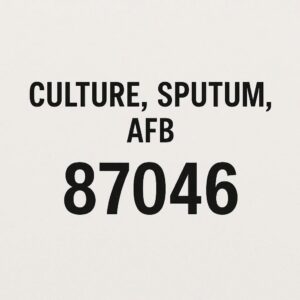
CPT Code for Culture Sputum AFB
What Does CPT 87116 Actually Cover?
CPT 87116 is titled: Culture, mycobacterial (AFB), definitive identification with susceptibilities if performed.
In simple terms: your lab takes the patient’s sputum sample, places it on specialized growth media (like Löwenstein-Jensen or Middlebrook), incubates it for weeks, looks for colonies of Mycobacterium tuberculosis or nontuberculous mycobacteria (NTM), and then identifies the organism. If the doctor needs drug susceptibility testing (DST), that is also included in 87116.
Key points about 87116:
-
It is a definitive culture – not just a screen.
-
It includes identification of the mycobacterial species.
-
It includes susceptibility testing if performed.
-
It is reported once per specimen, not per day or per organism.
-
The specimen source (sputum, BAL, tissue, etc.) does not change the code.
Important note for readers: Do not report 87116 for AFB smears. A smear (microscopy for acid-fast bacilli) is a different service with its own code: CPT 87206.
Many claims are denied because a provider bills only the smear or only the culture when both were done. We will cover the correct bundling rules later.
When Should You Use the Sputum AFB Culture Code?
Sputum is the most common respiratory specimen for AFB testing. A patient with a chronic cough, night sweats, weight loss, and abnormal chest imaging will often be asked to produce a deep cough sputum sample – ideally three consecutive early-morning specimens.
Each sputum sample that goes to the lab for AFB culture is billed with 87116.
Real-world example:
A pulmonologist orders:
-
AFB smear and culture x 3 sputum specimens (collected on three different days).
Correct coding per specimen:
-
87116 (culture + ID + susceptibilities if performed)
-
87206 (AFB smear, fluorochrome or Kinyoun stain)
If the lab performs the smear and the culture on the same specimen, both codes are separately billable unless your payer bundles them. We will discuss Medicare’s Clinical Laboratory Fee Schedule (CLFS) and NCCI edits shortly.
Do not use 87116 for:
-
Non-sputum sources billed as a different code? No – 87116 works for all sources.
-
Screening without clinical suspicion (payer denial risk).
-
Environmental samples or quality control testing.
CPT Codes Related to AFB Sputum Testing (Full Table)
Below is a clean, reader-friendly table of all common AFB-related codes. This helps you see where 87116 fits.
| CPT Code | Description | Common Use with Sputum |
|---|---|---|
| 87116 | Culture, mycobacterial (AFB), definitive identification with susceptibilities if performed | Main code for AFB culture |
| 87206 | Smear, primary source, with interpretation; fluorochrome or acid-fast stain for AFB | Same-day smear before culture |
| 87015 | Concentration (any type), for infectious agents | Often used for sputum digestion/decontamination |
| 87118 | Mycobacterial culture, isolation and presumptive identification only | Less common; does not include susceptibilities |
| 87149 | Culture, mycobacterial, identification by nucleic acid probe | Add-on for rapid ID (e.g., M. tuberculosis complex) |
| 87150 | Mycobacterial drug susceptibility, per drug | Usually included in 87116; bill separately only if explicitly not included per payer |
Takeaway: For routine sputum AFB culture with susceptibility, 87116 is your go-to code. For smear, add 87206.
AFB Smear vs. AFB Culture: Why You Need Both (and How to Bill)
Many clinicians mistakenly think an AFB smear is the same as a culture. It is not.
-
Smear (87206): Microscopy. Result in 24 hours. Tells you if acid-fast bacilli are present. Cannot differentiate M. tuberculosis from nontuberculous mycobacteria. Lower sensitivity.
-
Culture (87116): Growth on media. Result in 2–6 weeks. Gold standard. Provides species ID and drug susceptibility.
A negative smear with a positive culture happens often (low organism burden). A positive smear with a negative culture can occur from dead bacilli or contamination.
Billing both on the same specimen:
Medicare and most commercial payers accept both 87116 and 87206 on the same date for the same sputum specimen when both services are medically necessary and separately performed.
However, check your local MAC (Medicare Administrative Contractor) and private payer policies. Some commercial plans bundle the smear into the culture payment.
Pro tip: Always append modifier 59 (or XS, XU) to 87206 if the payer requires it to show the smear is a distinct service. Many lab billing systems automatically add modifier 59 to AFB smears when billed with 87116.
Medicare Payment and NCCI Edits for 87116
Medicare’s Clinical Laboratory Fee Schedule (CLFS) pays for 87116 under the outpatient prospective payment system (OPPS) for hospital labs and under the physician fee schedule for independent labs.
As of 2026, the national payment amount for 87116 is approximately $35–$45, depending on geographic adjustments. 87206 pays roughly $10–$15.
NCCI (National Correct Coding Initiative) Edits:
-
87116 and 87206 are not bundled by NCCI. You can bill them together without a modifier in most cases.
-
87116 and 87118 are mutually exclusive. Do not bill both for the same specimen.
-
87116 and 87149 can be billed together if the probe is used for rapid identification before culture results are final. Add modifier 59 to 87149.
Medicare coverage for AFB sputum culture:
Medicare covers AFB culture (87116) when:
-
The patient has signs/symptoms of pulmonary tuberculosis (cough >3 weeks, hemoptysis, fever, night sweats, weight loss).
-
There is known TB exposure with positive screening test.
-
There is immunocompromised status (HIV, organ transplant, long-term steroids) with respiratory symptoms.
-
Follow-up testing after positive AFB smear or culture to monitor treatment response (though frequency is limited).
Remember: Medicare does not pay for screening AFB cultures in asymptomatic low-risk patients. Medical necessity must be documented in the chart.
Diagnosis Codes That Support Medical Necessity for 87116
You need an ICD-10-CM code that justifies AFB culture of sputum. Below are the most commonly accepted codes.
| ICD-10-CM Code | Diagnosis | Notes |
|---|---|---|
| A15.0 | Tuberculosis of lung | Confirmed or suspected |
| A15.9 | Respiratory tuberculosis unspecified | Used before species confirmation |
| R05 | Cough | Chronic cough |
| R06.2 | Wheezing | With suspicion of infection |
| R50.9 | Fever, unspecified | With respiratory symptoms |
| R68.89 | Other general symptoms and signs | Weight loss, malaise |
| Z11.1 | Encounter for screening for respiratory tuberculosis | Only for high-risk groups (e.g., healthcare workers, recent immigrants) |
| Z20.1 | Contact with and exposure to tuberculosis | Asymptomatic exposed patient |
| B44.9 | Aspergillosis, unspecified | Rule out co-infection with NTM |
| B90.9 | Sequelae of respiratory tuberculosis | Follow-up testing |
Do not use vague codes like Z00.00 (general exam) or R53.83 (fatigue) alone. They will trigger denials.
Step-by-Step: How to Bill a Sputum AFB Culture
Let us walk through a real patient case.
Case:
Jane, 54 years old, HIV-positive, presents with productive cough for 6 weeks, low-grade fever, and night sweats. Chest x-ray shows upper lobe infiltrates. The provider orders AFB smear and culture x 3 sputum specimens, collected on Monday, Wednesday, and Friday.
Lab workflow for each specimen:
-
Sputum received → digestion/decontamination (87015 – often bundled into lab overhead but separately billable by some labs).
-
Concentrated sediment used for smear (87206).
-
Same sediment inoculated onto solid and liquid media (87116).
-
Incubation at 37°C for up to 8 weeks.
-
Positive growth → identification (included in 87116).
-
Susceptibility testing (included in 87116).
Billing per specimen:
-
87116 – AFB culture, definitive, with susceptibilities
-
87206 – AFB smear
Modifier: Add modifier 59 to 87206 if required by the payer (most common with Medicare).
ICD-10-CM: B20 (HIV disease) + A15.0 (tuberculosis of lung) – or A15.9 pending culture confirmation.
Place of service: Depends on where the lab is located (e.g., 81 for independent lab, 22 for hospital outpatient).
Total charge per specimen: Varies. Many labs charge $100–$250 for the culture and $30–$60 for the smear before contractual adjustments.
Common Billing Errors and How to Avoid Them
Even experienced billers make mistakes with AFB culture codes. Below are the top five errors.
1. Billing 87116 for a smear only
If the lab only performed a smear (e.g., because the specimen was insufficient for culture), do not bill 87116. Bill 87206 only. Document the reason.
2. Billing 87116 multiple times for the same specimen
One specimen = one culture code. Even if the lab incubates for 8 weeks and checks weekly, you bill 87116 once per specimen.
3. Missing the smear code
Some practices forget to add 87206 when both smear and culture are done. That leaves money on the table.
4. Using 87118 instead of 87116
87118 is for presumptive identification only (e.g., growth seen but no speciation or susceptibility). Most modern labs perform definitive identification and susceptibility, so 87116 is correct. Using 87118 when you did more work can lead to undercoding.
5. No diagnosis or a non-covered diagnosis
A claim with R05 (cough) alone may be denied unless the chart notes justify suspicion of TB (e.g., exposure, imaging, risk factors). Add a secondary code like Z20.1 or B20.
Private Payer Policies: What to Watch For
Medicare rules are fairly consistent. Private payers (UnitedHealthcare, Cigna, Aetna, BCBS) vary.
-
UnitedHealthcare: Covers 87116 and 87206 together without prior authorization for suspected TB. Requires medical necessity documented.
-
Cigna: Bundles smear and culture in some plans. Check the member’s benefit summary.
-
Aetna: Considers AFB culture medically necessary for patients with symptoms or high-risk exposure. Denies routine screening.
-
Blue Cross Blue Shield (varies by state): Some BCBS plans require a positive AFB smear before approving culture. Others allow direct culture.
Always verify with the specific payer’s medical policy. Search for “mycobacterial culture medical policy Aetna” or similar.
Billing for Multiple Sputum Specimens (3 Consecutive Days)
For pulmonary TB diagnosis, the standard is three sputum specimens collected 8–24 hours apart, with at least one being an early-morning specimen.
Can you bill three units of 87116?
Yes – one per specimen. But payers may limit the number of cultures per episode.
Medicare’s Local Coverage Determinations (LCDs) often state:
“Up to three AFB cultures per admission or outpatient episode are considered reasonable and necessary.”
If a fourth culture is ordered without a change in clinical status (e.g., persistent positive cultures after 4 weeks of therapy), it may be denied as not medically necessary.
Billing tip: Use the same diagnosis code for all three specimens. Append modifier 91 (repeat clinical diagnostic laboratory test) to the second and third 87116 only if required by your payer. Many payers do not require modifier 91 for separate collection dates, but some do.
How to Document Sputum AFB Culture in the Medical Record
Clean documentation prevents denials. Ensure the following elements are present:
-
Order: Signed order from a qualified provider stating “AFB culture sputum” or “mycobacterial culture.”
-
Specimen source: Sputum (not saliva – note “deep cough specimen” or “induced sputum”).
-
Collection date and time: Separate dates for each of three specimens.
-
Clinical indication: Symptoms (cough, fever, weight loss), risk factors (HIV, transplant, TB exposure), imaging findings.
-
Lab report: Includes method (liquid or solid media), dates of inoculation, reading dates, organism identified (e.g., M. tuberculosis complex, M. avium complex), and susceptibilities.
-
Interpretation: Provider note explaining results and next steps.
Without proper documentation, an audit can result in recoupment of payment.
What About Molecular Testing for AFB? (Not a Culture)
Molecular tests like CPT 87556 (Infectious agent detection by nucleic acid, MTB complex, amplified probe) are not cultures. They are separate tests.
Do not replace 87116 with a molecular test. Molecular tests are faster but less comprehensive (they only look for specific DNA sequences). Culture remains the gold standard for full identification and susceptibility.
You can bill both 87116 and 87556 on the same specimen when clinically appropriate (e.g., rapid confirmation of M. tuberculosis from a smear-positive specimen). Check NCCI edits – they are not bundled, but you may need modifier 59.
FAQ: Frequently Asked Questions
1. What is the exact CPT code for culture sputum AFB?
CPT 87116. It covers definitive mycobacterial culture, identification, and susceptibility testing from any specimen source, including sputum.
2. Do I need a separate code for AFB smear?
Yes. CPT 87206 is the code for AFB smear (acid-fast stain, fluorochrome or Kinyoun). Bill it with 87116 when both are performed on the same specimen.
3. Can I bill 87116 three times for three sputum samples?
Yes, if the provider ordered three separate specimens collected on different dates. Use modifier 91 for repeat tests if your payer requires it.
4. Does Medicare cover AFB sputum culture?
Yes, for patients with signs/symptoms of TB, known exposure, or immunocompromised status with respiratory symptoms. Medicare does not cover routine screening in asymptomatic low-risk patients.
5. Is 87116 bundled with 87206 under NCCI?
No. NCCI does not bundle these two codes. You may bill them together. Some payers still require modifier 59 on 87206 to indicate a distinct service.
6. What ICD-10 code should I use for AFB culture?
Common codes: A15.0 (TB lung), A15.9 (respiratory TB unspecified), R05 (cough), Z20.1 (TB exposure), B20 (HIV). Always add specific symptoms or risk factors.
7. How long does it take to get results for CPT 87116?
Preliminary negatives may be reported at 6 weeks. Positives can appear in 1–4 weeks. Final identification and susceptibilities add 1–3 weeks.
8. Can a nurse or medical assistant bill 87116?
No. Only the laboratory performing the test can bill for the technical component. A provider billing for professional interpretation would use a different code (e.g., 87116 with modifier 26 is rarely used – most labs bill global).
Additional Resource
For the most current Medicare payment rates and Local Coverage Determinations for AFB culture (87116), visit the CMS Clinical Laboratory Fee Schedule public files page:
🔗 https://www.cms.gov/medicare/payment/clinical-lab-fee-schedule/clinlab-fee-schedule-public-files
Look for the “CLFS Public File” for the current calendar year. Search for CPT 87116 to see the national payment amount and any applicable gap-fill amounts.
Conclusion
The correct CPT code for culture sputum AFB is 87116, which covers definitive mycobacterial culture, identification, and susceptibility testing. For AFB smear, add 87206 on the same specimen. Always document medical necessity with appropriate ICD-10 codes, follow payer-specific bundling rules, and avoid billing multiple cultures without clinical indication. Use this guide to submit clean claims, reduce denials, and ensure patients receive timely diagnosis of tuberculosis and nontuberculous mycobacterial infections.