If you have ever typed “cpt code for sniff test” into a search engine, you probably found a mix of forum answers, outdated suggestions, and vague references.
You need clarity. You need accuracy. And most importantly, you need a code that will actually get your claim paid.
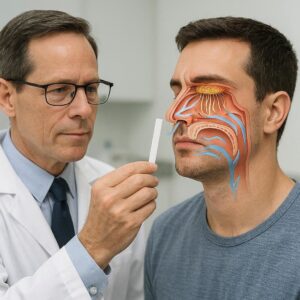
The sniff test—formally known as a fluoroscopic sniff test or diaphragm fluoroscopy—is a real-time X-ray exam that checks how your diaphragm moves when you breathe in and out quickly through your nose.
In this guide, we will walk through the correct CPT code, how to document it properly, common billing mistakes, and what to do when payers push back.
Let us start with the single most important answer.
CPT Code for Sniff Test
The Correct CPT Code for a Sniff Test
The standard and widely accepted CPT code for a sniff test is 70370.
CPT 70370 is officially described as: Radiologic examination; pharynx and/or larynx, including fluoroscopy and/or magnification.
Wait—pharynx and larynx? That sounds like a throat exam, not a diaphragm test.
That is a fair question. And it confuses many coders.
The reason 70370 is used for a sniff test is historical and practical. During a sniff test, the radiologist uses fluoroscopy (live X-ray) to watch the diaphragm move. But to get a clear view, they focus on the lower chest and upper abdomen. The code 70370 is the closest fluoroscopy code that includes dynamic imaging of the upper airway and adjacent structures. Many payers have accepted this code for diaphragm fluoroscopy for decades.
However, some coders and physicians argue that a more accurate code might be 76000 (Fluoroscopy, up to one hour, physician time). But 76000 is typically an add-on code or used for general fluoroscopic guidance. It does not specify the anatomical region.
In real-world practice, 70370 remains the most commonly reported code for a sniff test.
Important note: Always check with your specific commercial payer or Medicare Administrative Contractor (MAC). A small but growing number of payers now ask for 76000 with a specific modifier or a diaphragm-specific HCPCS code if one exists in your local coverage determination.
Why the Sniff Test Is Ordered
Before we dive deeper into billing, let us quickly cover why this study exists.
A sniff test helps diagnose:
-
Diaphragm paralysis (one side not moving)
-
Diaphragm weakness (reduced movement)
-
Phrenic nerve injury (often after heart or lung surgery)
-
Elevated hemidiaphragm (unknown cause)
-
Shortness of breath with unclear source
During the test, the patient lies down and then sits up. They take quick, sharp sniffs through their nose. The fluoroscope records how each side of the diaphragm moves.
Normal diaphragm moves down on sniff. Paradoxical movement (upward) means paralysis.
When Not to Bill 70370
You should not bill a sniff test separately if:
-
The sniff test is part of a larger fluoroscopic exam (like a barium swallow or videofluoroscopic swallowing study). In that case, the primary procedure code includes the fluoroscopy.
-
The ordering physician simply wants a standard chest X-ray. That is 71045 or 71046, not a sniff test.
-
No fluoroscopic recording or real-time interpretation was done. Some clinics try to bill a sniff test based on ultrasound alone. That is a different code (see below).
Ultrasound Sniff Test: A Different Code
Sometimes clinicians perform a “sniff test” using ultrasound instead of fluoroscopy. This is becoming more common because it is radiation-free.
If the test uses ultrasound to evaluate diaphragm movement during sniffing, do not use 70370.
Instead, you would typically report an unlisted code or a peripheral nerve code. However, most coders use:
76604 – Ultrasound, chest (includes mediastinum), real-time with image documentation.
Or, if the exam is limited to diaphragm evaluation only:
93975 – Vascular ultrasound, duplex scan of hemodialysis access, or 93976 if limited. But many payers prefer 76604 with a detailed note.
Because there is no specific diaphragm ultrasound code, many practices append modifier 52 (reduced services) or 22 (increased procedural services) and attach a clear report.
Pro tip: If your clinic performs ultrasound sniff tests frequently, contact your local MAC for a written guidance. Some regions have local coverage articles that specify which code to use.
Billing 70370: Technical vs. Professional Components
Like many radiology codes, 70370 has two parts:
| Component | Who bills | What it covers | Modifier |
|---|---|---|---|
| Technical (TC) | Facility or imaging center | Equipment, technician, supplies | TC |
| Professional (PC) | Radiologist or interpreting physician | Physician interpretation, report | 26 |
| Global | Single provider (e.g., radiology group) | Both TC and PC | None |
If a hospital does the test and a separate radiologist reads it, the hospital bills 70370-TC and the radiologist bills 70370-26.
If your private office owns the fluoroscope and your physician both performs and reads the test, you bill 70370 without a modifier.
Do not bill both TC and 26 on the same claim from the same provider. That is double-billing.
Documentation Requirements for a Sniff Test (70370)
You cannot just write “sniff test done, normal.” Payers will deny.
Your report must include:
-
Reason for exam (e.g., “Elevated right hemidiaphragm on prior chest X-ray, rule out paralysis”)
-
Fluoroscopy time (e.g., “Total fluoroscopy time: 45 seconds”)
-
Patient positioning (supine and upright or sitting)
-
Description of diaphragm movement on each side during normal breathing and during sniff
-
Any paradoxical motion (upward movement on sniff)
-
Comparison to prior studies (if available)
-
Impression (e.g., “Normal diaphragmatic excursion bilaterally” or “Left hemidiaphragm paralysis”)
Without these elements, expect a denial for lack of medical necessity or incomplete documentation.
Medicare and Sniff Test Coverage
Medicare does not have a single national coverage determination for the sniff test. Coverage varies by region.
However, most Medicare Administrative Contractors (MACs) cover diaphragm fluoroscopy (70370) when:
-
There is documented unexplained dyspnea
-
Prior imaging shows elevated hemidiaphragm
-
There is suspected phrenic nerve injury after surgery or trauma
-
Noninvasive testing (like pulmonary function tests) is inconclusive
Medicare will generally not cover a sniff test for:
-
Routine shortness of breath without prior workup
-
As part of a general pre-surgical clearance
-
Screening for asymptomatic elevated diaphragm found incidentally
Always check your local MAC’s Local Coverage Determination (LCD). Search for “Diaphragm Fluoroscopy” or “Phrenic Nerve Palsy.”
Common Denial Reasons and How to Fix Them
Even with the correct code, denials happen. Here are the most frequent ones.
Denial: “Code 70370 does not match diagnosis”
Why: The diagnosis does not support a pharynx/larynx exam.
Fix: Use a diaphragm-specific diagnosis code like:
-
J98.6 – Disorders of diaphragm
-
G54.2 – Phrenic nerve palsy
-
R06.02 – Shortness of breath, orthopnea (if documented)
Do not use throat diagnoses (e.g., J31.2) unless the patient actually has a throat condition.
Denial: “Missing medical necessity”
Why: The ordering provider did not explain why a sniff test is needed.
Fix: Add a brief note in the order or prior authorization: “Patient has elevated right diaphragm on CXR with unexplained dyspnea. Sniff test needed to differentiate paralysis vs. weakness.”
Denial: “Fluoroscopy not separately billable”
Why: The payer bundles fluoroscopy into another procedure on the same day.
Fix: Check if the patient had another fluoroscopic exam (e.g., GI series) on the same date. If yes, you may need to appeal with documentation that the sniff test was a separate anatomical region and separate medical necessity.
How Much Does a Sniff Test Cost (CPT 70370)?
Prices vary widely.
| Setting | Approximate cash price | Insurance-negotiated rate |
|---|---|---|
| Small outpatient clinic | $200 – $400 | $80 – $150 |
| Hospital outpatient department | $500 – $1,200 | $150 – $350 |
| Large academic medical center | $800 – $1,800 | $200 – $500 |
These are estimates. Your actual reimbursement depends on your payer contracts, region, and modifiers.
Patients without insurance should always ask for a self-pay discount upfront. Many facilities offer 30-50% off the billed amount.
Sniff Test vs. Other Diaphragm Tests: Coding Comparison
| Test | CPT Code | Key difference |
|---|---|---|
| Fluoroscopic sniff test | 70370 (most common) | Real-time X-ray, quick, widely accepted |
| Ultrasound sniff test | 76604 or unlisted | No radiation, but payer confusion common |
| Diaphragm EMG (needle) | 95869 | Measures nerve signal, not movement |
| Phrenic nerve conduction study | 95938 | Measures nerve conduction velocity |
| MRI diaphragm | 71555 | Expensive, not first-line |
If your referring provider is unsure which test to order, explain that 70370 is the traditional, payer-familiar option.
Sample Appeal Letter for Denied 70370 Claim
If your claim is denied as “not medically necessary” or “incorrect code,” use a letter like this.
[Date]
[Payer Name]
Appeals Department
[Address]RE: Patient: [Name], ID: [Number]
Date of Service: [Date]
CPT Code: 70370
Denial Reference: [Number]Dear Appeals Department,
This is an appeal for the above referenced claim, denied for [reason from EOB].
The patient presented with [brief clinical history, e.g., right diaphragm elevation on chest X-ray and persistent dyspnea]. A fluoroscopic sniff test (70370) was ordered to evaluate for diaphragmatic paralysis.
Code 70370 is the standard CPT code for diaphragm fluoroscopy as recognized by [cite local medical policy or CPT Assistant if available]. The study was performed with real-time fluoroscopic imaging. The attached report documents diaphragm excursion, patient positioning, and final interpretation.
This study is not a throat or swallowing study. It is the correct code for dynamic evaluation of diaphragm motion.
Please reverse the denial and reprocess this claim.
Sincerely,
[Provider Name, NPI]
Frequently Asked Questions (FAQ)
1. Can I use 70370 for a pediatric sniff test?
Yes. The same code applies. Pediatric patients often need a sniff test for suspected congenital diaphragmatic hernia or phrenic nerve palsy after birth trauma. Document fluoroscopy time carefully to justify radiation exposure.
2. Is a sniff test the same as a “diaphragm fluoroscopy”?
Yes. The two terms are used interchangeably. Some radiologists say “fluoroscopic sniff test,” others say “diaphragm fluoroscopy with sniff maneuver.” Both point to the same procedure.
3. What modifier should I add if only one side of the diaphragm is evaluated?
Do not add a modifier. The code 70370 covers bilateral evaluation. You do not bill less for one side. If you truly only image one side, you can use modifier 52 (reduced services), but that is rare.
4. Can a pulmonologist bill 70370?
Yes, if the pulmonologist owns the fluoroscope and personally performs the test. However, most pulmonologists refer to radiology. If the pulmonologist only interprets images taken by a tech, they must bill 70370-26.
5. What if my EHR does not have 70370 built in?
Ask your EHR vendor to add it. In the meantime, manually enter the code. If that is not possible, use an unlisted radiology code (76499) and attach a detailed operative report.
6. How long does a sniff test take?
The actual fluoroscopy time is usually under 60 seconds. Total room time (patient positioning, explanation, positioning changes) is 10–15 minutes.
7. Does insurance require prior authorization for 70370?
Many commercial plans do not, but some do. Always check. Medicare generally does not require prior auth for diagnostic fluoroscopy, but your local MAC may have specific notification requirements.
Additional Resources
For the most current coding guidance, visit the American College of Radiology (ACR) website and search for “Diaphragm Fluoroscopy” or “Sniff Test Coding.”
Link: https://www.acr.org/Clinical-Resources/Coding-and-Billing
You can also check your local Medicare Administrative Contractor’s (MAC) Local Coverage Determination (LCD) database. Search for “Diaphragm fluoroscopy” or “70370.”
Final Takeaways for Your Practice
-
Use 70370 for a fluoroscopic sniff test. It is not a perfect match, but it is the industry standard.
-
For ultrasound sniff tests, use 76604 and attach strong documentation.
-
Always document fluoroscopy time, diaphragm movement, and medical necessity.
-
Appeal denials with a clear letter and the full radiology report.
-
Check your local MAC LCD before billing for Medicare patients.
Conclusion
The correct CPT code for a sniff test is 70370 for fluoroscopic diaphragm evaluation, though ultrasound alternatives use 76604. Proper documentation of medical necessity, fluoroscopy time, and diaphragm movement is essential to avoid denials. Always verify local payer policies, as coverage and coding preferences vary by region and Medicare Administrative Contractor.